

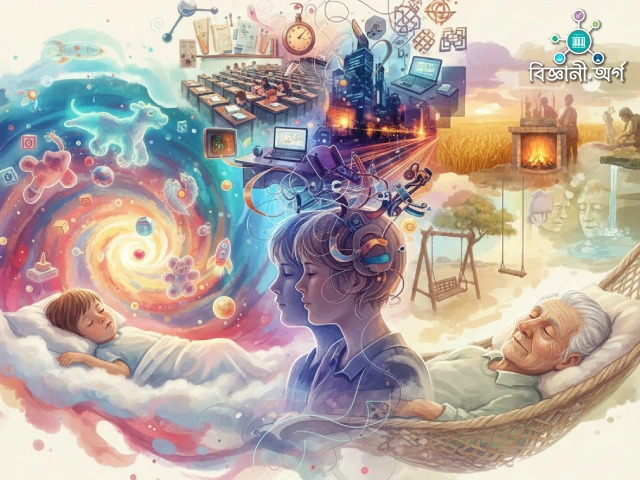
We often think monsters hide in the dreams of children. As we grow older, dreams fill with exam halls, office deadlines, or the unresolved pressures of life. But is there any scientific truth behind this popular belief? Do our dreams really change as we age, or is it just that we change—and that very transformation alters the colors of our dreams?
For scientists, dreams have always been shrouded in mystery. There’s no device that can capture dreams; all we have are people’s accounts upon waking. Still, sleep researchers like Dr. Giulio Bernardi from the EMT School in Lucca, Italy, say that dreams depend on the neural networks for imagination, memory, and emotion—systems that build, mature, and transform throughout life. Strangely enough, little systematic research has explored how dreams transform across age. Yet the studies that do exist give a clear indication: the dreams of children, adolescents, adults, and the elderly aren’t just different—they also redraw the inner map of the mind.
One interpretation has long been popular, known as the “continuity hypothesis.” It claims that dreams are a reflection of waking life. If you’re immersed in holiday joys, the sights of sea and sand float through your sleep; before an exam, the study desk dominates your dream world. There’s some truth to this idea. But it doesn’t fully answer the question—why do the colors, pace, and emotional tone of dreams shift so dramatically with age?
Pioneering research on childhood dreams was conducted by David Foulkes. His work shows that young children’s dreams are relatively simple. Their dreams often feature toys, animals, stationary objects, and small events. Children usually aren’t the center of their own dreams; instead, they watch events like spectators. This is not surprising—imagination, self-awareness, and language abilities are still developing in childhood. Furthermore, how a child describes a dream depends on their vocabulary and understanding. In effect, studying children’s dreams becomes a kind of translation: converting the child’s experience into scientific language.
As adolescence begins, the landscape quickly shifts. With hormonal surges, the tensions of social identity, and anxieties about the future, dreams become vivid, intense, and sometimes frightening. Younger teens often dream of being chased, falling, or encountering strange creatures. For older teenagers, dreams are filled with anxieties about new relationships, school pressure, and questions of self-identity. The aggressiveness of adolescence slowly appears in their dreams, and that same aggression takes new shapes with age—testing limits or grappling with the weight of others’ expectations.
In adult life, the drama of dreams doesn’t diminish—but their nature does change. Studies show that adults’ dreams often repeat the same themes: arriving late somewhere, repeatedly trying to complete the same task. Repetition of the familiar takes up more space than the novel or bizarre. Just as daily responsibilities shape waking life, the elements of routine invade our dreams. Nightmares still occur, but the intensity of adolescence fades. Here, the bridge between dreams and reality grows stronger—sleep becomes not just an escape, but an echo chamber for waking life.
In old age, many people say they dream less. Some talk of “white dreams”—where the presence of a dream is felt, but the story cannot be recalled. A major reason for this is the decline in sleep quality. As people age, sleep becomes lighter and more easily disrupted. Yet another crucial factor is at play—the nature of memory itself changes. According to Michael Schredl at Germany’s Central Institute of Mental Health, what we recall isn’t the dream itself, but rather a memory of the dream. So, while the nature of dreams changes somewhat with age, what changes more significantly is our ability to remember them.
At the end of life, dreams take on yet another form. Research on hospice patients has shown that, in this stage, people often dream of seeing loved ones, preparing for a journey, or scenes of putting things in order. Remarkably, these dreams do not evoke fear—they bring comfort. It’s as if the subconscious is saying in its own language, “Everything is okay.” The calculations of a lifetime, love, and the pain of farewell—all come together, wrapping the final episodes of sleep in a blanket of peace.
So, are these transformations in dreams just a play of age? No, it’s the story of changing brain architecture over the years. The stages of sleep—especially rapid eye movement, or REM sleep—shift as we grow older. The processing of memories, regulation of emotions, and the scope of imagination are all tied to the maturation of our nervous systems. As we age, we don’t just accumulate new memories, we select among the old ones too. These selections leave their marks on our dreams.
For students, the science of dreams offers a strangely powerful lesson. It teaches us that humans are the only creatures capable of experiencing their lives as stories—both awake and asleep. Dreams aren’t ghostly movies; they are the brain’s construction site, where new scenes are built every day and old ones are reconstructed. As we age, the architecture of that construction site changes—sometimes the colors fade, sometimes the stories grow complex, sometimes the emotions soften.
If we look at dreams with curiosity instead of fear, they can help us understand ourselves. Why do we have the same dream before every exam? Why is sleep restless when life’s big decisions loom? Why do older people see the faces of those long gone? These aren’t superstitions—they are the language of our brains. If we learn that language, we will learn to read our own minds.
In the end, one question remains—do dreams change, or is it us who change? Science says—both. Within that dual transformation lies one of humanity’s most unique traits: the power to create stories. From the simple tales of childhood to the calm conclusions of old age, dreams are the unseen memoirs of our lives. Every night in sleep, we write another chapter of ourselves.
Sources:
https://www.livescience.com/health/dreams/do-your-dreams-change-as-you-age