Sitting down to write an informative piece after a long time. Haven’t had much chance to write amidst the busyness.
But today, one question won’t leave my mind—
Has Eid changed… or have we?
Why don’t I feel the same excitement for Eid as I did in childhood?
Why doesn’t my heart race like before, even when I put on new clothes?
Why does it feel like there’s always an invisible distance, even when the whole family sits together?
Or has our very definition of joy quietly changed without us noticing?
There was a time when the night before Eid meant sleepless excitement.
From the moment the new moon was sighted, the whole world seemed different.
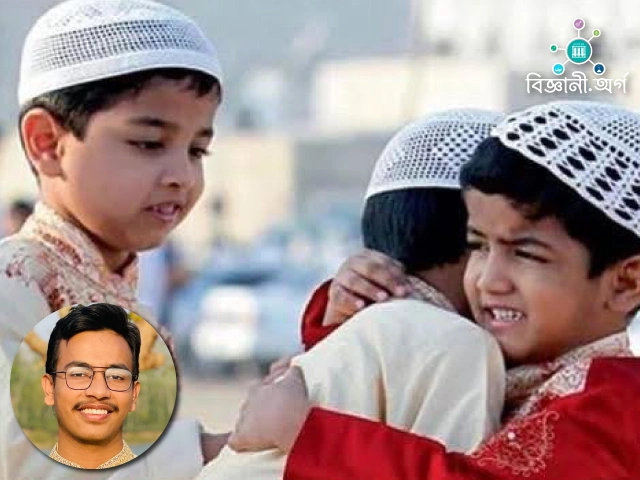
The scent of new clothes, the warm steam of semai in the morning, hugging everyone after Eid prayers—
Everything was intense, deep, alive.
And now?
Everything is still there.
But somehow, the intensity has faded.
It’s a kind of “it’s fine” feeling—not too bad, not very good either.
Is this change just a matter of time?
Or has something inside our brains changed?
Behind our joy, excitement, and motivation is one key neurotransmitter: dopamine.
We usually call dopamine the “pleasure chemical,” but actually, it’s not about pleasure,
it’s the “anticipation chemical.”
That means, more than receiving joy, dopamine is at work during the anticipation of joy.
Why did we have so much excitement before Eid as kids?
Because everything was rare then—
1. One or two new outfits a year
2. Certain special foods
3. Limited opportunities for fun
That’s why anticipation built up before Eid, and that anticipation boosted dopamine.
Now we live in an era where joy isn’t rare,
it’s actually over-available.
Every day, we get little “dopamine hits”—
1. Scrolling social media
2. Reels, shorts
3. Gaming
4. Instant entertainment
This constant stimulation has set our brain’s reward system to a new baseline.
Where Eid used to be a big spike,
now it’s become
just another day with slightly better food and clothes.
The brain does something interesting—
what it gets repeatedly, it turns into “normal.”
This is called a dopamine baseline shift.
Before:
New clothes = huge excitement
Now:
New clothes = expected
Before:
Eid day = special
Now:
Every day has its own excitement = Eid’s uniqueness wears off
The result?
Eid can no longer stand out on its own.
Another big factor: comparison.
Before, we were happy with our own Eid.
Now, even on Eid itself, we notice—
1. Who’s gone where on vacation
2. Whose outfit is the most expensive
3. Whose celebration is the grandest
This comparison creates a subtle dissatisfaction in our brains.
You may be doing well,
but if you see someone doing “even better,”
your own joy automatically lessens.
Perhaps the biggest question is this—
Do we really stay present in the moments of Eid?
Or—do we eat for the sake of photos? Smile for the sake of posting? Go places for stories?
When our brains focus more on documentation than real experience,
the depth of emotions fades.
Change will happen—
But to get that old feeling back, we’ll need to change our approach.
Maybe we can try a few things—
1. Dopamine detox (cutting down on social media before Eid)
2. Building anticipation (holding back from some things)
3. Making small things special again
4. Reducing comparison and increasing gratitude
5. Being present in the moment
Eid hasn’t changed.
The Eid moon still rises the same way,
The morning breeze is still as pure,
The love among people hasn’t diminished.
The change
is in our ability to feel.
Perhaps we need to relearn
how to find more joy in less,
how to truly live a moment.
Then, maybe one day—
Suddenly, you’ll feel,
“Eid feels just like it used to…”
Md. Iftekhar Hossain
2nd Year MBBS, Cox’s Bazar Medical College, Bangladesh
Primary interests: behavioral science, neuroscience, and habit science.