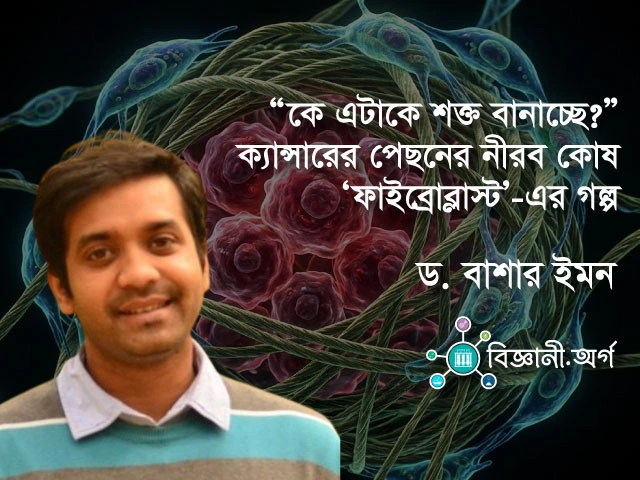
We usually think of cancer as just a problem of cancer cells. But the environment inside a tumor is actually much more complex. Alongside cancer cells, there are many other types of cells, proteins, and fiber-like structures. This entire environment is known as the tumor microenvironment. In his research, Dr. Bashar Emon has brought forward an important question about this complex world—“Who is making it stiff?”
Research shows that in the early stages of cancer, the tumor is relatively soft. But as the disease progresses, the tumor becomes harder. This hardening is not only due to cancer cells. Rather, one type of supporting cell plays a major role—fibroblasts.
Fibroblasts are essentially the body’s “repair workers.” When you get a cut or a wound, they rush to the spot and deposit a protein called collagen to bind the tissue together. It’s similar to how a mason fills a crack in a wall with cement. In normal situations, this process is beneficial for the body.
But in the cancer environment, these repair cells seem to receive the wrong signal. Cancer cells influence them to produce excess collagen. As a result, a tough “net” forms around the tumor. This stiff environment changes how cancer cells move and behave. In softer surroundings, the cells tend to be relatively calm, but in a tougher environment, they become more aggressive and are more likely to spread to other parts of the body.
This spreading process is called metastasis in medical science. It is the most dangerous stage for cancer patients, because the disease is no longer confined to one spot. Dr. Emon’s research is showing that the stiff environment created by fibroblasts makes metastasis easier. In other words, these ‘silent’ cells play a crucial role in the spread of cancer.
This is where the engineer’s perspective comes in. Dr. Bashar Emon is analyzing the interaction between cancer cells and fibroblasts from a mechanical point of view. He is measuring how much force is applied to the cells, how they pull or press on each other—these details. It is becoming clear that the ‘structure’ within the tumor plays a major role in determining the course of cancer.
This research could lead to new types of treatments in the future. If this abnormal behavior of fibroblasts can be controlled, it may be possible to reduce the stiffness of the tumor. This could slow the spread of cancer cells. That means cancer treatment could move beyond simply destroying cells to also targeting the environment within tumors.
Dr. Bashar Emon’s work shows us that cancer is not just a story of “bad cells”; it is a problem of the entire environment. If we can identify the silent players within this environment, perhaps we will be able to fight cancer more effectively in the future.
🔗 Read the full interview: