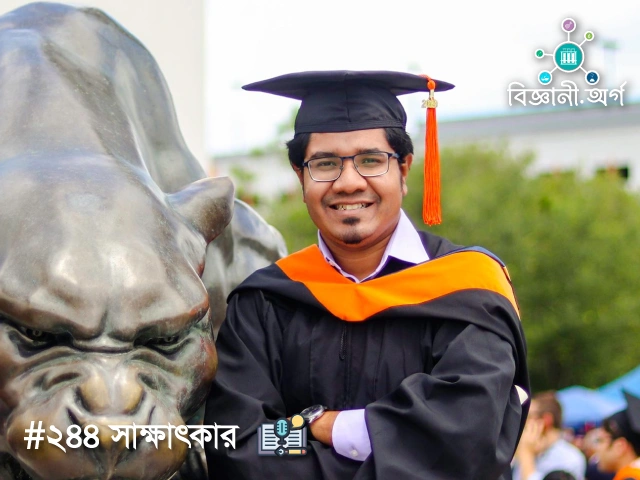
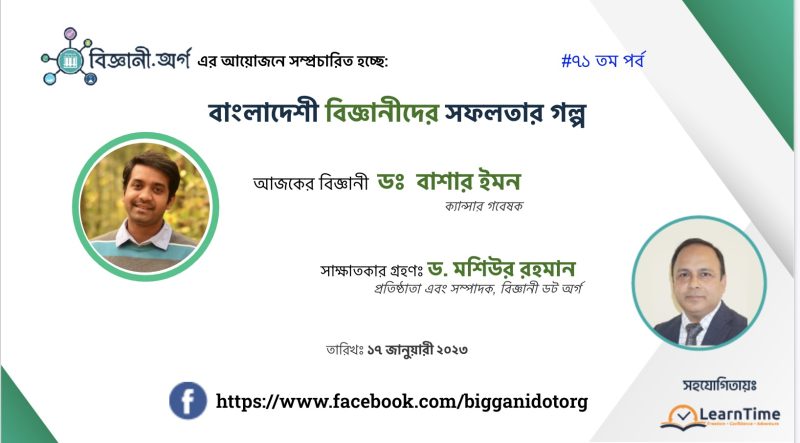
A remarkable and timely journey emerged in a conversation on Biggani.org—the interview-based platform for Bangladeshi researchers. The person who once learned the language of design, measurement, and load in the world of bridges and concrete is now measuring the “tensions” inside cancer—at a level of subtlety almost unimaginable to most people. That person is Dr. Bashar Emon—known in international publications as “Bashar Emon.”
The backdrop is significant. In 2022, there were about 19,976,000 new cancer cases worldwide; deaths amounted to nearly 9,743,000. That same year in Bangladesh, there were about 167,000 new cancer cases and around 116,000 deaths. This reality reminds us—cancer is not just a matter for hospitals; it is an urgent question for laboratories, decision-making, and public health alike. Dr. Emon’s research aims to open a new door on one such “urgent question”: Why do tumors (clusters of cancer cells) become stiffer over time, and does this stiffening accelerate the spread (metastasis) of cancer?
Childhood, Education, and the Story of Changing Paths
Recalling his childhood and teenage years, Dr. Emon first returns to his days at Rajshahi Cadet College—a place where discipline, regular study, and mathematical thinking shaped his curiosity. The next step came at the Bangladesh University of Engineering and Technology (BUET), one of the most renowned addresses for engineering education in Bangladesh. Earning his undergraduate degree in Civil Engineering, followed by teaching and graduate studies at the same institution, established his professional identity.
The idea of someone trained in civil engineering moving into cancer research may naturally prompt the question—“Why?” Dr. Emon does not shy away; instead, he views this very question as a core research mindset. His argument is simple: Although much progress has been made, solutions for many cancers remain incomplete—so researchers from outside medical science (engineering, physics, biophysics) can offer new perspectives on problem-solving. This “convergent” or multidisciplinary approach is now a major trend in cancer research.
For his advanced studies, he moved to the United States and joined research at the University of Illinois at Urbana-Champaign. There he focused on understanding the “mechanics”—the physical forces—of tumor tissue behavior. Another important aspect of his identity: He has worked on several initiatives and collaborations at the Cancer Center at Illinois, where mechanical engineers and cancer biologists approach the same questions from different perspectives.
In the interview, he says that research must be genuinely enjoyable; working over the long span of a PhD is nearly impossible otherwise. Although this is a personal reflection, his involvement in interdisciplinary training programs—like the Tissue Microenvironment (TiME) training program—shows that working as part of a team rather than alone shaped his research experience.
More recently, he has taken on responsibilities at the Mechanical Testing Instructional Laboratory, a key hands-on teaching and testing facility within The Grainger College of Engineering. According to that profile, he joined as “Teaching Lab Coordinator” in May 2025, and completed his doctoral/postdoctoral research under the supervision of Professor Taher Saif. (It is worth noting, another lab profile indicates he completed his PhD in 2022—there is a slight difference in timelines across published profiles.)
Cancer Mechanics: Why Do Tumors Get “Stiff”?
We usually try to understand cancer in terms of genes, mutations, or cell division. But in recent decades, research has increasingly highlighted another reality: The physical properties (such as stiffness or tension) of the environment surrounding cancer cells can influence disease progression. This field is “cancer mechanics” or tumor biophysics—where concepts like tumor “stiffness” or “elastic modulus” are highly significant.
Stiffness can be understood with a simple example. If you press a sponge and a rubber ball, both compress under pressure—but the sponge gives way more than the ball because the ball is stiffer. The same is true for human tissues. In many solid tumors, as the disease advances, the surrounding extracellular matrix (ECM)—the biological “scaffold” between cells—becomes denser and stiffer. Collagen accumulation, the rearrangement of collagen fibers, and “cross-linking” (the tightening of fiber bonds) are key processes behind this stiffening.
But is this stiffening merely an “effect,” or does it itself become a “cause” that speeds up cancer spread? A study on colon cancer noted that as cancer progresses, the ECM of colon tumors becomes stiffer; and tumor stiffness is associated with cancer progression and metastasis. Dr. Emon’s research also focuses on this question—how the hard or soft nature of the tumor microenvironment (TME) influences cellular behavior.
The tumor microenvironment encompasses more than just cancer cells. It includes ECM, various stromal cells (like fibroblasts), blood vessel cells, and immune cells. Reviews have observed that the stiffness of this environment can influence not only cell movement or shape, but also drug resistance, invasiveness, and even response to treatment.
Fibroblasts: How the Body’s “Repair Workers” Become Tumor “Allies”
The cell Dr. Emon particularly emphasizes is the “fibroblast.” To general readers, fibroblasts can be thought of as the body’s “repair workers.” When tissue is cut or damaged, fibroblasts go to the site, produce and deposit ECM components (especially collagen), and help heal the wound—essentially rebuilding the tissue’s “bricks and mortar.”
But inside tumors, these same cells can transform—becoming “cancer-associated fibroblasts” (CAFs). CAFs are a major component of the tumor microenvironment and have diverse roles: depositing and remodeling ECM, signaling with cancer cells, interacting with immune cells—all together, they can influence tumor progression.
In simple terms, Dr. Emon explains that fibroblasts are not immune cells—they’re not “soldiers” in the body’s defense army; rather, their normal role is “wound healing.” Cancer cells, however, “recruit” these fibroblasts to constantly deposit collagen under false instructions. Result: the tumor’s ECM gets stiffer, the tumor becomes denser, and a favorable environment for cancer spread is created. This description echoes modern research literature, which states that CAFs play roles in ECM remodeling, EMT (epithelial-to-mesenchymal transition), invasion, and metastasis.
There is a famous metaphor in cancer research: “A tumor is a wound that never heals”—the dilemma between fibroblasts’ role in healing versus supporting the tumor fits this idea well. Dr. Emon’s work aims to capture this metaphor in quantifiable language—determining how much force each cell applies, how stiff the tissue becomes, and how these changes visibly/measurably influence cancer behavior.
Nano-Newton Forces: How Dr. Emon’s Sensor Works
Measuring cell force is not easy. The forces cells exert are so minuscule we don’t feel them as “weight” or “push” by ordinary standards. To meet this challenge, Dr. Emon developed a sensor capable of detecting cellular forces at a 1 nano-Newton (one billionth of a Newton) resolution, alongside microscopic observation.
One key idea here is that for a long time, cells have been cultured in 2D flasks or dishes, but in the human body, they exist within a 3D matrix, surrounded by ECM on all sides. In 2D culture, cell shape, polarity, and cell-environment interactions can all change; thus, 3D models can be more realistic for answering many questions. Dr. Emon’s innovation targeted direct measurement of cellular “tension” in this true 3D context.
In a 2021 study (as summarized in his Science Advances paper), the sensor hosts a 3D cell–ECM “tissue” (formed by self-assembly); it measures both cellular force and tissue stiffness, and even allows for applying tension or compression to the tissue. The summary also notes that they observed force dynamics at 1 nano-Newton resolution using various cells—fibroblasts, colon and lung cancer cells, and CAFs; notably, when colon cancer cells and CAFs were cultured together, tissue stiffness increased severalfold within 24 hours.
The sensor’s function can be imagined as a kind of “spring scale”—just as a market scale measures weight by stretching a spring, when a cell pulls on the ECM, that tension deforms the spring-like part of the sensor; and from that deformation, the force can be calculated. Dr. Emon himself explains that the sensor operates like a spring, but in a 3D environment.
Another real aspect of this innovation is the material. The sensor is built with PDMS (polydimethylsiloxane)—a rubber-like elastomer widely used in biological research because it’s transparent, relatively biocompatible, and allows for fine structure molding/replica molding. His research summary explicitly mentions photolithography/microfabrication molds and PDMS casting in constructing the sensor.
Why is this device important? Because measuring cellular traction force is not just about “curiosity”—it provides quantifiable insight into how cells “feel” their environment—a process called mechanotransduction. Mechanotransduction refers to how cells convert mechanical stimuli into biochemical signals, affecting gene expression, movement, survival, or transformation. Dr. Emon’s work helps capture this “sensation and response” at the tissue level—especially when the tumor’s ECM stiffens, forcing the cell to make different decisions.
Challenges, The Bangladeshi Context, and the Real-World Impact of Research
For a Bangladeshi engineering instructor, starting cancer research means not only changing disciplines—but also using a new language, adapting to different lab cultures, and most importantly, adjusting to new types of questions. Looking at his roles at the Saif Lab, it is clear that engineering alone is not enough; biology, chemistry, and imaging—all must come together. The importance of such cooperation is also mentioned in a “Student Spotlight” article by the Cancer Center at Illinois—collaboration across specialized labs is essential for results.
In Bangladesh, the public health burden is evident. According to the IARC fact sheet, the number of new cancer cases and deaths in Bangladesh in 2022 is significant; the data also shows which cancers are most common (such as cancers of the esophagus/oral cavity/lungs for both sexes). In this reality, not only “medicine”—but also early detection, risk assessment, and treatment response—all require new tools and fresh perspectives.
Tumor ECM stiffness can drive cancer progression, invasion, metastasis, and even act as a barrier to drug delivery—this is widely reviewed in recent literature; and research is also advancing on therapeutic strategies targeting ECM stiffness. Similarly, while the idea of “targeting” CAFs for therapy is attractive, it is complex—since there is heterogeneity among CAFs and not all of them are equally “bad.” Amid these complexities, the special value of Dr. Emon’s research is that he brings “measurement” rather than just “opinion”: quantifying how stiff tissues become under certain conditions, how much force different cells generate, and the rate of these changes over time—this data-driven approach may provide the foundation for future clinical research.
Vision For the Future, Advice for Young People, and Closing Thoughts
At the heart of Dr. Emon’s plans for the future is a combined focus on research and teaching. According to published profiles, he also undertakes laboratory management responsibilities, and his doctoral/postdoctoral research centers on experimental biomechanics, MEMS, and cellular mechanotransduction. In the interview, he says that his sensor can be used not only for cancer, but also for studying healthy tissue or investigating how electrical/magnetic signals connect with tissue changes; for now, however, the main goal is to advance cancer research toward more “clinical stages.” This vision matches the recent publications from his lab—which mention potential uses of the sensor in patient-specific drug/phenotypic screening and other clinical assay contexts.
When asked about the qualities of a good scientist, his answer was remarkably “journalistic”: ask questions. Never take anything as “given”—question why it happens, how it happens—nurture curiosity and critical thinking. Most importantly, don’t just wait for others’ answers; try to find your own. With this philosophy, he defines research as: questioning—searching—clear understanding—comprehension.
For those aspiring to become scientists or researchers, his advice is practical. From university onwards, one must figure out whether they truly enjoy research; it’s important to learn beyond the curriculum; while opportunities are increasing at home, there are also many abroad—so don’t waste time, be proactive, and apply for scholarships/fellowships.
In the end, Dr. Emon’s story delivers a dual message for Bangladeshi youth. On one hand, it shows that switching disciplines is not a “mistake”; to address big societal problems, sometimes you must learn new disciplines, languages, or tools. On the other hand, it serves as a reminder that national identity is not limited by borders—even from a world-class laboratory, someone from Bangladesh can work for humanity—measuring nano-Newton forces of single cells in the quest to uncover the mysteries of a major disease. This journey is not merely individual success—it is a brilliant reflection of the scientific self-confidence of the country.
Contact info:
For more detailed information about his scientific work, please contact Dr. Bashar Emon at the following:
- Email: [email protected]
- Google Scholar: https://scholar.google.com/citations?user=-uHpmLYAAAAJ&hl=en
- LinkedIn: https://www.linkedin.com/in/bashar-emon-12b0ab9a/