Introduction
Another name for a solar cell is a photovoltaic cell. It can directly convert the sun’s light energy into electricity. In today’s world, solar cells are playing a vital role among environmentally friendly energy sources. The use of this technology is rapidly increasing to combat air pollution and global warming. In this article, we will shed light on the technical concept of solar cells, how they work, their current status, and future prospects.
History and Evolution
The concept of the solar cell was originally invented in the late 19th century. In 1839, French scientist Edmond Becquerel discovered the photovoltaic effect for the first time, indicating electricity generation in the presence of sunlight. However, in 1954, scientists at Bell Laboratories created the first functional silicon solar cell. This invention was a major step toward making the use of solar energy accessible to the public.
Contributions of Notable Scientists
Several scientists have contributed to the development of the solar cell. Among the notable names are:
- Edmond Becquerel: Discovered the first photovoltaic effect.
- Russell Ohl: The scientist who laid the foundation for the modern solar cell.
- Gardner and Pearson: Created the first functional silicon solar cell at Bell Laboratories.
How Do Solar Cells Work?
To understand how a solar cell works, it’s important to first learn about the photovoltaic effect. A solar cell is primarily made from semiconductor materials, most commonly silicon. When sunlight hits the surface of a solar cell, it generates tiny energy particles known as photons. These photons excite the electrons in the semiconductor material of the solar cell. The excited electrons move away from their original position, and an electric field is created within the semiconductor. Due to this electric field, the electrons flow in a specific direction, resulting in the generation of electricity. In this way, a solar cell directly converts sunlight into electricity, and this electricity can be used in various electronic devices.
To understand the operation of a solar cell in more detail, we need to look into its structure and the detailed mechanism of the photovoltaic process.
Firstly, a solar cell typically consists of two layers: a positive (p-type) and a negative (n-type) semiconductor layer. At the junction of these two layers, a PN (p-n) junction is formed. When sunlight falls on the solar cell, photons from the sunlight excite the electrons in the n-type layer. As a result of this excitation, the electrons move from their original position and attempt to travel towards the p-type layer.
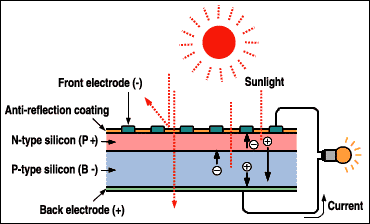
When these energized electrons are connected through a circuit, they flow from the n-type layer to the p-type layer, producing an electric current in this process. This directly generates DC (Direct Current) electricity, which is the primary output of a solar cell.
This electricity is then converted to AC (Alternating Current) by an inverter, which is used in various electronic devices in our homes or offices. This entire process is regarded as an environmentally friendly and sustainable way to convert sunlight into electricity.
The photovoltaic process and the properties of semiconductor materials are the core basis of a solar cell’s efficiency. The movement of electrons and the presence of the PN junction are what enable a solar cell to generate electricity, helping to meet the energy needs of our daily lives.
Current Status and Applications of Solar Cells
Today, solar cell technology is widely used around the world. Electricity is produced for homes, offices, and large-scale power plants using solar cells. By combining solar panels, large-scale electricity production is now possible and is recognized as a reliable and sustainable source of energy. Governments in various countries are encouraging the use of solar energy and are providing special incentives for solar cell adoption.
Future Prospects and Development
The future of solar cell technology is very bright. Researchers are currently working on materials and designs that will further increase the efficiency of solar cells and reduce costs. Innovations such as nanotechnology and organic solar cells will expand the use of solar energy even further. In the future, solar cells will be able to generate electricity effectively even in low-light conditions.
Important for Students
Gaining knowledge about solar cells is extremely important for students. Firstly, it makes them more conscious about environmentally friendly energy and helps them understand the concept of sustainable development more deeply. Secondly, this field is growing rapidly, which will open new doors of career opportunities for them in the future. Finally, solar cell technology will enrich their knowledge of science and engineering, which is highly valuable in the current era.
Supplementary Websites, Online Resources, and Books
To learn more about solar cells, the following websites and books can be helpful:
- Websites:
- Books:
- “Solar Cells: Operating Principles, Technology, and System Applications” by Martin A. Green
- “Photovoltaics: Design and Installation Manual” by Solar Energy International
- “Fundamentals of Photovoltaic Modules and Their Applications” by G. N. Tiwari and Swapnil Dubey