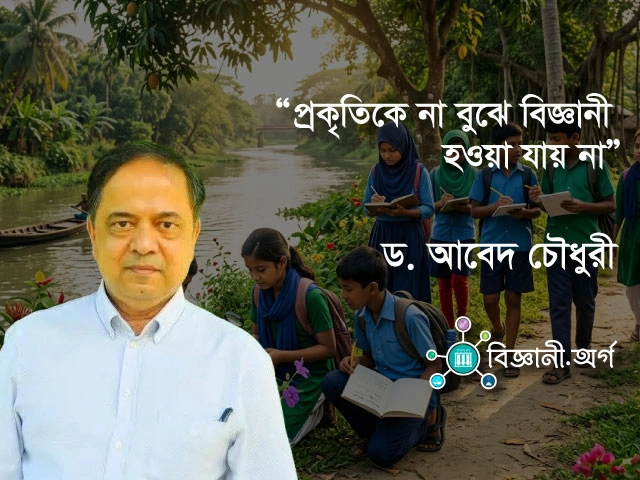
For many, the image of a science student today is all about laboratories, computer screens, and foreign universities. But botanist Dr. Abed Chowdhury reminds us that the roots of science are deeply embedded in nature itself. In his words, “You cannot become a scientist without understanding nature.” This is not just an inspirational quote; it is a profound philosophy of scientific pursuit.
Learning from Nature: The First Classroom of Science
According to Dr. Abed Chowdhury, nature is the greatest classroom for science. The growth of a plant, seed germination, the course of a river, or seasonal changes—all these observations give rise to the fundamental questions of science. In the reality of Bangladesh, the closest experience of nature can be found in the villages. Watching crops grow in the fields, hearing stories of farmers’ hard work, witnessing the effects of floods or droughts—these experiences offer lessons beyond the pages of textbooks.
He believes that those who try to learn science only within the confines of textbooks or laboratories often end up with a limited perspective. Direct interaction with nature enhances a scientist’s ability to ask questions and creates a habit of viewing problems within real-world contexts.
A Call for Urban Students to Visit Villages
Dr. Abed Chowdhury especially urges urban students to spend time close to nature by visiting the countryside. Many children from educated urban families have never had direct experience of village life. As a result, the realities of agriculture and the environment in their own country remain only abstract concepts to them.
He encourages young people to befriend students from village schools and listen to their life stories. This not only increases social sensitivity but also creates awareness about real problems in the country. Such awareness can play a vital role in their future responsibilities as scientists, engineers, or policymakers.
The Need for a Humane Approach to Science
According to Dr. Abed Chowdhury, science is not just about technology or invention; science is about improving human life. If scientific practice is not connected to people’s real-world problems, it often fails to have meaningful impact on society. In countries like Bangladesh, scientists have a crucial role in solving fundamental issues like agriculture, environment, health, and nutrition.
He believes that it is essential for young people to integrate a humane perspective into their science. From selecting research topics to applying its results—at every stage, if the welfare of people is considered, science becomes even more relevant.
Big Dreams, Deep Roots
Dr. Abed Chowdhury encourages young people to dream big. Studying abroad, joining international research—he does not discourage pursuing these opportunities. In fact, he believes that global experiences broaden a scientist’s perspective. However, he also reminds us of the importance of not forgetting one’s roots. When scientific practice remains connected to the country’s nature, people, and real problems, it becomes more meaningful and responsible.
In Conclusion
Dr. Abed Chowdhury’s message offers a kind of guidance for our youth—learning science is not just about exam scores or degrees; it is about understanding nature, staying connected to people’s lives, and preparing oneself to solve society’s problems. If this philosophy of learning from nature spreads among the younger generation, the future of science in Bangladesh will become more humane and relevant.
Read Dr. Abed Chowdhury’s full interview: