July 1, 2025. Larry Denno, a researcher at the University of Hawaii, discovers a mysterious interstellar object by observing through a telescope in Chile. The object is named 3I/ATLAS — the third interstellar object discovered in our solar system. It’s a colossal cosmic traveler, drawn in slightly by the Sun’s gravity, but soon to veer off and continue on its unknown journey after being ejected from its home star.
The discovery of such a rare cosmic visitor represents a significant opportunity for space science. This kind of object can help unravel mysteries about the history, chemistry, and even the formation of planets beyond our solar system.
Scientific Explanation of the Cosmic Visitor
Imagine our solar system as a large family orbiting the sun. Now, think of a stranger arriving one day from the edge of another galaxy, lingering briefly before departing. That ‘stranger’ is 3I/ATLAS. Its speed is so great (about 60 km per second) that even the Sun’s gravity isn’t enough to hold it — it will leave forever.
Scientists note that this object likely formed around an ancient star, which may no longer exist. Analyzing its rotation, size, and composition suggests it could be between 3 and 11 billion years old — two to three times older than our solar system.
A Look Back Through History
The first interstellar object detected was 1I/ʻOumuamua in 2017. Next came 2I/Borisov. Now comes 3I/ATLAS. The first resembled a cigar or pancake, the second was comet-like. 3I/ATLAS is also initially thought to be a comet, though its tail is not very distinct yet — just a dusty haze so far.
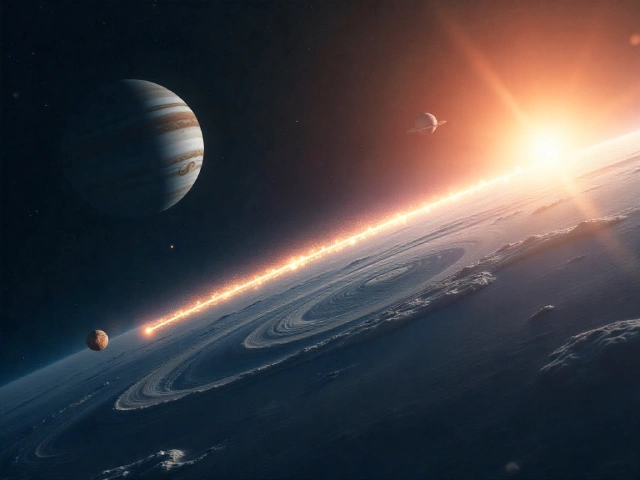
It has crossed Jupiter’s orbit in our solar system and is now heading toward Mars. By October, it will approach the Sun (perihelion). At that point, its ice will begin to melt, and we may witness a long tail — like a giant, fiery glass orb in space!
What Is This Object Made Of?
This is the most exciting question for scientists. If the object is very old, its ice and gas could reveal information about the ancient chemical makeup of the galaxy. Stephanie Milam and her team at NASA’s Goddard Space Flight Center will analyze 3I/ATLAS with the JWST (James Webb Space Telescope), searching for water, carbon dioxide, hydrogen cyanide, and possibly other unknown compounds.
Invisible from Earth, But Visible from Mars
Unfortunately, when 3I/ATLAS is closest to the Sun at the end of October, Earth will be on the opposite side of the Sun. So, we won’t be able to observe it directly. However, NASA’s MAVEN spacecraft — currently orbiting Mars — may be able to monitor the object. If it is visible from Mars, we’ll be able to study its tail structure and gas emissions — priceless data.
Is It Possible to Catch Up to It?
Sadly, we cannot send a spacecraft toward the object fast enough. Its speed and current location put it beyond our reach. However, in 2029, the European Space Agency (ESA) will launch a mission called ‘Comet Interceptor’, which may target this kind of interstellar object in the future — if another such visitor is detected in time.
Debate and Possibilities Among Scientists
Still, the question remains: why do we observe so few interstellar objects? If billions of them are roaming the cosmos, surely we should detect many more. Researchers suggest that perhaps small interstellar objects burn up in our atmosphere, or are simply too small to be detected by our telescopes.
But there is hope for the Vera C. Rubin Observatory, set to begin a decade-long sky survey by the end of 2025. Scientists are optimistic it will discover at least 6 to 50 new interstellar objects.
The Horizon Ahead
3I/ATLAS not only enriches our scientific understanding with new data, but it also expands the scope of our imagination and curiosity. This single object teaches us how matter flung from one end of the galaxy can be woven into the story of our solar system. Its chemical composition will reveal the structural diversity of stars and planets, and its motion and rotation may tell us how such objects spread through space.
This new visitor seems to look us in the eye and say — “You are not alone; there are many more out here wanting to hear your story.” Perhaps, when the haze around it clears, we may one day discover a hint of its original home.
This is the beauty of science — the pursuit of the unknown, until everything is understood. 3I/ATLAS is another shining beacon on that path.