Dr. Mashiur Rahman
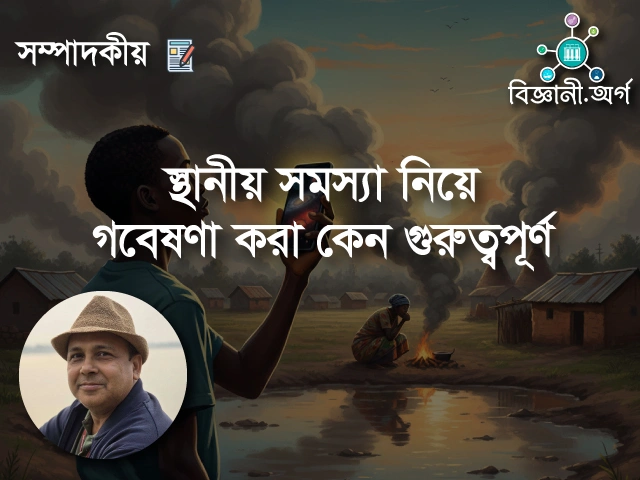
Just after the 5 a.m. call to prayer, a teenage boy standing by the village pond feels his eyes sting. The smoke from the nearby brick kiln drifted all night onto the crops, the water, and his lungs. The boy has a smartphone in his hand; he watches pictures of Mars on YouTube. But this morning, his mother collapsed into a coughing fit while cooking—because the combined smoke from the kitchen and the brick kiln has made today’s air toxic. Maybe you’re sitting in a Dhaka dorm, staying up late writing code, or doing titration in a chemistry lab. But has that dawn chorus of coughing entered your research?
We dream of international journals, impact factors, and overseas conferences. There’s nothing wrong with these goals. The problem arises only when the questions of our own land don’t make their way into our research. Eighty percent of the world’s research is focused on problems of developed countries, while developing nations bear ninety percent of the burden of disease—this disparity is not just numbers on a graph; it is daily coughs, daily diarrhea, daily uncertainty. Every year in Bangladesh, nearly a hundred thousand people die prematurely from air pollution—this is not just news, it is your neighbor’s breath.
To research local issues is not just to be patriotic; it means to be realistic. Where data is in your hands, results are in your ears, and solutions are before your eyes—that’s where science is most powerful. If you work on arsenic in the water of Narail, your results could change someone’s life tomorrow. If you improve the efficiency of a char-land threshing machine, someone may be able to pay school fees next season. This immediate impact is what gives research a human face.
Yet we often ask, “Will international journals accept local work?” There’s pain hidden in that question. But the reality is different. During the global pandemic, it became clear: no model works without local data. Over 60% of worldwide COVID research depended on records from local hospitals and community surveys. Global science is now seeking local voices, because the solution from one place is not the answer elsewhere. The river islands and urban slums speak different languages; so science, too, must be multilingual.
In a country like Bangladesh, local issues are a goldmine for research. Saline water in paddy fields, TB in slums, landslides in the hills, noise pollution in cities, fish breeding in wetlands—these are not just problems; they are matters of international interest. Because climate is changing, the population is rising, cities are swelling—Bangladesh is the microcosm of this future. What happens here today could happen somewhere else in the world tomorrow. So, your village is, in fact, the world’s laboratory.
One more thing must be mentioned, though it often catches in our throats—funding. We neglect local problems and assume the money won’t come. Yet in the past decade, international grants for climate and health in South Asia have tripled. Donors are now seeking “field-impact,” not just “paper-impact.” The research that stands in the field and changes policy—that’s what gets sustained funding. Money is coming globally for local questions—you just need the courage to knock on the door.
Working on local issues changes your identity too. You are no longer just a student; you are a witness. You are the eyes that see, the voice that speaks, the hand that changes. People look at you and say—“That boy writes about our lives.” The value of this recognition is not written on a certificate, but this is the value that upholds a scientist’s ethics.
You might feel afraid—“Am I shrinking in significance?” No—you are diving deeper. Depth is never small. Depth makes an ocean. The difference lies in whether you are a good student or a ruthlessly curious thinker. The good student memorizes questions; the curious thinker seeks them out. And when you go looking for questions, you have to draw the map in your own backyard.
If we neglect local issues, we turn science into a colony. Our labs serve others’ questions; our calculations fit someone else’s agenda. But when you address your own questions—language changes, courage changes, science changes. You are no longer a notice pinned to someone’s board; you are the chronicle of your time.
What issue in your city keeps you awake at night? What illness sees the highest sales at the pharmacy below your home? Which river is drying up, which child is dropping out of school, what old woman is struggling to breathe—these are not just news stories, they are your research agenda. Open a new chapter in your notebook—title it, “My Place, My Question.”
One day, you’ll see your name in print—that will bring you joy. But the day someone in your village says, “His work made our water clean,” you’ll understand—it’s not the journal, it’s the world that’s publishing you. This is where the responsibility lies. Will you just observe, or will you change things? Looking at local problems teaches you to point a finger—but at the end of pointing, to extend a hand.
Tonight again, maybe there’s smoke outside, but light inside. Make the light broader through your questions, make your questions braver with courage. Change your research address—not London or Tokyo, but write your neighborhood’s name for today. The future is being written there.