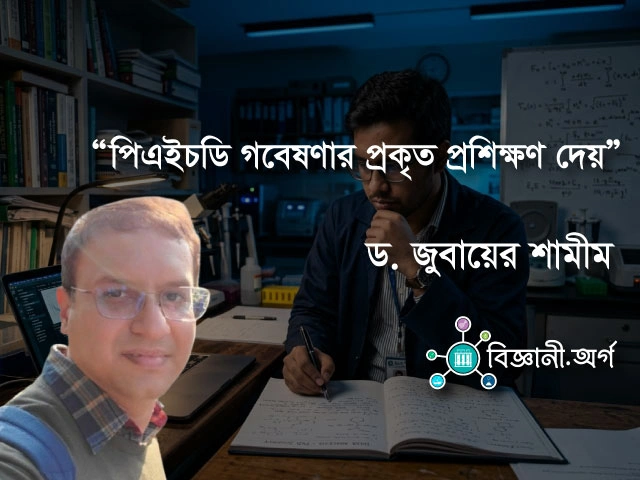
This statement by Dr. Jubayer Shamim brings to light an important reality for the young students of Bangladesh. Many people, when thinking about higher education, only focus on degrees or the prospect of going abroad. But in the world of research, a PhD is not just a certificate—it is a kind of long-term training process where a student learns to ask questions, to pursue those questions, and to build new knowledge step by step.
From the outside, research often appears romantic—new discoveries, publications in prestigious journals, participation in international conferences. But behind these visible achievements lies a deep training built up over years. The PhD is the structured form of that very training. Here, students do not only learn from books; rather, they acquire practical skills such as how to formulate a research question, design experiments, and analyze data to reach logical conclusions.
Dr. Jubayer Shamim’s own experience supports this view. After graduating from BUET, he worked in the industrial sector. Later, during his master’s and PhD studies abroad, he realized that the depth and freedom found at the doctoral level of research is rarely available elsewhere. At this stage, students themselves map out their research path. The supervisor provides guidance, but gradually the responsibility for decisions passes on to the student. This freedom instills confidence in a researcher.
Many students in Bangladesh harbor the notion that a PhD means long years, uncertainty, and financial stress. These realities cannot be denied. However, Dr. Jubayer Shamim reminds us that the true value of a PhD lies in how it “shapes someone into a researcher.” Even when working in the research divisions of industries, lacking a PhD can limit one’s opportunities for leadership in research. This is because it is at the PhD stage that one learns how to break down problems, learn from failure, and move towards new solutions.
Another major aspect of a PhD is networking and global connections. Participating in international conferences, collaborating with various labs, and engaging in discussions with researchers from different countries broaden the perspective of a young researcher. Dr. Jubayer Shamim himself observed while working in the research environment in Japan how collaborative relationships are built between universities and industries. These networks play an important role in future research and professional life.
However, he cautions that being admitted to a PhD is not the final step. Choosing a good lab and supervisor is extremely important. Much of the PhD experience depends on the environment in which you work. You will be able to utilize your potential best when the research focus of the lab aligns with your interests.
These words offer a realistic guideline for the youth of Bangladesh. For those aspiring to become researchers, it is important not to view the PhD simply as a degree but as a comprehensive period of training. It is time consuming, at times exhausting, and sometimes even discouraging. But through this path, a student gradually attains intellectual independence—which is the hallmark of a true researcher.
Thus, Dr. Jubayer Shamim’s remarks stand as a kind of cautionary yet optimistic call for aspiring researchers—the path of the PhD is difficult, but this is where future scientists and thought leaders are shaped.
🔗 Read the full interview: