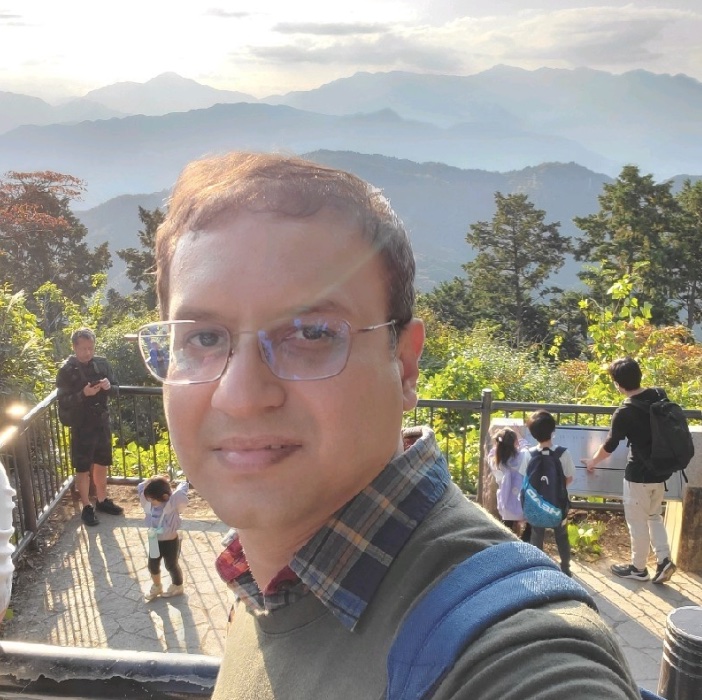
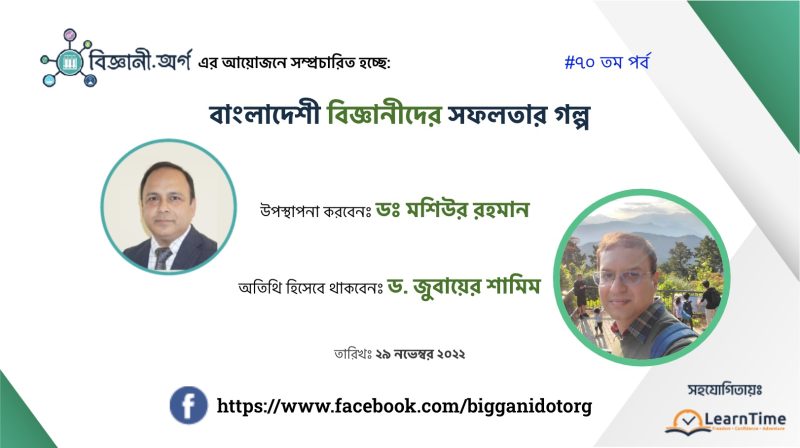
Coolness With Less Power: Dr. Jubair Shamim’s Research Journey at the University of Tokyo
For many young engineers in Bangladesh, the word “mechanical engineering” is still largely confined to the world of pistons, gears, and engines. But the reality is—this discipline has become multidimensional: from robotics to nuclear technology, material science to micro-devices—mechanical engineers are becoming increasingly vital everywhere. In the 70th episode of Biggani.org, the University of Tokyo’s Specially Appointed Assistant Professor (and, as he mentions in the interview, former Project Research Associate) Dr. Jubair Shamim shines as a bright example of this changing reality—someone who started at BUET, developed himself in the research environments of Korea and Japan, and is now working on a type of “smart” material that could make the future of air conditioning technology more energy-efficient and more effective.
From BUET to Seoul, Seoul to Tokyo—A Dream Built Step by Step
Dr. Jubair Shamim’s educational path is similar to that of many talented students from South Asia, shaped by a combination of practicality and opportunity. He completed his undergraduate degree in Mechanical Engineering from Bangladesh University of Engineering and Technology (BUET). He then went to Seoul National University, South Korea for higher education, where he earned his Master’s in Nuclear Engineering. Later, he completed his PhD in Mechanical Engineering from the University of Tokyo, Japan, and is now involved in both research and teaching at the same university.
This journey may seem planned and smooth from the outside, but as Dr. Jubair Shamim himself says—he never had a set plan “I will be a scientist” since his childhood. Rather, as life progressed, after completing one step, the next was often decided by circumstances, experiences, and his own inner aspirations.
Is “Mechanical” Just About Machines? In Reality, It’s a Highly Versatile Field
Among many students in Bangladesh, there is a common perception that mechanical engineering is a relatively less “top” subject—especially when compared to computer science or electrical engineering. Dr. Jubair Shamim directly challenges this notion. In his words, mechanical engineering is not just about machines; it includes—
- Thermal Engineering (heat and energy management),
- Fluid Mechanics (flow of liquids and gases),
- Thermodynamics,
- Robotics, nuclear technology,
- Even material science—working with carbon nanotubes and other advanced materials.
He points out that, after going abroad, he noticed there is not much of such “high-low” subject division. Rather, in each field, research and career opportunities are vast. The key point: if you develop skills in what interests you, the doors will open.
Thermodynamics: From Power Plants to Home AC—The Same Principle Everywhere
The foundation of Dr. Jubair Shamim’s areas of work is largely thermodynamics. Simply put, this is the science that discusses the rules of how heat is transformed into energy, and how energy, in turn, controls heat.
A familiar example is the steam power plant. There, water is heated to produce steam; the steam turns turbines to generate electricity. These core theories of energy transformation are some of the biggest applications of thermodynamics. However, Dr. Jubair Shamim clarifies that while the power plant example helps explain the use of thermodynamics, his own research materials are not directly tied to power plants, but rather are more relevant to other energy-saving technologies.
“Metal-Organic Framework”: Hollow Yet Strong—A Type of Designer Material
A major focus of Dr. Jubair Shamim’s current research revolves around a modern material—Metal–Organic Framework (MOF). He uses the English term because it is difficult to translate into Bengali in a single word. What is MOF?
He explains, MOF is a porous material—that is, a substance that contains numerous tiny internal spaces (pores). Think of common sponge or mesh structures in everyday life—just as a sponge soaks up water because it has little gaps inside, MOF works similarly, except the gaps here are ultra-tiny—on the nanometer scale.
This structure is made by combining two things—
- Metal ions (like calcium, magnesium, zinc, etc.),
- Organic ligands (a kind of molecular “link” or connector),
which bind the metal parts together in a specific geometric structure.
The great strength of MOF is that it can be designed. By changing the type of metal, ligand, or connections, researchers can “tailor” the properties as per their requirements. In other words, it’s a customizable material.
Dr. Jubair Shamim further explains that the size of these pores is crucial. Based on the pore size, materials are classified as microporous and mesoporous. In his work, the focus is on pores within a precise nanometer range—because changing their size changes the material’s behavior and capabilities.
Why Do ACs Consume So Much Electricity—And How Desiccant Technology Can Change the Equation
The most practical and accessible application of Dr. Jubair Shamim’s research comes in the context of air conditioning. He explains that a conventional AC has two main goals—
- Temperature control: Keeping the room at 18–25 degrees Celsius in hot weather.
- Humidity control: Lowering outside humidity (e.g., 80%) down to 50–60% indoors.
Where’s the problem? To reduce humidity, the AC must cool the air a lot, so that the water vapor in the air condenses into liquid. Dr. Jubair Shamim uses a familiar, everyday example—droplets forming on the outside of a cold glass of water, caused by air’s vapor condensing after coming in contact with something cold.
ACs do the same thing. To remove humidity, sometimes the outside air at 35°C has to be cooled below 7–8°C. But such cold air can’t be fed directly back into the room—so it is re-heated back to a “comfortable” temperature. This double process of cooling and reheating wastes a huge amount of energy.
This is where the research idea of Dr. Jubair Shamim and his team comes in: if there’s a separate material that can remove water vapor from air—such as a special kind of functional material—then you don’t have to make the air extremely cold. You can first reduce the humidity and create “dry air,” then only control the temperature. This reduces the need for reheating and saves energy.
He says that with this method, it may be possible to save about 35% to 50% energy. This technology is known as Desiccant Air Conditioner, Desiccant Dehumidifier, or Hybrid Air Conditioning. Simply put, a “desiccant” is a substance that absorbs water vapor from air, like salt or silica gel does—but here, it is far more advanced and controllable.
Why Is Research in This Field So Fast-Paced in Japan—The Research-Industry Link
Dr. Jubair Shamim points out that there is a high demand for energy-saving technology in countries like Japan, and thus a high level of investment in research. In particular, major industrial manufacturers of ACs and heat pumps fund university research to create “next generation” technology. This forges an effective relationship between research labs and industry, helping new concepts move toward real-world applications.
The Wish to Become a Scientist: Breaking Free From “Four Walls”
There is an emotional side to Dr. Jubair Shamim’s personal story. After graduating from BUET, he worked at an oil refinery in Chittagong for almost three years. But at some point, he felt that his life had become “trapped within four walls.” He had never been abroad, and his family wasn’t wealthy enough to make foreign travel easy. The desire to see the world, learn in new environments—all this came together to fuel his urge to study abroad.
But the path was not easy. He says his BUET results were not within the “top ten percent,” so getting a scholarship was difficult. Besides, there was Bangladesh’s familiar dilemma—BCS (civil service exam) or higher studies—that he too struggled with. He even started BCS preparation. But rote-memorization-based studying did not match his true interests. He was much more attracted to topics like heat transfer, fluid mechanics, multiphase flow simulation. Finally, he decided to focus on preparing for higher studies abroad.
After his PhD, he worked in the research division of a semiconductor company in Japan. However, after a year and a half, he realized that while the company job was stable, the excitement of research—making new findings, writing papers, presenting at conferences, networking with scientists—was missing. Just then, an email arrived from his former supervisor: a new project, was he interested?
Again, a dilemma—choose a stable job or an uncertain project? But he thought back to his “first big risk” —leaving his job in Bangladesh to pursue his master’s. And he chose research again. In his own words, if you can realize what you truly want in life and follow it, then gradually you will arrive at the right place.
He shares a movie quote as his personal motto:
“Those who work for passion are always richer than those who work only for money.”
Here, by “richer” he means not just in terms of money, but also in the satisfaction and meaning found in life.
His Advice to Young People: Not “Bypassing,” but Preparation—and the Importance of a PhD
Dr. Jubair Shamim’s advice for young people in Bangladesh is realistic and based on his own experience.
1) To become a researcher, a PhD is crucial.
Many do work in industry research without a PhD—he acknowledges this. But, the “how to do research” training is most strongly gained at the PhD level. So, if you dream of research, your goal should be to get PhD admission in a good lab at a good university.
2) Try to understand what professors are looking for.
He says—even if your own results are not very high—it’s important to figure out what skills or qualities foreign professors are seeking in research assistants. He himself tried for almost three years before winning a master’s opportunity.
3) Avoid the “bypass mentality”—don’t try to skip GRE/IELTS.
Many seek universities where GRE/IELTS are not required—Dr. Jubair Shamim considers this risky. It narrows your options and reduces opportunities. On the other hand, doing well in the exams boosts confidence and shows professors your capacity to take on pressure.
4) Publications are possible even from Bangladesh—look for ways.
It’s true that research facilities in Bangladesh are limited. But he says that nowadays, by contacting senior researchers abroad and assisting with part of their work—such as software/simulation, theoretical, numerical analysis, etc.—you can be a co-author. Alongside, you can also try hard to publish in university conferences or local journals in Bangladesh—this helps build your CV.
5) You lose opportunities if you email a lab without understanding its focus.
He gives a practical example—once a talented IIT student applied to their lab, but the student’s interest (solar cells/photonics) didn’t match the lab’s research area. So, despite a strong profile, it wasn’t possible to accept him. So, before emailing a professor, it’s critical to understand the lab’s focus.
Is Changing Subjects Prohibited? No—But “Building a Foundation” Is Key
Many students are hesitant—studied one subject, but are interested in another. Dr. Jubair Shamim says, in research, “borders” aren’t rigid. His own life is an example: his master’s in nuclear engineering, PhD in mechanical engineering. But he explains—the “strategy” here is: develop a core skill or foundation. For example, heat transfer, fluid mechanics, thermodynamics—these basics are relevant in both nuclear and mechanical fields. That’s why he could apply his foundation to different domains.
He emphasizes—skillsets develop over time. Changing topics too frequently prevents deep expertise. So, first build depth in one area, then seek opportunities to apply your skills to different fields—just as Dr. Moshiur Rahman explained with the example of mathematics, Dr. Jubair Shamim echoes the same idea.
Final Thoughts: The Promise of Bangladesh in the Light of Research
Dr. Jubair Shamim’s story reminds us that reaching the global stage of research isn’t only about “top results” or taking the “straight path.” Often, confidence, passion, patience, and focused preparation together become the strength to overcome the greatest obstacles. The young engineer who once felt “trapped within four walls” in his job in Chittagong is now working in a Tokyo University lab on technology that could open new frontiers of efficiency—from home ACs to global energy management.
This journey sends a message to the youth of Bangladesh: If your dream is science, your path will also be like a scientist—starting with curiosity, striving with perseverance, and filled with the joy of discovering the truth. The achievements of such individuals are not just personal—they are a source of national pride, and a living inspiration for future generations.
References:
Dr. Jubair Shamim’s LinkedIn: https://www.linkedin.com/in/jubair-a-shamim-ph-d-0a0923136/
Interview conducted by: Dr. Moshiur Rahman
Date: 29 November 2022
Video: https://www.youtube.com/watch?v=4FypsRiDgrI