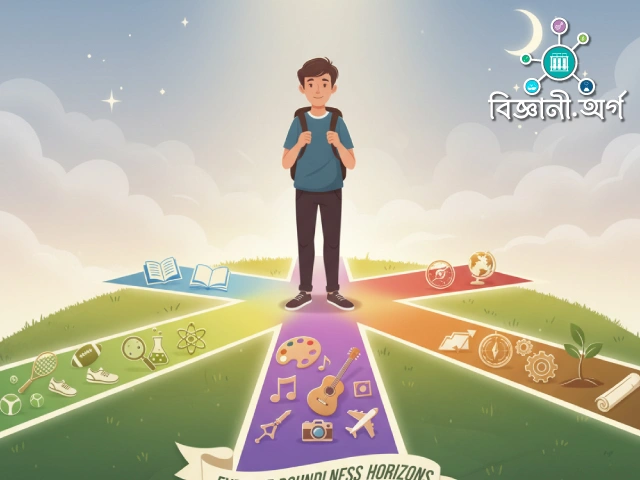
If you look into the lives of the world’s most talked-about tennis stars, a common pattern emerges—they were almost all dedicated to a single sport from childhood. Tiger Woods in golf, Serena Williams in tennis—these names seem to prove that the nurturing of talent begins from a very young age, and the key to success lies in early specialization. Yet, David Epstein challenges this notion in his book Range: Why Generalists Triumph in a Specialized World. He argues that the path to success isn’t limited to specialization; rather, exploring different avenues and gathering varied experiences often leads to enduring and far-reaching achievement.
The book begins with the stories of two competitors—Tiger Woods versus Roger Federer. Tiger Woods was immersed in golf from early childhood; his father was his first coach, and by the age of just two, Woods was making waves on the golf course. In contrast, Roger Federer spent his early years participating in a variety of sports—football, badminton, basketball—devoting time to each, only later choosing tennis as his main sport. Remarkably, both have achieved extraordinary feats in their respective fields. But Federer’s journey offers us a different perspective—that gaining diverse experiences often helps people understand themselves better, leading to greater success in the long run.
In the context of Bangladesh’s education system and job market, Epstein’s argument sheds new light. Here, students usually choose their field of study by secondary or higher secondary level and are then compelled to stick to a fixed path. But this pressure to specialize unsettles many. If a student is a science major, their interest in creative writing or music tends to be overlooked. Similarly, if someone studies commerce, their curiosity in science or technology is dismissed as “irrelevant.” In reality, though, problems in the real world aren’t so narrowly defined; solving them often requires combining science with social science, technology with ethics, or economics with environmental studies.
In Range, Epstein illustrates that those who are exposed to a variety of work and experiences early in life are more able to find new and creative solutions to problems later on. This is because they develop an open-minded perspective. They aren’t trapped by a single approach, but rather, can draw ideas from multiple contexts and apply them in new ways. This philosophy is also relevant to modern research on complex problems. For example, a health scientist with knowledge of social sciences will be much better equipped to understand and solve public health issues. In this case, their “range” or diverse experience becomes an extra strength.
This concept isn’t just important for personal success; it’s also significant for broader societal and national contexts. Even global tech companies are increasingly seeking not just technical skills, but employees who possess knowledge across various fields, can understand the multidimensional nature of problems, and adapt quickly to new environments. Giants like Google and Amazon now look for “T-shaped” individuals—those with deep expertise in one area, but also a broad understanding across others. This generalist approach has become even more relevant in today’s world.
But the question arises—how does one gain this “range”? Does our education and social system even allow students the freedom to explore their interests across different subjects? The answer is not simple. Family, institutions, and society alike seem to push us toward swift “competence.” Young people are told, “Don’t waste time,” “Set a goal,” “Build your career quickly.” And yet, Epstein says that moving slowly can sometimes be more rewarding, if that time is spent in genuine exploration and self-discovery.
This message can be liberating for students in Bangladesh. Especially for those who are interested in multiple fields but are forced by society or family to walk one set path, this book can offer courage. A student might love math but also love writing stories—this diverse interest should no longer be seen as “indecision,” but rather, could be the very foundation of their success. Whether one becomes a future researcher, entrepreneur, or policymaker—those who grow up with a multifaceted perspective are the ones who can lead in creating a healthier, more innovative society.
Epstein’s arguments are not limited to the individual realm; they also challenge our national development planning. The advancement of technology, climate change, public health crises, educational reform—for all these challenges, a single-disciplinary perspective simply isn’t enough. What’s needed is a meeting ground for diverse ways of thinking. A place where engineers and artists, doctors and philosophers, statisticians and writers—learn from each other’s experiences, complement one another, and together build greater ideas.
For our generation, especially for those still searching for their path, Range is a source of inspiration. It instills a kind of confidence—that the detours in life are not “wrong turns,” but rather, valuable experiences that lay the foundations for the future. This courage to explore, this patience in the face of uncertainty, might just be our greatest strength in today’s complex world.
This is why, if today we, our students, our youth, and even ourselves, take the time—patiently—to learn, read, and reflect on a variety of subjects, perhaps we too can become the generation whose success is rooted in one thing—learning to appreciate the power of breadth before depth. To build Bangladesh for tomorrow, we need young people who dare to think beyond textbooks, discover themselves amidst uncertainty, and grow the roots of knowledge across multiple fields to help create a healthy and prosperous society. Don’t be afraid to explore—let this be our guiding mantra for the journey ahead.