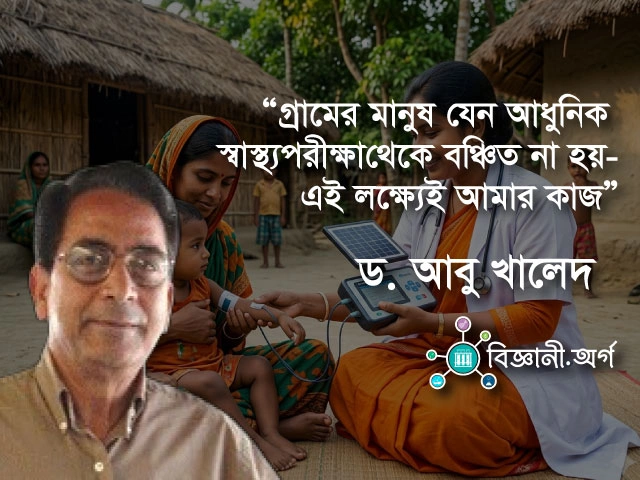
A major reality of Bangladesh’s healthcare system is the vast disparity in services between urban and rural areas. While large hospitals in cities offer modern diagnostic facilities, even basic healthcare can often be a big challenge for people living in villages. Keeping this reality in mind, Dr. Abu Khaled has set a key objective for his research: “My work is driven by the goal that rural people should not be deprived of modern health diagnostics.” In his view, medical advancements are only truly meaningful when their benefits reach society’s most marginalized people.
The BIA (Bioelectrical Impedance Analysis) method developed and improved by Dr. Abu Khaled was originally designed for hospital-based research, but he is now considering how to make it suitable for rural settings. Currently, the cost of such equipment runs into thousands of dollars, making widespread use in countries like Bangladesh unattainable. As a result, critical tests for conditions like dehydration, malnutrition, or assessing the body’s water and fat balance remain limited to just a few large institutions in major cities. Dr. Khaled’s dream is to make this technology affordable, portable, and solar-powered, so it can be used in villages even where electricity is lacking.

The importance of this initiative becomes even clearer when we consider the reality of rural health centers. Many villages do not have regular electricity, and there is limited infrastructure to house modern equipment. In such circumstances, if a small battery or solar-powered device could be used to assess a child’s dehydration, a pregnant woman’s nutritional status, or the risks facing premature newborns in advance, it could bring a significant change to rural healthcare. According to Dr. Khaled, this type of technology will help not just in disease detection, but also in reducing the risk of misdiagnosis.
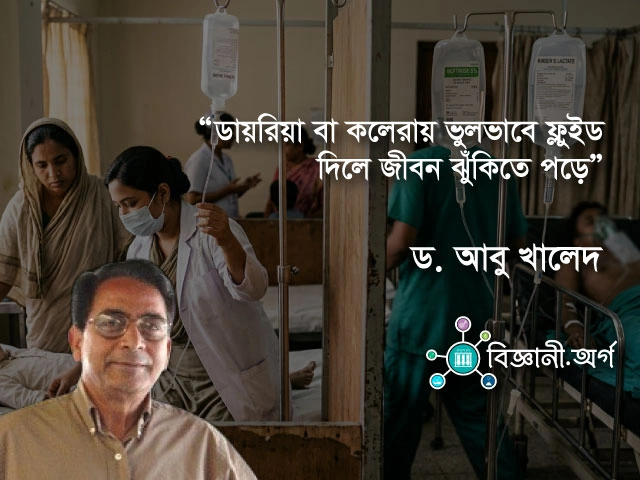
Behind this approach lies Dr. Khaled’s many years of field experience. While working at icddr,b, he witnessed first-hand how the outcomes for two children with the same illness could depend entirely on timely and accurate decision-making. When doctors are forced to rely on estimation due to lack of technology, the risk of mistakes increases, with the consequences falling squarely on patients and their families. That’s why he believes it is a researcher’s moral responsibility to make technology accessible to people.
Dr. Abu Khaled’s perspective also raises an important question for our country’s health policy and research—do we only want to develop advanced technology, or do we want to make that technology accessible to everyone? Equipment made for developed countries often cannot be directly applied to our context. That’s why countries like Bangladesh need “low-cost innovation”—effective solutions at an affordable price. That’s exactly Dr. Khaled’s aim—to make science relevant and useful in people’s everyday lives.
If this initiative succeeds, doctors at rural health centers will be able to make better, data-driven decisions. Errors regarding issues like dehydration, malnutrition, or fluid management will decrease. In the long run, this could help reduce mortality rates for children and mothers. In Dr. Khaled’s words, modern health diagnostics are not a luxury—they should be a part of basic health rights.
In Bangladesh’s context, his vision is not just a technological project; it is a demand for health equity. If we are to reduce the gap between city and village, the benefits of modern medical science must reach rural areas. Dr. Abu Khaled’s research points the way forward—where science becomes not just a tool of the developed world, but a means to save the lives of marginalized people.
Read Dr. Khaled’s full interview: