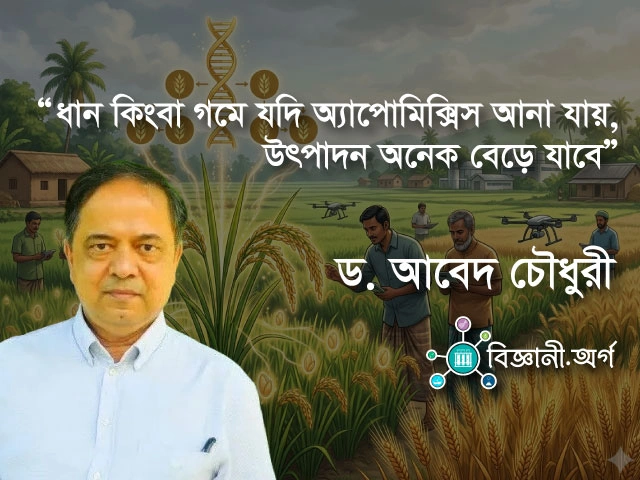
When discussing the future of agriculture, many people focus on modern machinery, irrigation systems, or digital technology. However, there are fundamental studies underway within plant science that have the potential to transform agriculture at a much deeper level. One such concept is “apomixis.” In the words of plant scientist Dr. Abed Chaudhury, “If apomixis can be introduced in rice or wheat, yields will increase significantly.” Hidden within this statement lies the potential for a possible revolution in the future of agriculture.
What is Apomixis? An Easy Explanation
Generally, plant seeds are formed by the union of pollen from the male part and the ovule from the female part of the flower. This is similar to how, in humans, children are born from the union of father and mother. However, in nature, there are some plants where seeds are produced without any involvement from the male part. This process is called apomixis.
Simply put, through apomixis, a plant can create a ‘copy’ of itself to reproduce. As a result, the next generation of plants is genetically identical to the mother plant. The biggest advantage of this is that—if a particular variety of a plant gives excellent yield or is resistant to disease, those good traits will be preserved unchanged over successive generations.
Why is This Important for Agriculture?
Hybrid crop varieties are very popular in modern agriculture because they typically yield more. However, a limitation of hybrid seeds is that—once they are harvested, the seeds from those crops cannot be used again to achieve the same level of yield. As a result, farmers have to buy new seeds every year, which increases their costs and creates a dependency on seeds in many cases.
If apomixis technology can be applied to staple crops like rice or wheat, a farmer who has good-quality seeds can produce the same quality of crops the following year from those seeds. This would reduce seed costs, stabilize production, and could be particularly beneficial for small farmers.
Research Progress and Limitations
Dr. Abed Chaudhury and his colleagues have conducted research on certain genes involved in seed formation in plants, which play an important role in understanding processes like apomixis. These studies have shown just how complex and precisely controlled the internal biological processes of seed formation are.
However, apomixis has not yet been successfully applied in major crops like rice, wheat, or maize. It remains at the laboratory stage. The reasons behind this include the complexities of genetic control, environmental effects, and the risk of possible side effects. Even so, scientists remain hopeful that this technology may become field-applicable in the future.
Potential in the Context of Bangladesh
In countries like Bangladesh, where the lives of vast populations depend on agriculture, the potential impact of apomixis technology could be revolutionary. If improved varieties that can withstand adverse conditions like floods, droughts, or salinity can be permanently established through apomixis, the risks for farmers would be greatly reduced. At the same time, it would be easier to ensure continuity in food production.
According to Dr. Abed Chaudhury, it is important for Bangladesh’s agricultural research institutions to strengthen their connections with such fundamental research. This could pave the way for the results of international research to be applied to local realities in the future.
Science-Based Investment on the Path to Future Agriculture
Technologies like apomixis are not merely subjects of scientific curiosity; they could become the foundations of future agricultural systems. However, to realize this potential, long-term research investments, plans to nurture new scientists, and policy support are necessary.
The life and research of Dr. Abed Chaudhury demonstrate that fundamental science often takes a long time to bear fruit. But once it does, the impact is far-reaching. If we can harness the biological potential hidden within seeds, the future of Bangladesh’s agriculture could become more secure and sustainable.
Read Dr. Abed Chaudhury’s full interview: