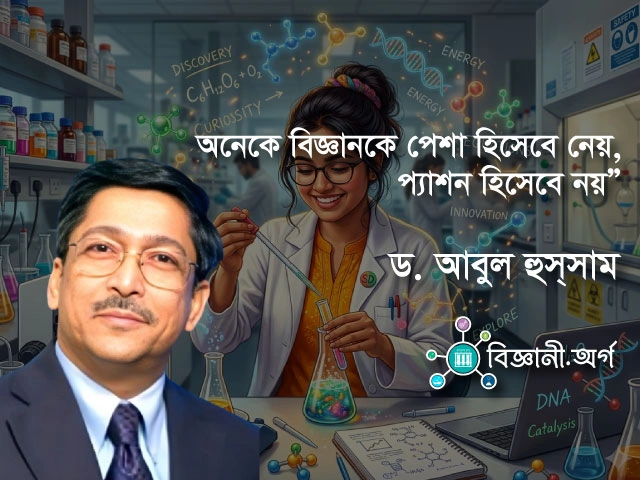
For many students in today’s Bangladesh, studying science is a strategic decision. If they get good results, they’ll have opportunities in engineering or medicine, open doors to study abroad, or land a respectable job—many opt for science based on these calculations. But Dr. Abul Hussam has a different observation. In his words, “Many choose science as a profession, not a passion.” This single sentence encapsulates a major weakness in our science education system.
Viewing science merely as a career ladder, many students perform well academically but lose interest in genuine research. Rote-based learning, coaching-dependent preparation, and exam-centric assessments often turn science into just a means to score marks. Yet, the true driving force behind scientific pursuit should be curiosity—why did this happen, how did it happen, and what could happen if things change? Without these questions, the study of science gradually becomes lifeless.
Dr. Hussam’s life stands as the opposite example of this mindset. From childhood, he was fascinated by science—the joy of creating things with his own hands, the curiosity to experiment with devices led him towards becoming a scientist. For him, science was never just a pathway to a job; rather, it was a way to think, to invent, and to solve society’s problems. This passion inspired him to tackle complex issues like arsenic contamination.
This brings forth an important question for young people—am I studying science just to build a career, or do I truly love to learn and create? If your answer is the first, you may land a good job, but contributing to the solution of society’s bigger problems will be difficult. And if your answer is the second, then science can become a powerful tool for change.
Bangladesh’s education system offers comparatively few opportunities for research-based learning. Limitations of laboratory facilities, lack of project-based work, and the failure to recognize setbacks as part of learning—all these restrict the development of passion among students. Dr. Hussam’s experience shows that failure in scientific work is not the end; rather, it is through failure that new ideas are born. If we can foster this mindset, it is possible to embrace science not as a job, but as a passion.
Therefore, Dr. Hussam’s comment is not just a remark; it is a call to reflect on our culture of science education and research. If we want to foster a generation who not only achieves good results but also creates something new, we must build a culture that encourages a genuine love for science.
Read Dr. Abul Hussam’s full interview:
If you want, I can prepare a “Dr. Abul Hussam: Lessons from Quotes” series package with these five articles—
The package will include:
- A short social media caption for each article
- Facebook/LinkedIn post
- Cover text/headline design ideas