

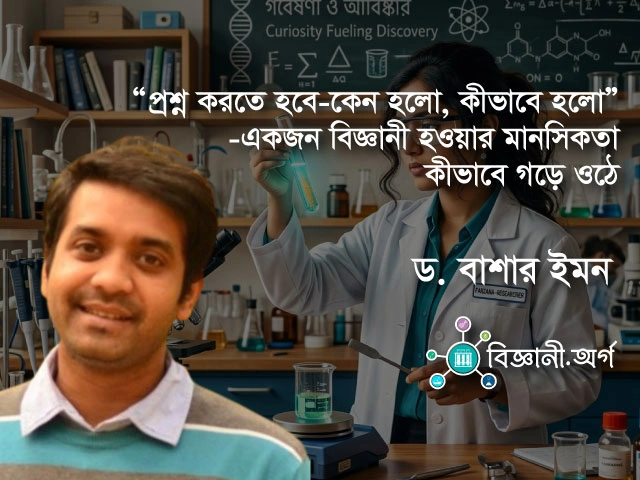
Many people dream of becoming scientists. But being a scientist is not just about wearing a lab coat or using complex equipment. The core of being a scientist is actually in the mind—how we see the world, how we ask questions, and how we strive to understand the unknown. Bangladeshi researcher Dr. Bashar Emon has provided a simple yet profound definition of the scientist’s mindset based on his own experience: “You have to ask—why did it happen, how did it happen.”
In our daily lives, we take many things for granted. Why does it rain, why does a disease spread, why is an object hard or soft—we often ignore these questions. But a scientist cannot accept these things as “given.” Every event sparks a new question for them. This curiosity is the first step in science.
According to Dr. Bashar Emon, just asking questions isn’t enough to become a scientist; the real task is to try to find the answers. We find many answers in school or university textbooks, but when you step into the world of research, you see that there aren’t ready-made answers for many questions. Then you have to carve your own path. Gathering information, reading other research papers, conducting experiments—all these processes help shape a researcher’s thinking.
A real-life example of this mindset is Dr. Emon’s own journey. Coming from an engineering background, he is working on complex diseases like cancer. He wondered—why do tumors become harder over time? The answer was not in any textbook. As a result, he had to choose the path of research himself. This question gave rise to new types of instruments, new methods of analysis, and new perspectives on understanding cancer.
The scientist’s mindset means accepting failure as normal. In research, results often don’t turn out as expected. An idea might be proven wrong. But a scientist’s work does not stop there. Instead, these failures give rise to new questions—why didn’t it work? Where was the mistake? This is where the difference between a scientist and an ordinary student appears.
Dr. Bashar Emon advises young people to recognize this curious mindset within themselves from the university level. Reading subject-based books beyond the curriculum, exploring research articles, and seeking opportunities to work in labs—all of these help you discover whether research is really for you. To be a scientist means embracing a lifestyle—where learning never ends.
This mindset is even more important in the context of Bangladesh. Even within limited resources, if students learn to ask questions and develop the habit of self-learning, then the foundation for research can become strong here at home. The experience of those who work abroad for higher education send the same message—just having good grades doesn’t make someone a scientist; it is the courage to ask questions and the patience to seek answers that make a true researcher.
As Dr. Bashar Emon says, science is not rote memorization; science is seeing the world with new eyes. If young people can develop this habit of seeing things anew from an early age, the journey of future Bangladeshi scientists will be even more enriched.
🔗 Read the full interview: