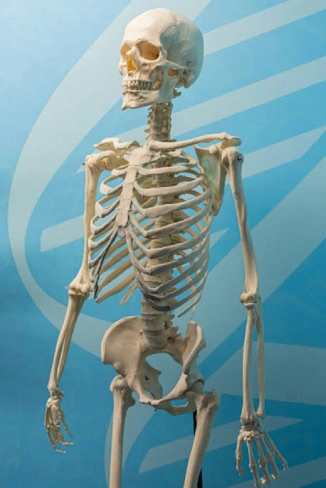
The human skeleton—even the name sends a chill down the spine. Countless stories, legends, movies, and ghostly series repeatedly bring up the topic of human skeletons. It’s as if the human skeleton forms a strange world where imagination and reality are blended together. Even in this era of modern science, these bones remain at the center of human curiosity and mystery. While some mysteries have logical explanations, others remain unknown and unexplained, making the fascination with human skeletons endless. But are human skeletons truly mysterious? Let’s examine the reality under the light of science.
The Final Destination of the Human Body
When a person dies, their body decays and returns to the earth, leaving behind only bones. Those bones gradually become shrouded in mystery, fear, and stand as witnesses to history. From Egypt to Mexico, ancient civilizations had various customs involving skeletons! Sometimes buried under tombs, sometimes hidden in secret caves, century-old bones lie concealed in unknown darkness.
Human Skeletons: Just Fear or Science?
There have been many striking incidents behind these mysterious skeletons. Sometimes, excavating an ancient graveyard reveals human bones hundreds of years old. Sometimes, a decomposed body is found in an abandoned house, spreading panic among people. Police, archaeologists, and forensic experts have all investigated these cases.
But are all skeletons really mysterious? The answer is, not always. History shows us that from ancient mummies to wartime mass graves, humans have discovered many unknown skeletons. After the discovery of Tutankhamun’s tomb in 1922, new mysteries began to emerge around human skeletons and tombs. In 1991, the 5,300-year-old “Iceman” was found in Europe, deepening the question: how do bones remain intact for so many years?
Science Searches the Secrets of Bones
For many years, various research organizations have been studying human skeletons. Mysterious skeletons have been found in Europe, Egypt, Latin America, and even in snow-capped Himalayan regions. Organizations like Discovery Channel and National Geographic have produced extensive documentaries about human skeletons.
Forensic experts state that most of these mysteries can be explained by natural processes, climate, and human actions. The stories of many secret deaths and missing persons remain under the ground only as skeletons.
Technology Unravels the Tangle of Bones
Thanks to science, much of the mystery around the human skeleton has been unveiled. Through DNA testing, fossil dating, and biochemical analysis, scientists can now determine the age, identity, and cause of death associated with skeletons. With modern technology and lab tests, even an unknown skeleton can become a key to unraveling history.
More History Than Mystery
Experts say that most of the fear and stories about human skeletons are creations of human imagination. They are less about mystery and more about living history. A skeleton is not just a dead body; every bone is like a witness to a different era. Through these bones, people can trace their own roots, their own past.
So, the human skeleton is no longer just a source of eerie mystery, but stands as a living history under the lights of science labs and museums.
There is no greater teacher than the skeleton for understanding the structure of the human body. Without seeing, touching, or dissecting bones, learning the science of medicine is nearly impossible. This is why the human skeleton is an indispensable part of medical science—the history of skeleton procurement is itself wrapped in secret mysteries, amusing stories, and unknown chapters.
At that time, Bangladesh was part of British India. Kolkata Medical College was the first modern medical college in the subcontinent (1835). Back then, students learned medicine by dissecting bodies, a practice called Dissection. Cadavers mostly came from unidentified deceased individuals.
Gradually, medical schools started in Dhaka, initially centered around Mitford Hospital (now Sir Salimullah Medical College). Then came Dhaka Medical College (1946). Even then, the lack of cadavers and bones was a major problem.
During the Pakistan era, medical colleges still received bodies and skeletons mostly from unidentified deceased persons. In rural areas, when someone with no known identity died, the police would send the body to the morgue. Some of these would go to students’ dissection tables, while the bones would be dried and preserved for educational use.
At the same time, many people in the country were secretly involved in bringing skeletons from India and Kolkata. Numerous unidentified bodies were found along the banks of the Ganges, and those bodies were cleaned and processed into skeletons to be sold to medical colleges. This led to the development of clandestine “skeleton smuggling rings.”
After independence, the number of medical colleges in the country increased. From 1971 to 1980, new colleges were established in Comilla, Rajshahi, Chattogram, and Mymensingh. The demand for bones and dead bodies multiplied. At the time, local groups would excavate skeletons from cremation grounds and graveyards at night, selling them to medical colleges domestically and abroad.
In the 1980s, newspapers frequently reported news like ‘missing corpse’ or ‘grave dug up, skeleton stolen.’ The government eventually banned the export of bones. Before that, many skeletons from Bangladesh were exported to Japan, Europe, and even America for education and medical research.
For medical students in the country, bodies and bones are essential for learning anatomy. There was a time when whole “Bone Sets” could be found secretly in the alleys of Old Dhaka.
Even now, many anatomy departments in the country prepare their own bones—unknown bodies are chemically dried to create skeletons. However, due to human rights, law, and religious sensitivities, this practice is now controlled and limited.
Currently, many medical colleges use plastic model skeletons, 3D virtual dissection tables, and digital cadaver labs. But there is still no full substitute for real bodies and bones. Thus, the quiet “skeleton procurement mystery” still lingers in the background.
The practice of teaching medicine by exploring human skeletons is not new—it’s been done for hundreds of years. However, over time, secrecy and mystery have diminished, replaced by rules, ethics, and technology.
The blend of untold human stories, society’s shadows, and the light of science makes the human skeleton a strange “teacher of mysteries” in the country’s medical science even today.
The Horror and Prohibition in Religious Texts
Islam:
In Islam, the dead have as much dignity as the living. Prophet Muhammad (peace be upon him) clearly said:
“Breaking a dead person’s bones is as sinful as breaking the bones of a living person.” (Abu Dawood, Tirmidhi)
Any form of disrespect, sale, or excavation of a dead body is strictly forbidden in Islam. Therefore, the history of secretly digging graves and selling bones in Muslim countries is considered a grave sin from an Islamic perspective.
Hinduism:
In Hinduism, after cremation, the sacred ashes are floated on the Ganges. Body theft or disruption of cremation is regarded as a serious sin. If this faith is violated, the family faces social disgrace.
Christianity:
In Christianity, after burial, disturbing the grave is not permitted; the grave must be preserved with as much dignity as possible. Therefore, in medical education, bones are generally obtained through body donation, never forcibly.
Buddhism:
In Buddhism, the dead body is sacred and tied to the concept of rebirth. Interfering with the body is seen as a grave sin, though there are partial exceptions in Tibetan or Thai Buddhist cultures.
Why Are Alternatives Necessary?
1. Ethics:
Students must develop the awareness that the dead have rights, just like the living.
2. Legal restrictions:
In modern times, grave robbing or bone smuggling is an international crime. Skeleton export, once legal abroad, is now banned.
3. Social confusion:
Rumors about grave robbing spread fear and mistrust in society. Such secret activities decrease trust in medical education.
4. Harm to science itself:
When cadavers or skeletons are sourced secretly, quality can’t be ensured, and students often study faulty structures. This leads to mislearning.
What Must Be Done—It Must Be Done Now
1. Make synthetic skeletons mandatory in every medical college
2. Develop guidelines for virtual labs and body donation
3. Raise public awareness with religious leaders
4. Strictly enforce the law to stop illegal skeleton trade
5. Teach ‘cadaver ethics’ in students’ ethics classes
6. Use more hand-drawn bone charts and labeled sketches by students
7. Seniors share their bone sets with juniors during study
8. Ensure proper care and reuse of skeletons in colleges
9. Show more video lectures and YouTube 3D models in anatomy class
10. Set up small group study sessions using models
11. When needed, have 4–5 students study with one bone set together
12. Teach students to draw diagrams from medical books more frequently
13. Use each anatomy room in public medical colleges as a shared resource
14. Anatomy teachers should share more of their own handmade models or charts
15. Organize awareness seminars instead of illegal trade in bones
The human skeleton is an essential teacher in medical science, but secret corpse theft and the bone trade are incredibly unethical and contrary to religion. With the combination of modern science, technology, and ethical awareness, we need to relegate the ‘Skeleton Mystery’ to the pages of history—not let it continue in reality!
Md. Iftekhar Hossain
Medical student, Cox’s Bazar Medical College | Interested in neuroscience, habit building, and behavioral changes in the human brain.