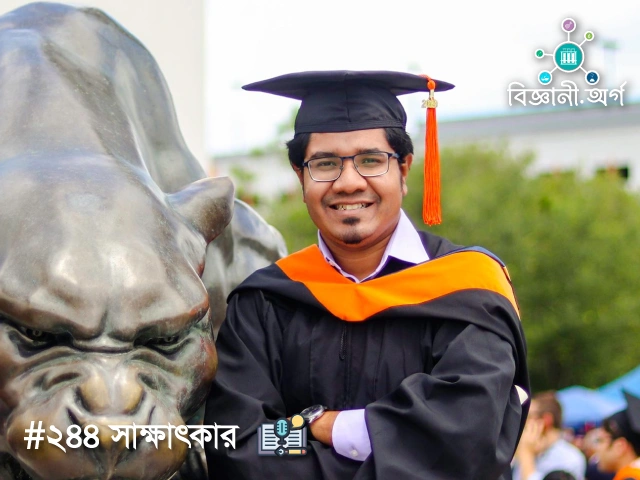
In the 74th episode of Scientist.org’s interview series, we spoke with Mahbub Ul Alam, a scientist currently residing in Sweden.
Introduction:
Scientist Mahbub Ul Alam studied Science at the secondary and higher secondary level at Rajshahi Cadet College. He then completed his undergraduate studies in Computer Science and Information Technology at the Islamic University of Technology (IUT), Gazipur. Afterwards, he pursued higher education in Germany. There, he finished a Master’s in Computational Linguistics at the University of Stuttgart. He is currently undertaking his PhD research at Stockholm University in Sweden. His primary research focuses on enhancing smart healthcare using distributed machine learning—“Improvement of Internet of Medical Things based Applications with Distributed Machine Learning.” A new field involving the application of various Internet of Things technologies in healthcare is the Internet of Medical Things (IoMT), which is his area of expertise. In 2022, his research paper, “Exploring LRP and Grad-CAM visualization to interpret multi-label-multi-class pathology prediction using chest radiography,” was awarded Best Student Paper by IEEE-TCCLS (Institute of Electrical and Electronics Engineers – Technical Committee on Computational Life Science).
His interview for Scientist.org was conducted by Dr. Moshioor Rahman. Some highlights from the interview are:
- Currently, specialized subjects are being taught at universities around the world, and curricula are being designed for these specialized topics because cross-disciplinary research is increasingly necessary for learning in those areas.
- There is now greater use of digital technology in healthcare systems. EHR or Electronic Health Records are being used to collect patient information. Clinical Decision Support Systems are being employed to assist doctors in their work.
- Efforts are being made to use machine learning for predictive analysis with hospital data repositories. Different types of models are currently being developed in this field.
- We still do not fully understand why artificial intelligence produces the results that it does (Interpretability / Explainability). Therefore, these outputs are being observed in detail to gain further insights.
- Artificial intelligence technology is assisting doctors in various ways in the field of medicine.
- There are now extensive discussions regarding the ethics of artificial intelligence (Ethical AI), and many scientists are working on this issue.
- He offered two pieces of advice for those who wish to become scientists in the future:
- (1) One must have curiosity and a desire to learn, and
- (2) One must remain persistent and dedicated.
Interview video link: https://youtu.be/C77h4o8csrg
Date of Interview: 17 February 2023
Contact scientist Mahbub Ul Alam:
Email: [email protected]
Website: https://www.su.se/english/profiles/maul8511-1.397920