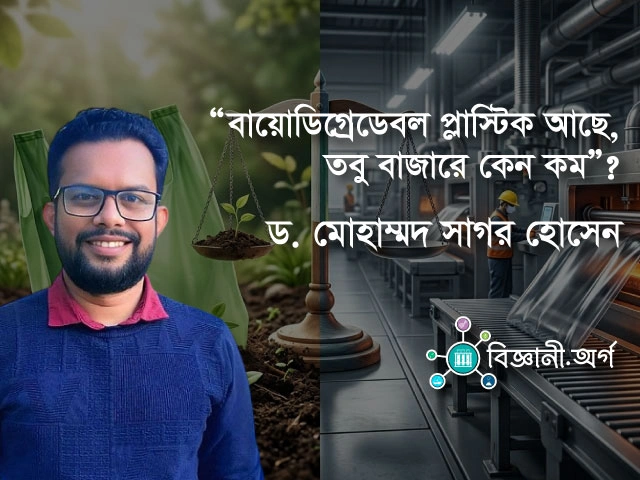
In a recent interview with biggani.org, Dr. Mohammad Sagor Hossain highlighted an important reality regarding biodegradable plastics and eco-friendly materials. At first glance, it seems that bioplastics or biodegradable materials are the simplest solution to replace plastics for environmental protection. However, he explains that the reality is not so straightforward.
In the interview, he said that it is scientifically possible to produce biodegradable or home-compostable materials. There are materials available that, when disposed of in the soil, gradually break down and do not harm the environment. But the problem starts when multiple qualities are expected from a single material. In real-world product manufacturing, being eco-friendly alone is not enough; the material also needs to be durable, flexible or strong as needed, safe for food contact, and able to withstand heat.
As Dr. Sagor Hossain puts it, to give a single material various properties like flexibility, strength, safety, and heat resistance at the same time, it often needs to be modified. However, such modification can often reduce or even eliminate the material’s biodegradable properties. In other words, the biggest challenge in developing eco-friendly materials is maintaining many desired properties within a single material.
He further mentioned in the interview that there are some biodegradable plastics that break down in certain environments. But to make these materials suitable for industrial use, additional features often need to be incorporated. This is where the main challenge arises. The more effective and versatile the material is made, the greater the risk that its natural decomposability will decrease.
Due to this reality, biodegradable plastic has not yet become a complete alternative to conventional plastics. According to Dr. Sagor Hossain, research is gradually progressing toward developing materials that are both environmentally friendly and capable of retaining the necessary properties for industrial use. However, this will take time.
The views he shared on biggani.org help us understand that solving the plastic problem is not just about inventing new materials. Rather, the biggest challenge is achieving a scientific balance—creating materials that are both safe for the environment and effective for practical use.
To learn more about this discussion, readers can view the full interview with Dr. Mohammad Sagor Hossain published on biggani.org.