


Abul Bashar
The border region between modern-day Germany and the Czech Republic. In the early 16th century, this area was divided into two parts by a rugged mountain range. On one side was Saxony, and on the other, Bohemia. There was also a dense, impenetrable forest, home to bloodthirsty wolves and bears. Yet even more fearsome were the ruthless bandits who made these woods their lair, attacking with savage ferocity whenever they caught the scent of prey.

During that century, a highly valuable metal, silver, was discovered in this region—so much of it that people believed the supply was all but endless. Drawn by greed, mining entrepreneurs risked every danger to come here from distant lands, bringing their cohorts along. History remembers this as the world’s first “Silver Rush.”
As a result, a small town right near the border, called Joachimsthal, quickly became Europe’s largest mining center. Crowds of people, hoping to change their destinies, flocked eagerly to the town. Within just a few years, the population soared to 20,000—far beyond the norm. The extracted silver was used to mint coins called Joachimthalers. Over time, this name was shortened in local speech to “thaler,” a coin that gained great popularity across the world at the time. Although these silver coins no longer circulate, the name survives today in altered form: “dollar.” The term is still used for currencies in the United States and other countries.
Naturally, the supply of silver in the Joachimsthal mines did not last forever. Within three decades, the deposits were depleted. Soon after, another blow struck like a monster—the plague. A massive number of people died. Before the wounds could heal, war broke out, dealing a fatal blow to the bustling town. Its population plummeted nearly to zero, and Joachimsthal became a ghost town, infamous for its unhealthy conditions. Only the desperate would dare set foot there. This infamy had a reason: long before the plague, miners had frequently fallen ill to a strange and mysterious disease, the cause of which was unknown.
Besides silver, Joachimsthal’s mines yielded another mineral—a shiny black substance nobody found appealing, as it was deemed a stone of misfortune. It was given the name “pitchblende.” In German, “pitch” means misfortune and “blende” means mineral.
The mineral caught the attention of the amateur German chemist Martin Klaproth, who was curious about its composition back in 1789. Through his experiments and research, he discovered a peculiar semi-metal in pitchblende, unknown until then. Just eight years earlier, astronomer William Herschel had discovered a new planet, Uranus, named after the Greek sky god. At the time, Uranus was thought to be the outermost planet in the solar system. In honor of the planet, Klaproth named the new element “uranium.”
In the following century, pitchblende was discovered in France, Austria, and Romania. By the end of the Victorian era, thousands of scientific papers had been published on the geological and other properties of uranium. The element became an object of fascination for scientists. There were reasons for this. Uranium is as dense as gold; at the time, it was believed to be the heaviest element on earth. Another allure was the variety of colors in its oxides and salts, used for manufacturing glass, ceramics, and porcelain. These oxides and salts created attractive radiance in glass and produced orange, yellow, red, green, and black sheens in ceramic and porcelain. Some of these techniques dated back to Roman times, but nobody could have guessed the invisible dangers lurking within this vibrant decor.
Amid all these applications, Henri Becquerel made a dramatic discovery about uranium. In 1896, almost by accident, he noticed that an invisible ray emanated from the metal, capable of fogging photographic plates even when wrapped in black, light-blocking paper.
Just months earlier, German physicist Wilhelm Roentgen had witnessed another strange phenomenon. In 1895, while experimenting with cathode rays in a vacuum tube, he observed that a phosphorescent screen placed at the other end began to glow. Even when a thick black card was inserted between the tube and the screen, the screen still glowed. Eventually, he placed his hand in front of the tube and saw the bones of his own hand on a photographic plate—a startling revelation. He realized that powerful electrons striking the glass inside the tube were creating a new kind of radiation.
Though the phenomenon seemed spooky and mysterious at first, a week later Roentgen realized it could be useful. He photographed his wife’s hand with the rays, clearly capturing the shadows of her bones and even her wedding ring. While Roentgen found the ghostly images fascinating, his wife was unnerved. However, the medical community quickly grasped the importance of this discovery. The new rays allowed doctors to locate bone fractures or identify surgical sites with far greater accuracy. But what were these rays? Some suspected they were a kind of invisible light. Since nobody knew the answer, they called them “X-rays”—an unknown quantity. Some even named them “Roentgen rays” after the scientist.
2.
Becquerel’s uranium rays appeared to have some similarities with X-rays: invisible rays from certain minerals could penetrate black paper. Especially, he observed that uranium nuclei spontaneously emitted these rays. The phenomenon was later named “Becquerel rays” after him. French scientist Pierre Curie and his wife, Marie Curie, experimented further and found that only specific substances emitted such powerful rays. To describe this property, they used the French term “radio-actif,” which later became “radioactive” in English. To describe the property of emitting energy, they coined “radioactivity”—a term which, in Bengali, translates as “tejoskriyata.” The word combines “tejos” (meaning ray or radiation) and “kriya” (work or action). However, before the proper structure of the atom was discovered, nobody understood the cause of radioactivity. The Curies decided to investigate further—but where could they find a proper laboratory?
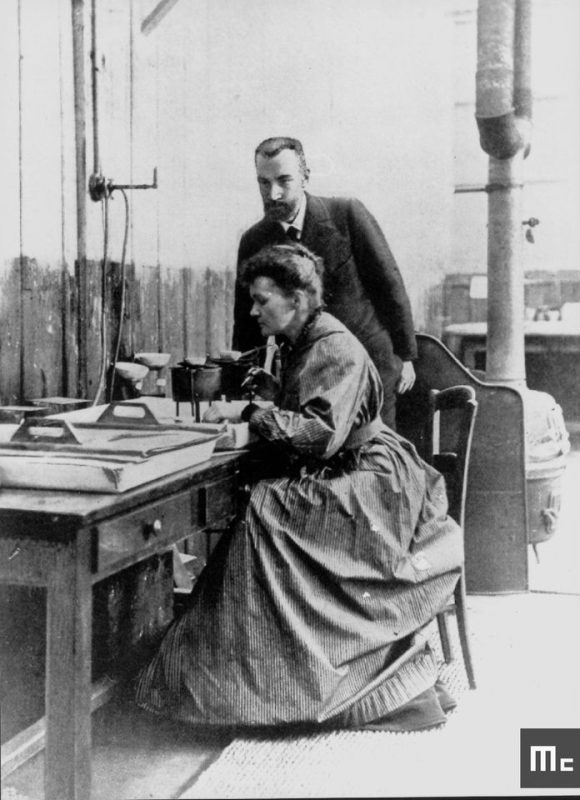
After overcoming many obstacles, they finally secured a lab in 1898 when Paris’s School of Physics and Chemistry allowed them to use theirs. But the place was a lab in name only; compared to a modern laboratory, it was more like a rundown stable or a potato warehouse. The floors and roof were cracked, so the room flooded whenever it rained, while scorching heat made summers unbearable, and in winter, freezing drafts poured in through gaps in the walls. The smell of gas burners and chemicals made conditions even worse.
German chemist Wilhelm Ostwald, after visiting the Curies’ lab, described it as a cross between a stable and a potato storehouse. He could hardly imagine that research could be conducted there until he saw the scientific equipment. Yet it was in this lab that the Curies began their backbreaking work extracting uranium from pitchblende, working tirelessly day and night.
The Curies worked strictly by routine, day after day. Sacks of pitchblende from the abandoned Joachimsthal mines were brought to the lab. Marie started by cleaning away the mud, grass, and pine needles, breaking it all down into fine powder. The material was then heated in liquid and filtered for further purification, washed with acid to remove unwanted substances, and finally processed via electrolysis. After months of relentless effort, only a few grams of pure uranium were produced—a painstaking process. “I would stir these heavy, hot solutions with an iron rod as long as my own body. Sometimes the day would end before the task was done, and my whole body would ache,” Marie later wrote. Yet she never complained; she was always accompanied by her husband, Pierre, and she reflected that their years in that “wretched old shack” were the happiest and most fulfilling of their lives. Soon, their superhuman effort bore fruit.
A strange fact emerged: unrefined pitchblende was more radioactive than purified uranium. Pierre and Marie suspected that pitchblende contained another radioactive element, as yet undiscovered. Within a year, they confirmed their suspicion by discovering two new radioactive elements.
One was named polonium, in honor of Marie Curie’s homeland, Poland (Latin: Polonia). The other was named radium, discovered in pitchblende on December 21, 1898; the discovery was announced to the French Academy of Sciences on December 26. Almost a year later, it was officially named radium, from the Latin “radius” (ray), because of its energy emission. According to the Curies, radium’s radioactivity was 200,000 times greater than uranium. Further experiments revealed that radioactivity did not depend on the element’s chemical properties; whatever the element—polonium, radium, or uranium—radioactivity was fundamentally an atomic phenomenon.
But where did the energy inside radioactive materials come from? Pierre speculated that radioactive substances borrowed energy from external sources and released it, a comforting and popular theory of the age. When any material is heated, it radiates warmth for a while afterward. Yet the Curies noticed that their radioactive elements generated heat not typical for such materials—just touching them felt warm. It was as if the substances were drawing energy from themselves and emitting it. “The amount of heat a given amount of radium can emit in a few years is vastly greater than that produced by any chemical reaction of a similar quantity of other substances,” Marie noted.
In 1903, Pierre and Marie Curie were rewarded for their hard work. Along with Henri Becquerel, they won the Nobel Prize in Physics that year. The prize money alleviated their financial hardships. That same year, Pierre, at 45, was appointed professor at the Sorbonne—a post created in his honor. Marie became his assistant. Soon after, another happy event occurred: the birth of their second child, Eve. Their first daughter, Irène, was then six years old.
Fame after the Nobel, however, brought its own burdens. Newspapers persistently requested interviews, and the couple were constantly invited to events. These disruptions interfered with their research more than they helped, but the greatest obstacles came from chronic pain, illness, and malnutrition caused by years of hard labor—and, of course, by exposure to radioactive substances.
The Curies grew concerned that the effects of radioactivity could be even more dangerous than what they experienced. In his Nobel lecture, Pierre Curie issued a warning—but few heeded his words. He stated, “A small ampule of radium salt in someone’s pocket may show no ill effects after a few hours, but if kept for days, it would redden the skin and cause wounds difficult to heal, possibly leading to paralysis or death. Therefore, radium should always be carried in thick lead containers.”
Pierre even tied a packet of radium to his own body for several hours, testing whether it could destroy cancer cells. Meanwhile, Marie kept a vial of radium by her pillow. They needed seven tons of pitchblende to extract just one gram of radium. Marie enjoyed watching their creation glow in the dark. “One of our pleasures was going to our workroom at night. The substances we created glowed faintly in their bottles and vials. It was a beautiful sight—always new to us. The glowing tubes seemed like fairy lights to us,” Marie wrote.
3.
April 19, 1906. Thursday. That day, after a meeting with fellow scientists, Pierre Curie was on his way to his publisher with proofs of his upcoming book. Later, he planned to visit the library, and in the evening, join friends for a gathering with Marie.
Arriving at the publisher’s office in pouring rain, Pierre found it closed and empty. Disappointed, he turned back onto the rainy street. Perhaps the rain blurred his vision, for he didn’t see the heavy, horse-drawn military wagon in time. Before he could react, he was caught under the six-ton wagon’s wheels and killed instantly—the tragic end of one of the pioneers of radioactivity.
Grief-stricken yet determined, Marie channeled all her energy into continuing the work she had begun with Pierre. Immersing herself in research helped her cope with her loss. She eventually became head of a Sorbonne laboratory, the first woman lecturer in the university’s history. Writing research papers in Pierre’s name brought her some solace, as if he were still working by her side. Marie reflected, “I walked as if hypnotized, ignoring everything around me. I didn’t kill myself, nor even wish for death. But could not one of those horse carts end my life as it ended my beloved’s?”
Marie Curie was striking in her students’ eyes as well. One recalled, “She looked very plain, expressionless, dressed simply in black. But that impression vanished upon seeing her broad, radiant forehead beneath a crown of ash-blonde hair, which she tried to tie back but could never conceal her charm.”
In 1908, she became a full professor at the Sorbonne. In 1911, she received her second Nobel Prize, this time in chemistry, for discovering radium. Just three years later, World War I began, during which she deployed mobile X-ray units to treat wounded soldiers, saving countless lives.
Marie gradually emerged from the grief of losing Pierre, only to be embroiled in a scandal before receiving her second Nobel. Unlike other widows of her time, she refused to forgo romance. She believed that losing a husband did not mean she had to spend the rest of her days in mourning—she still had much life ahead. Around 1910, she abandoned widows’ mourning black for a white gown adorned with rose patterns and fell in love again, this time with Pierre’s former colleague, Paul Langevin. Their affair was not just a meeting of minds but a passionate romance; soon they moved in together like a married couple. Unfortunately, Langevin was already married with four children.
After the announcement of her second Nobel Prize, Marie’s life became more difficult. Her fame was now global, and newspapers reported on her private life relentlessly. French nationalists branded her as Polish, and anti-feminists condemned the invasion of personal scandal into the scientific realm. People struggled to decide whether Marie Curie was a villainess or a remarkable scientific heroine.
In this climate, the French National Academy of Sciences wrote to Marie, urging her not to travel to Stockholm for the 1911 Nobel ceremony. She politely replied, “The prize is being awarded for the discovery of radium and polonium. I believe my scientific research and my personal life are unrelated. The value of scientific achievement ought not to be influenced by slander and gossip—this is a principle I cannot accept.” Confronted with her impeccable logic, the French Academy relented, and Marie received her award as deserved.
4.
Years of working with radioactive substances eventually led to Marie’s diagnosis of leukemia—the effects of radiation took a long time to manifest. On July 4, 1934, at the age of 66, the first female Nobel laureate scientist passed away. Despite exposure, her lifespan was not unusually short compared to other women of her time.
At first, neither Curie recognized the dangers posed by radioactive substances. Marie kept them by her bedside and delighted in their glow, but she was not alone; many others in Europe and America were similarly enchanted. When mixed with water, radium glowed in the dark. After its discovery, some believed it to be a miracle cure for various ailments. Quack doctors quickly embraced it as a new panacea. In the early 20th century, radium was incorporated in “wonder medicines.”
Radium chocolates, radium water, radium bread—novel products flooded the market. The most popular was a device called the Radiendocrinator. Many wore this expensive device near their abdomen at night hoping to retain their youth and vigor. As it contained large amounts of radium, production costs—and therefore prices—were high, making it a luxury for the wealthy. Cheaper, usually fake versions, containing little or no radium, were marketed to the poor and lower-middle class eager to maintain their youth. Ironically, these poorer buyers were the lucky ones—their exposure to radium was limited or nonexistent, so the harm was minimal.
To make watch dials visible in the dark, radium-based luminous paint with about one microgram of radium was used. Several factories in the United States employed young women for this purpose. They painted the numbers using fine brushes, which they were instructed to shape with their lips. These workers, later known as the “Radium Girls,” were assured that radium was completely safe.
This reassurance led to wider use of radium as a fashion statement. Women applied radium to their hair, eyelashes, nails, lips, and even their teeth for glowing smiles in the dark. Soon, the consequences became clear. Many lost their teeth and developed anemia. Their jaws began to decay, and cancer set in. At a factory in New Jersey, over a hundred young women perished this way. These tragedies finally awakened public awareness. The terrifying potential of radioactive substances was revealed to the world in 1945, when American atomic bombs devastated Hiroshima and Nagasaki. But that is another story.

Author: Executive Editor, BigganChinta
Sources:
♣ In Search of Schrödinger’s Cat / John Gribbin
♣ Atom / Piers Bizony
♣ Abiskarer Neshay / Abdullah Al Muti
♣ Wikipedia
♣ https://www.facebook.com/bigganchinta/
♣ http://visioncreatesvalue.blogspot.com/2020/08/blog-post.html
♥♪♥
VCV Technical Communications:
Received From Abul Bashar via email: 20200902
Converted by Unicode Converter – Bijoy to Unicode: 20200902
Published: Abul Bashar, FB Biggani.org Group: 20200822
Last Edited: 20200904
Last Updated: 20201003












Leave a comment