


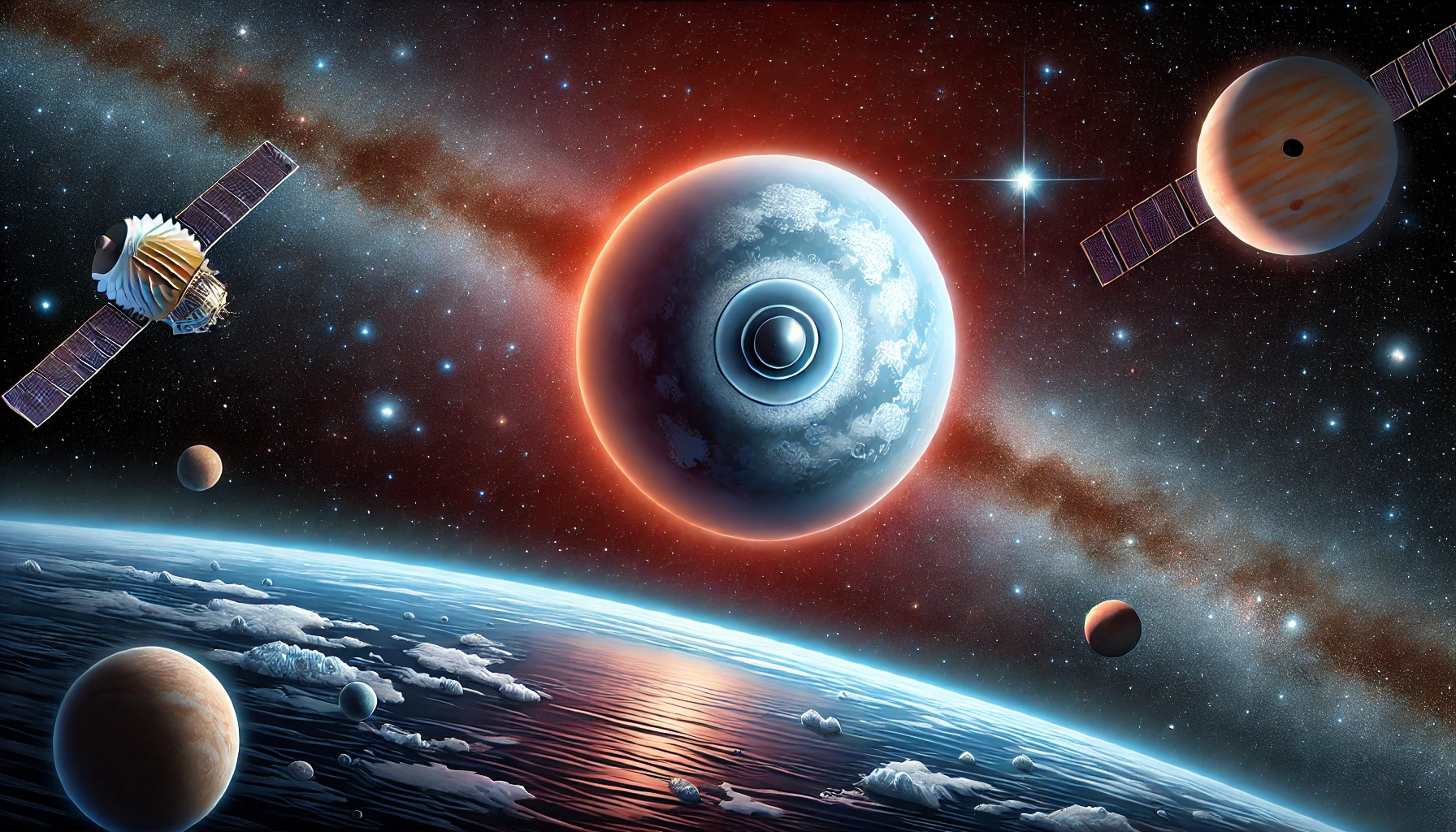
This Earth is home to all of us. Throughout the ages, people have discovered new countries to expand their empires. Nearly all of Earth’s habitable places have now been found, so humanity is turning its gaze beyond Earth to other planets. The universe is home to billions of planets. Among these, there may be one where humans can establish a new home. With this goal in mind, scientists are searching for another planet like Earth—these candidates are called super-Earths. Not only could humans potentially live on a super-Earth, but it may also be possible to find signs of other life forms there as well. Let’s learn more about super-Earths. And up next: an exciting new discovery! Scientists have recently found a new planet that might just be a super-Earth.
What is a Super-Earth?
Super-Earth refers to an exoplanet, meaning a planet outside our solar system, that has a mass greater than Earth’s but less than our solar system’s gas giants Neptune or Uranus. The term “super-Earth” is based solely on the planet’s mass and does not provide any information about its surface, atmosphere, or habitability.

Characteristics:
- Mass and Size: Typically, a super-Earth can be 1 to 10 times the mass of Earth.
- Composition: A super-Earth can be rocky, icy, or gas-rich, depending on its makeup and location.
- Habitability: Many super-Earths may be located in habitable zones, where liquid water could exist and the potential for life may be present.
Why are Super-Earths Important to Us?
Super-Earths provide us with crucial information about our universe and aid our search for life beyond our solar system. Here are a few reasons why super-Earths are important:
- Potential for Habitability: Super-Earths can be situated in their star’s habitable zone, where liquid water might exist. This is key to the search for life beyond Earth.
- Atmosphere and Climate: Studying the atmospheres and climates of super-Earths provides valuable insights about environmental conditions beyond Earth.
- Formation and Evolution: Research into the formation and evolution of super-Earths helps us better understand the development of our own solar system.
- Technological Advancement: The technology used to detect and study super-Earths fosters innovation and advancements in space research.
Super-Earth – LHS 1140 b
This is currently the most talked-about candidate for a super-Earth. What a strange name, isn’t it? Located about 48 light-years away, LHS 1140 b is a super-Earth situated in its star’s habitable zone and may have a nitrogen-rich atmosphere. A light-year is a unit of distance used in space, representing the distance that light travels in one year. It measures distance, not time. Light-years are used to describe enormous distances between stars and galaxies. That means if we shone a light towards this S 1140 b planet, it would take 48 years to reach it. Just imagine how distant this planet really is!
LHS 1140 b was discovered in 2017. At the time, it was thought to be a mini-Neptune, but further observation later identified it as a rocky super-Earth. Using the James Webb Space Telescope’s high sensitivity and advanced technology, scientists have been able to collect even more precise information about the planet’s atmosphere and surface. The planet lies in the constellation Cetus, orbiting the star LHS 1140. It resides within the habitable zone and is currently being studied in detail to further understand its atmosphere and surface conditions.
Latest News
Recently, the James Webb Space Telescope (JWST) has been used for detailed observations of this planet. The planet is especially noteworthy because it orbits within its star’s habitable zone, making it potentially suitable for life. New data from JWST suggests that its atmosphere is nitrogen-rich and there may be water present on the planet.
New Measurements and Analysis
Earlier this year, researchers led by Ph.D. student Charles Cadieux of the University of Montreal’s Trottier Institute for Research on Exoplanets (iREx) provided new measurements of LHS 1140 b’s mass and radius. Their results showed that the planet is 1.7 times larger than Earth, with a mass 5.6 times that of our planet.
Super-Earth or Mini-Neptune?
An important question was whether LHS 1140 b is a mini-Neptune or a super-Earth. There is also a possibility that it is a “Hycean world,” which would have a rocky core, a global ocean of liquid water, and a hydrogen-rich atmosphere. These distinctive atmospheric signals could be detected by the Webb Telescope.
Insights from Webb Data
Last December, the research team observed two transits of LHS 1140 b using the Webb Telescope’s NIRISS (Near-Infrared Imager and Slitless Spectrograph) instrument. The results ruled out the mini-Neptune theory and indicated that LHS 1140 b is a super-Earth, likely with a nitrogen-rich atmosphere. If confirmed, this would be the first cool planet found to have a secondary atmosphere formed after its initial formation.
The data suggest that LHS 1140 b is less dense than a typical rocky planet, meaning 10 to 20 percent of its mass might be water. This indicates that LHS 1140 b could be an ice-covered world, possibly with a subsurface ocean at its substellar point, where the planet’s surface always faces its parent star—a phenomenon known as synchronous rotation.
Nitrogen-Rich Atmosphere: The nitrogen-rich atmosphere of LHS 1140 b suggests a stable and substantial environment, which could support the presence of liquid water. This supports the water-world or ice-planet hypothesis.
Current Models: According to current models, if LHS 1140 b’s atmosphere is like Earth’s, it would be an ice planet with a giant “bull’s-eye” ocean about 4,000 kilometers in diameter at its center. The temperature at the center of this ocean could be close to 20 degrees Celsius.
Potential for Habitability: The presence of an atmosphere and liquid water on LHS 1140 b makes it an exceptional candidate for habitability research, offering us a unique opportunity to study a potentially life-supporting world.
Future Observations
Observation Plans: More observations are needed to confirm LHS 1140 b’s atmosphere and determine whether it is an ice planet or a true bull’s-eye ocean world. The research team plans further transit and eclipse measurements with the Webb Telescope, which will help identify carbon dioxide and study the atmospheric composition and possible greenhouse gases.
Conclusion
LHS 1140 b is a significant super-Earth planet that could help answer vital questions about the possibilities for life elsewhere. The latest data from the James Webb Space Telescope has opened new horizons for research on this world. This study is considered a major step forward in space exploration.
References:
- SciTechDaily: Webb’s Super-Earth Discovery
- Daily Mail: NASA James Webb super-Earth aliens
- Space Daily: Potentially Habitable Ice-Covered Super Earth











Leave a comment