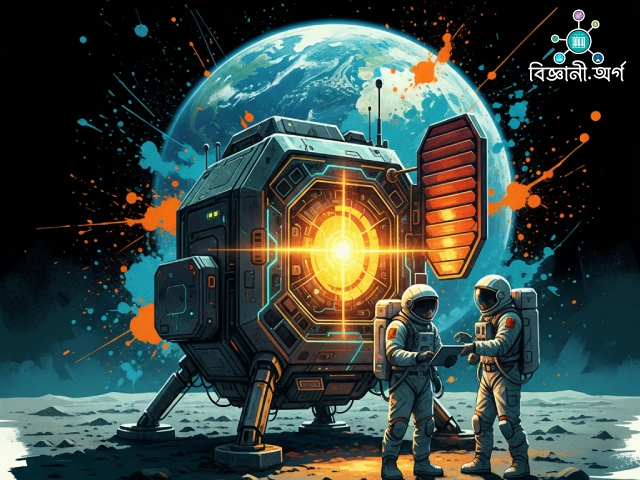
The dream of establishing a permanent human presence on the Moon is nothing new. But the problem that continually stands in the way of making that dream a reality is uninterrupted and reliable power supply. While solar energy can partially meet this need, the Moon’s long nights, dusty environment, and extreme temperature fluctuations present major obstacles. This reality has prompted NASA and the United States Department of Energy to once again announce, in strong terms, their intention to move forward with plans to install a nuclear fission reactor on the lunar surface.
In a recent announcement, NASA stated that the goal is to complete the development phase of this lunar-based nuclear power plant by 2030. This will include various tests on Earth. The planned reactor will be designed to provide uninterrupted power for years—without the need to continually send fuel from Earth. In the words of NASA Administrator Jared Isaacman, this joint initiative will “pave the way for a new golden era of space exploration and discovery.”
But setting up a nuclear power plant on the Moon is no simple engineering task. Even on Earth, running a reactor safely and stably is extremely complex; on the Moon, the environment multiplies these challenges. The biggest issue is heat management. On Earth, cooling towers at nuclear power plants use water to turn excess heat into vapor, releasing it into the atmosphere. But the Moon is a near-vacuum—there’s no thick atmosphere or natural water flow there.
Given this situation, scientists are considering alternative methods—such as solid-state conduction through solid materials or using liquid metal coolants. However, each solution brings new complexities, making the design even more intricate and expensive.
There’s also the issue of lunar dust. While the Moon doesn’t have frequent, severe dust storms like Mars, its dust is extremely fine, abrasive, and electrically charged by solar radiation. This dust can stick to the surfaces of any equipment and impair their functionality. As a result, every device designed for use on the Moon has to be specially engineered to prevent dust from entering and causing harm.
Another crucial consideration is radiation protection. Powerful radiation shielding is needed to keep astronauts working near the reactor safe. At the same time, the entire system must be built so that maintenance and repairs are needed as little as possible—since making repeat repairs on the Moon is nearly impossible.
However, NASA and the Department of Energy are not starting entirely from scratch. Scientists have been researching these kinds of technical challenges for many years. According to the current plan, the reactor will be able to generate at least 40 kilowatts of electricity—which is enough to continuously meet the power needs of about 30 homes for 10 years straight. This energy will be vitally important for lunar research outposts, scientific equipment, communications systems, and future human settlements.
Although the design’s initial phase is complete, turning it into hardware suitable for real-world use is a slow process. Here, not just engineering but also funding and regulatory approvals will play a major role. So, the dream of installing a nuclear power plant on the Moon is not happening just yet—it remains a long-term goal for now.
Still, it can be said that if this plan succeeds, it would be a groundbreaking step in the history of space exploration. With a permanent and reliable energy source on the Moon, humans will not only be able to survive there—but will also gain new confidence and a technological foundation for missions to Mars and more distant planets.