



Google’s new chip demonstrates error correction and performance that pave the way for a practical, large-scale quantum computer.
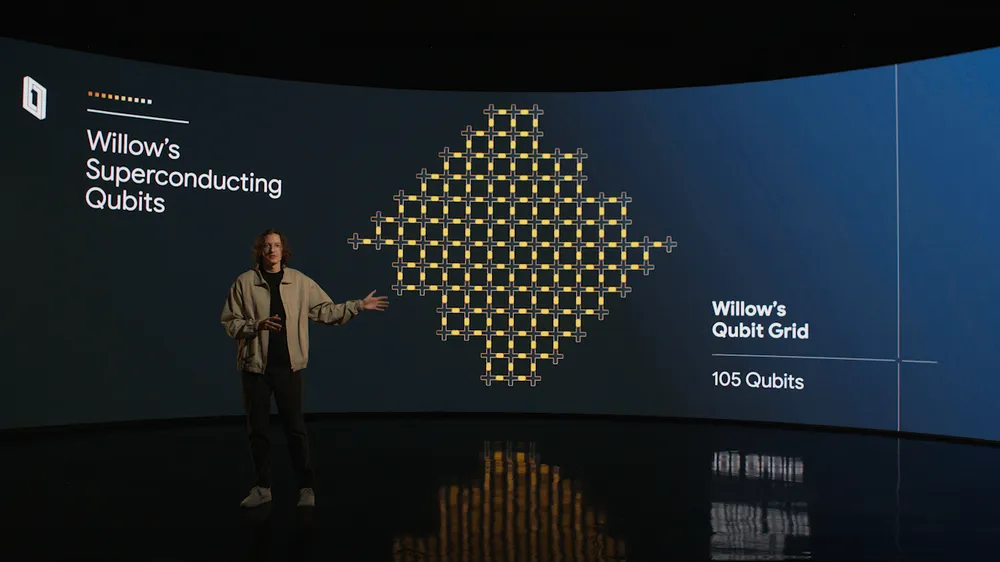
Google has unveiled its latest quantum chip, Willow. Willow demonstrated state-of-the-art performance across various metrics, enabling two significant breakthroughs.

First, Willow can exponentially reduce errors by using more qubits. This solves an important challenge in quantum error correction, which researchers have been trying to overcome for nearly 30 years.
Second, Willow completed a standard benchmark calculation in under five minutes—a task that would take today’s fastest supercomputer 10 septillion (that is, 1025) years to finish—an amount of time that exceeds even the age of the universe.
The Willow chip is a major milestone on a journey that began more than a decade ago. When Google Quantum AI was established in 2012, its goal was to build a practical, large-scale quantum computer—one that uses quantum mechanics, the “operating system” of nature as we know it, for the benefit of society, to push scientific discovery forward, create helpful applications, and tackle society’s greatest challenges.
Exponential Quantum Error Correction — Below the Threshold!
Error is one of the biggest challenges in quantum computing because qubits, the units of quantum computation, tend to quickly exchange information with their environment. This makes it difficult to keep important information protected. Typically, the more qubits are used, the more errors occur, causing the system to gradually become classical.
The results published in Nature show that in Willow, the more qubits are used, the fewer errors are seen, and the system displays even stronger quantum characteristics. We tested progressively larger grids of encoded qubits—from a 3×3 grid to 5×5 and 7×7 qubit arrays. Each time, using our latest quantum error correction technology, we managed to cut the error rate in half. Simply put, we achieved exponential reduction in error rates. This historic feat is known as staying “below the threshold”—where increasing the number of qubits still results in a decrease in error rates. Demonstrating progress in true error correction requires being “below threshold,” which has been a major challenge ever since Peter Shor introduced quantum error correction in 1995.
These results include several scientific “firsts.” For example, it is among the first demonstrations of real-time error correction in a superconducting quantum system—a critical milestone for practical computation. If errors can’t be corrected quickly enough, they ruin the calculation before it finishes. This is also a “beyond break-even” demonstration, where the lifetime of our qubit grids exceeded that of a single physical qubit—a proof that error correction actually improves the performance of the entire system.
As the first system below threshold, this is the most credible prototype of a scalable logical qubit created to date. It proves that building a practical, large-scale quantum computer is possible. Willow brings us significantly closer to running real, commercially relevant algorithms that cannot be reproduced on traditional computers.
10 Septillion Years on the World’s Fastest Supercomputer
To measure Willow’s performance, Google used the Random Circuit Sampling (RCS) benchmark. Developed by Google’s team, this benchmark is now widely used as a standard in the field. RCS is currently the hardest classical task that a quantum computer can perform. It’s considered a starting point for quantum computing—it checks whether a quantum computer can do something that a classical computer can’t. Anyone building a quantum computer should first ensure it can beat a classical computer on RCS; otherwise, there’s reason to doubt its capability to handle even more complex quantum tasks. We have consistently used this benchmark to measure progress across chip generations—Google reported Sycamore’s results in October 2019 and again with Willow in October 2024.
Willow delivered astonishing performance on this benchmark: it completed a calculation in under five minutes—a task that would take today’s fastest supercomputer 10²⁵, or 10 septillion, years. Written out, that is 10,000,000,000,000,000,000,000,000 years. This mind-blowing number exceeds the known physical timescales and is much greater than the age of the universe. This strengthens the notion that quantum computation happens across many parallel universes—a concept David Deutsch first proposed, suggesting that we live in a multiverse.
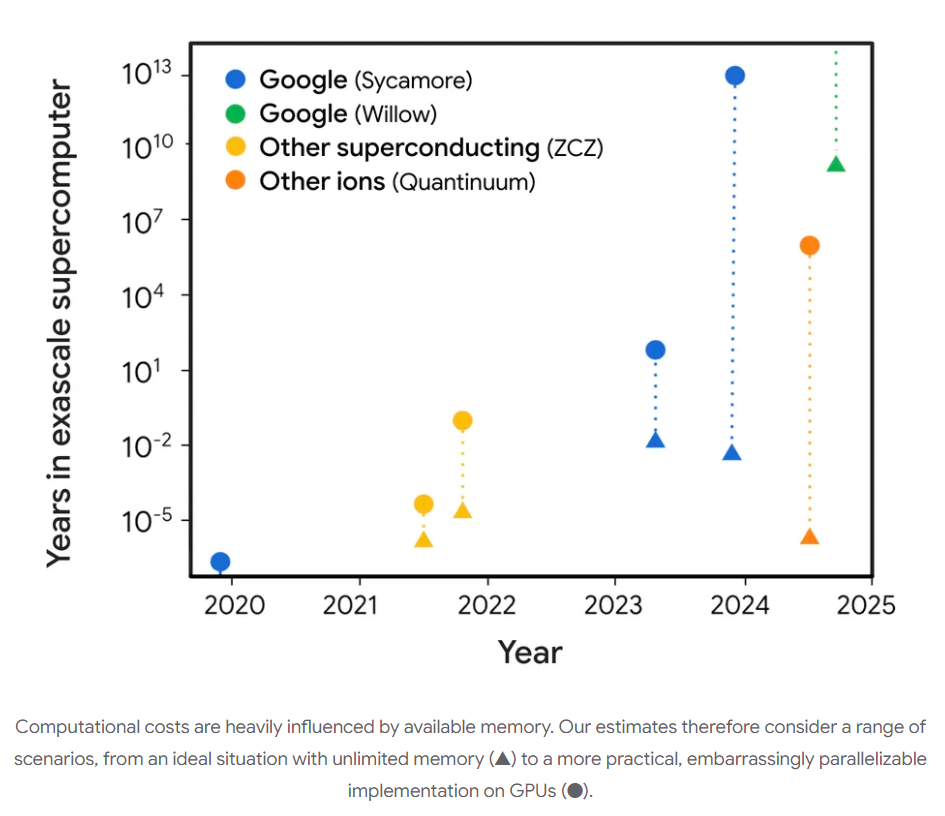
Willow’s latest results, shown in the plot below, are Google’s best so far. However, we will continue to make further progress.
Our assessment showing how Willow surpassed one of the world’s most powerful classical supercomputers, Frontier, is based on conservative assumptions. For example, we assumed that Frontier could fully use all secondary storage, like hard drives, without any bandwidth limitations—a generous and unrealistic assumption for the Frontier system.
Of course, just as we saw after the first “beyond-classical” announcement in 2019, we expect classical computers to continue improving on this benchmark. But the rapidly growing disparity shows that quantum processors are advancing at a doubly exponential rate, and as the number of qubits increases, they will pull even further ahead of classical computers.
References: https://blog.google/technology/research/google-willow-quantum-chip/










Leave a comment