


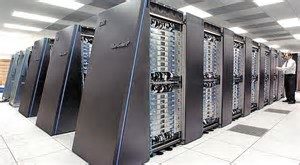
Most people have at least some idea about the power of supercomputers. So, let me write directly about one such system. Its name is “SUGAR” (Syracuse University Gravitational and Relativity Cluster). This supercomputer, built by the Physics Department of Syracuse University (SU) in New York, has the following configuration: 320 CPUs, 460 gigabytes of RAM, and 96 terabytes of hard disk space. According to a university press release published on February 18, they expect this computer to help identify sounds emitted from black holes. To verify this, SUGAR will soon collect all black hole-related data from LIGO (Laser Interferometer Gravitational-Wave Observatory), managed by Caltech and MIT. This data transfer will happen via optical fiber.
Now, let’s talk about exactly what they hope to identify with this system. Certain events in the universe generate mysterious gravitational waves. Examples include the explosion of two or more black holes, or extremely massive supernovae. However, such gravitational waves cannot be identified by ordinary means. Einstein predicted the existence of these kinds of gravitational waves as early as 1916, in his general theory of relativity. But it was many years before they were proven. Over time, every new proof of Einstein’s revolutionary theory has been significant, and gravitational waves are a remarkable addition. While there may be conflicts between quantum physics and this theory, general relativity has always proven effective in its own context. Thus, efforts are being made to unify the two, but more extensive research on general relativity is still needed. In this respect, the SUGAR computer will undoubtedly bring about a revolution. It will establish itself as a crucial component of the postmodern scientific revolution.
Only one task remains: establishing a connection between Syracuse and Caltech. To achieve this, data must cross the United States, since Syracuse is in New York on the Atlantic coast, while Caltech is in California on the Pacific coast. Soon, optical fiber will accomplish this job. For this purpose, Syracuse University has made an agreement with NYSERNet (New York State Education and Research Network). Accordingly, high-speed optical fiber capable of transferring data at a gigabyte per second will begin its journey from SU’s Physics Building. Then the path continues as follows: Physics Building -> University’s Machinery Hall -> a facility in downtown Syracuse -> NYSERNet’s fiber optic link -> New York City -> Internet2 high-speed network -> Caltech’s computer room. You can imagine that Syracuse will make full use of their 96 terabytes of space.

According to the university, the optical fiber connection will be completed within this February. After that, all that remains is to analyze and verify the data. If successful, people will be able to hear the sound of black holes. Many have already dubbed these the “cosmic symphony,” and according to Dr. Brown, one of the scientists there, “Gravitational waves can give us a much clearer understanding of what exists in the universe. … We’ve never really thought about Einstein’s theory from this perspective before.”









i wish i could b a part of that research project.
diner
http://www.dinerthegenious.tk