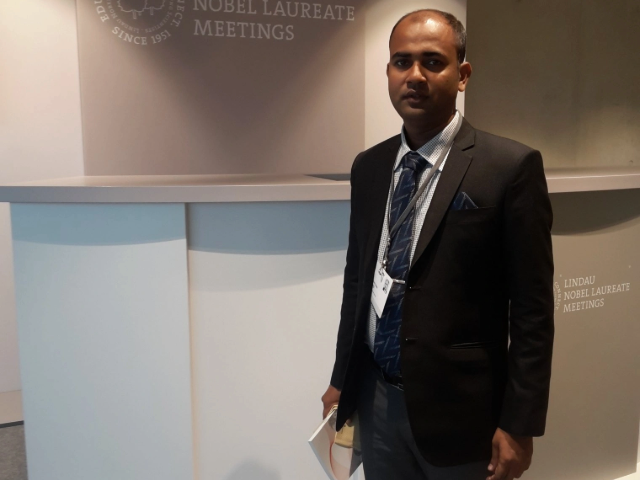
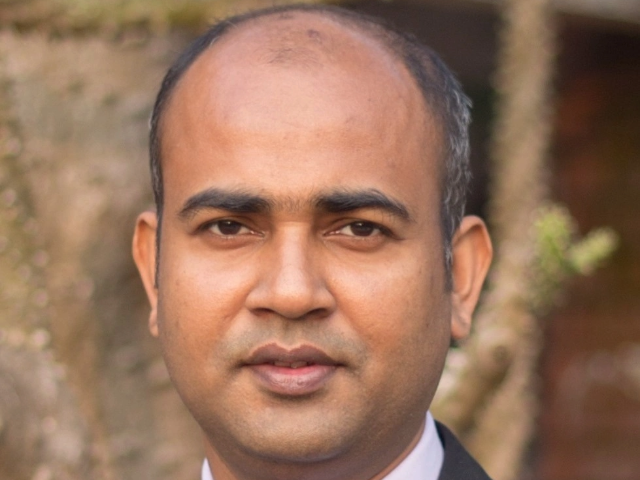
In our interview series with the younger generation, this time we interviewed Tanveer Islam Rajib. Tanveer Islam Rajib is currently pursuing a PhD in the Department of Physics and Astronomy at Texas A&M University. Read his interview:
First, we would like to know about you.
I am currently doing my PhD in the Department of Physics and Astronomy at Texas A&M University. I completed my Bachelor’s, Master’s, and MPhil from Jahangirnagar University. Later, in 2019, I joined the same department as a faculty member. At present, I am on study leave.
What is your research topic?
My research is in quantum optics. Simply put, this field studies the behavior of light, or photons, at a very small scale. Specifically, I am working with entangled photon interferometers, which are commonly known as Hong-Ou-Mandel (HOM) interferometers. Entangled photons are two light particles whose behaviors are so interconnected that the position and momentum of one are related to the other, even if they are far apart. This is an amazing feature of quantum mechanics (https://en.wikipedia.org/wiki/Hong%E2%80%93Ou%E2%80%93Mandel_effect).
In the HOM interferometer experiment, two beam splitters are used. The first beam splitter splits the photons into two separate paths. The second beam splitter brings the photons together again. After recombination, coincidence is measured using detectors, where we observe the Hong-Ou-Mandel dip based on the combined behavior of the photons. In this experiment, one of the generated photons (commonly called the “signal photon”) passes through a sample (for example, IR140 and IR806), while the other (called the “idler photon”) arrives after an extra delay process. The distinction between the signal and idler photon is important, as it helps characterize the nature of the signal photon. The smaller the difference, the greater the quantum feature of indistinguishability.
This experiment involves a nonlinear process and spontaneous parametric down-conversion (SPDC). In the SPDC process, when a high-energy photon (for example, 405 nm) passes through a nonlinear medium (special crystal), it is split into two lower-energy photons (810 nm). The photons produced this way form quantum correlations. In the Hong-Ou-Mandel experiment, the relative delay between photons during coincidence measurements plays a key role. When the signal and idler photons arrive together, they combine at the same detector, producing a dip that provides valuable insight into quantum properties and system behavior.
How do your research activities benefit us, or how might they do so in the future?
My experimental method demonstrates the effects of photon absorption, which will enable a better understanding of the optical properties of organic molecules. In the future, this method can be applied to more advanced research on nonlinear optical properties.
Would you share any special experience from your research work?
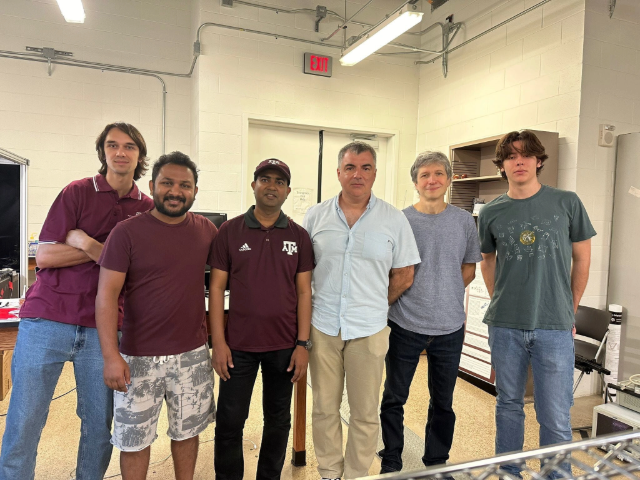
I transitioned from theoretical research to experimental research. Honestly, theory and experiment work differently. Due to optical losses, we never get 100% accurate results as you could in theory. Since single-photon experiments are extremely sensitive, especially regarding alignment, I have been fortunate to have good lab mates. They have helped me a lot from a fundamental perspective. I am still learning, and after finishing three side projects, I have now started my own project.
World-renowned scientists, especially Nobel laureates, often visit the Zheltikov Nonlinear Optics and Quantum Sensing Lab. Presenting my research to them is a unique experience.
What qualities do you think are necessary for a scientist?
Some important qualities for a scientist are: constructive thinking, creativity, perseverance, and integrity (most important). “The focus should be on the quality and impact of research rather than just the quantity.” These qualities help in research and encourage the creation of new ideas. I think students and young scientists should follow these traits.
Do you have any message or advice for young students in Bangladesh who want to pursue a career in science?
Run after your goals until you achieve them, and always stay curious.
Your Email : [email protected]
Your LinkedIn : https://www.linkedin.com/in/tanvir-islam-rajib-14609bb3/
Your website, research link: https://juniv.edu/teachers/tirajibphys
On behalf of Biggani.org, we wish Tanveer Islam Rajib continued success. He is a unique example for our young researchers.