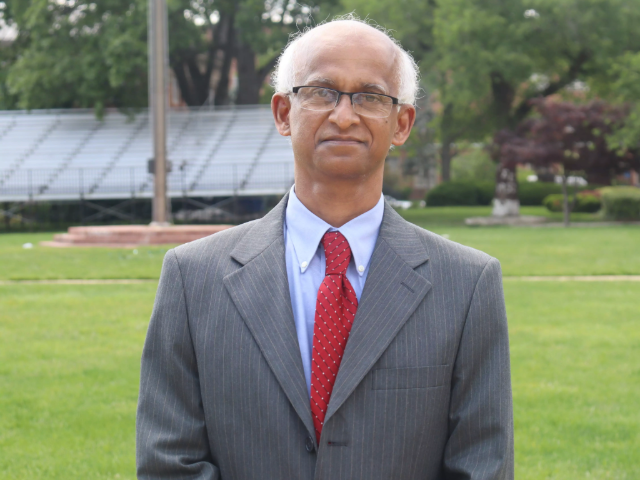
During his Ph.D. research (University of North Carolina, Chapel Hill), he studied a protein (G-protein) that is typically known in mammals but he worked on it in plants. By making modifications himself, he found that this protein family regulates environmental stress resistance in crops. For a more detailed discussion, read his interview.
First, we would like to know about you?
I have been working as a professor in the Department of Biology at Howard University, Washington DC for over 20 years.
What is your research focus?
During my Ph.D. research (University of North Carolina, Chapel Hill), I studied a protein (G-protein) that is commonly known in mammals but I worked on it in plants. By introducing genetic modifications, we found that this protein family regulates crops’ environmental stress resistance.
After starting my own laboratory at Howard University, I worked on a gene called RACK1, which behaved similarly to G-proteins. When we removed this gene from the model plant Arabidopsis, we observed that the plants became tolerant to drought and salt. Seeing this, I decided to develop chemical compounds (drugs for plants) that could inhibit the function of the RACK1 protein. This helps to avoid the need for creating GMO plants.
We developed the crystal structure of the RACK1 protein, which was published on the cover of the journal Protein Science by Cold Spring Harbor Lab. Through research, we found that a specific amino acid (Y248) in this protein is extremely important for its function. Therefore, we searched for chemicals that could target this specific part to inhibit the activity of the RACK1 protein. Currently, these chemical compounds are being tested in various crops and laboratories, helping to increase crop growth and environmental resilience without the need for GMO plants.
Since the RACK1 protein is common to all living organisms (from yeast to humans), we are also applying it to inhibit cancer cell proliferation and virus resistance. Several studies and patents on these subjects have been published from our laboratory.
During the coronavirus pandemic, we invented two new technologies to aid in virus detection and prevention. There are two separate patents and publications on these. One technology has discovered a novel method of virus prevention by targeting the virus’s “negative RNA strand.” Another technology uses CRISPR to create a testing method that can distinguish between rapidly replicating live viruses and dead viruses.
You can find details of all my publications and patents here:
How do your research works benefit us, or will benefit us?
Our RACK1 inhibitors are being used in three sectors: to produce salt/drought-tolerant crops, to stop cancer cell proliferation, and to inhibit human pathogenic viruses. On the other hand, the coronavirus-related technologies have opened new horizons for virus prevention and detection.
Can you share any special research experience with us?
I came to the United States to pursue a Ph.D. in Economics (after an MBA from IBA and an MA in Japan). However, the American education system gave me the opportunity to research G-proteins, which sparked my interest while studying economics.
What qualities do you think a scientist should have?
I don’t want to give advice. Every individual is special in their own way.
Your email: [email protected]
Your LinkedIn: https://x.com/biologists1
Your website and research link: https://biology.howard.edu/research/laboratories/ullah-laboratory
It is truly admirable to thank and congratulate Hemayet Ullah for his remarkable work. He has made significant contributions to plant, cancer, and virus research through his innovative efforts. His initiatives and innovations have boosted plant environmental stress resistance, as well as contributed greatly to the fight against the pandemic by inventing new technologies during the coronavirus outbreak.
Hemayet Ullah, sincere congratulations on your research and best wishes for success in all your future endeavors.
From Cancer to Coronavirus: Hemayet Ullah Story of Scientific Invention!
First, we want to know about you?
Working as Professor, Biology Department, Howard University, Washington DC for more than 20 years.
What is your research topic?
During my Ph.D. studies at the University of North Carolina- Chapel Hill, I studied a widely known mammalian protein (G-protein) in plants. We mutated the gene and found that many environmental stress resistance responses in crop plants are regulated by this protein family. So, when I started my own lab at Howard University, I used a gene named RACK1 which was, at that time, known as similar to the G-protein. When we knocked out (deleted) the gene from the model plant Arabidopsis, surprisingly, the mutated plants became drought/salt stress resistant. So, I decided to develop some small chemical compounds (as a drug for plants) that would be able to inhibit the function of RACK1 protein (like the gene deleted plants). Small chemical inhibitor compounds would circumvent the need for a GMO plant. To do that, we developed the crystal structure of the RACK1 protein and it was published on the cover page of an esteemed journal- Protein Science published by Cold Spring Harbor Lab. Based on my lab’s mutagenesis studies, we knew that a particular residue on this protein is very essential for its function, therefore, we decided to isolate the chemical inhibitors by targeting that residue (amino acid Y248), so that application of the compounds would bind to that residue and inhibit the function of the RACK1 protein. We approached the Georgetown University Cancer Center to screen library of small compound to find small compounds that will be able to fit to our crystal structure’s Y248 pocket. They helped us to find dozens of such binders to the Y248 pocket. Now these compounds are being tested on diverse crops in many different labs/commercial company. This allows us to use the compounds as like fertilizer without making GMO plants (mutating RACK1 gene). Recently we obtained the patent from the USA patent office.
As the RACK1 protein is widely conserved (similar) in ALL organisms (from yeast to human), now we are using the compounds in many human diseases regulated by RACK1 like in Cancer cell migration/metastasis (published/patented) and in the inhibition of pathogenic virus replications (published/patented). All the publications and patents can be seen in these websites:
https://scholar.google.com/scholar?hl=en&as_sdt=0%2C21&q=hemayet+ullah&btnG=
https://patents.google.com/?inventor=Hemayet+Ullah&oq=Hemayet+Ullah
Teaching Coronavirus biology during the pandemic also led my lab to develop two different technologies to aid/mitigate the burden of the pandemic. Two different publications and two separate patents on these technologies have been done. And we are in active discussion with a commercial company for licensing our patents. In short, I proposed early in 2020 (patented the idea!!!) that the coronavirus is a positive RNA virus and it requires a negative RNA strand to complete its life cycle. And during the negative RNA depended life-cycle, it generate a unique tag on its one end of the negative strand which is absolutely needed for their replication but that tag is absent from human RNA. Therefore, targeting that tag would inhibit the virus from replicating and targeting the tag will be virus specific, so host(human) cell will not be affected and virus will not be able escape the inhibition by developing mutation (variant development proof technology). Please see the publication :
https://www.biorxiv.org/content/10.1101/2022.03.04.483076v1
Another good thing about the negative RNA strand of coronavirus is that the virus only produce the negative strand ONLY when it is replicating. So I proposed that detecting the negative strand will be able to tell whether somebody is infected with actively dividing viruses (replicating). Sometimes, current market tests give you false positive from residual/dead/remnant/broken down viruses. There are no tests available to detect the negative strands. So we used CRISPR to develop the test strips that can distinguish rapidly dividing viruses from non-replicating viruses.
https://www.biorxiv.org/content/10.1101/2024.07.18.604218v1
How is your research benefiting us, or how will it benefit us?
Our RACK1 inhibitors are now being used in three different sectors- allowing crops to survive saline/drought conditions, prevent cancer cell migration, and inhibiting human pathogenic viruses. On the other hand, the two coronavirus related technology have far reaching utilities as there many pathogenic viruses replicate using negative RNA strand and all can be targeted using our patented technologies.
Do you have any special research experiences you would like to share with us?
I hate to preach. Every person is unique…..
What is your message for young students in Bangladesh who want to work in science?
What qualities do you think a scientist should have?
It is truly commendable to thank and congratulate Hemayet Ullah for her extraordinary work. She has made significant contributions to plant, cancer and virus research through her research. Her efforts and innovations have contributed to combating the pandemic by developing new technologies, such as increasing the resistance of plants to environmental stress, during the Corona pandemic.
Hemayet Ullah, my sincere congratulations on your research and wish you success in all your future endeavors.