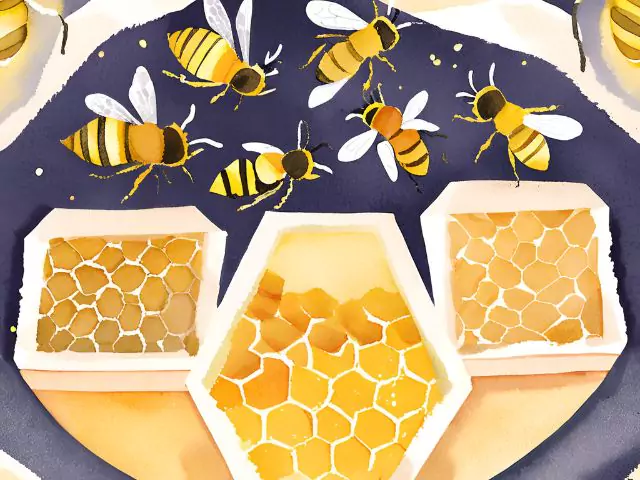
In the tiny chambers of the hive, bees tirelessly work day after day to create a remarkable and sweet substance—honey. Throughout the ages, people have valued honey not only as a delicious food but also as a unique source of nutrition, medicinal properties, and spiritual significance. Honey is not just unmatched in taste; it boasts lasting preservability, remarkable health benefits, historic importance, scientific qualities, and fascinating chemistry. That’s why honey is seen as one of the Creator’s rare gifts. In this article, honey’s historical significance, chemical features, scientific analysis, medicinal uses, economic impact, and some fun facts will be presented comprehensively. Through this 2000-word exploration, we will strive to understand honey from every perspective.
The Origin of Honey & The Tireless Labor of Bees!
The story of honey begins with floral nectar. Various bee species—especially Apis mellifera—collect nectar from flowers. This nectar undergoes chemical changes through specific enzymes present in the bee’s body. The enzyme invertase, in the bee’s gut, breaks down the sugar into glucose and fructose, which are then stored in small cells within the hive. Next, by fluttering their wings to create a gentle breeze, the bees remove excess moisture from the honey, transforming it into a thick, sticky substance. As a result, honey ends up with an average moisture content of 17-18% or less, making it suitable for long-term storage.
Historical and Cultural Context:
Honey has been intertwined with human civilization since ancient times. Thousands of years ago, in the Paleolithic era, cave paintings depicted bees and honey. In ancient Egypt, honey was considered divine nectar; there are accounts of honey preserved deep within pyramids remaining unspoiled after thousands of years. In Greek and Roman civilizations, honey was offered to the gods, while both Ayurveda and ancient Chinese medicine maintain traditions of using honey that continue to this day. In ancient India, honey was a sacred element; it was offered in worship to Vishnu and Krishna. Honey’s use and significance can be found in almost every religion and culture across the globe.
A Special Blessing from the Creator:
Among the Creator’s countless gifts, honey stands out as a unique one. Honey is cherished not only as food but also as a natural preservative, a source of advanced nutrition and medicinal elements, and a substance with deep spiritual meaning. Various religious texts and folk beliefs praise honey—at the core is its exceptional quality and permanence.
Nutritional Value and Ingredient Analysis of Honey:
Honey is rich in carbohydrates: more than 75-80% sugars (with glucose and fructose together making up about 85%). It also contains protein, amino acids, various minerals (potassium, calcium, magnesium, iron), small amounts of vitamins (B2, B3, B5, B6, C), enzymes, antioxidants (phenolic compounds), and a trace of organic acids.
For example, 100 grams of honey contains on average about 304 calories. This energy mainly comes from easily digestible carbohydrates, which help quickly deliver energy to the human body. Studies show that the antioxidants in honey may reduce the risk of heart disease, and there is evidence of honey’s use for sore throat and mild colds/coughs.
The Scientific Explanation for Honey’s Eternal Shelf Life:
People often believe that honey never spoils. It’s a true marvel of nature! There are several scientific reasons behind this extraordinary longevity:
- Low Moisture: Honey typically contains less than 18% water. This low-moisture environment hinders the growth of microorganisms.
- High Sugar Content: The high amount of sugar in honey is not ideal for microorganisms. Sugar draws water out of microbial cells, restricting their growth.
- Acidic Nature: Honey’s pH usually ranges from 3.2 to 4.5, making it quite acidic. Most microbes require a neutral or slightly alkaline environment to survive. They cannot thrive in an acidic setting.
- Natural Preservative Enzymes: The invertase enzyme produced in bees’ guts generates hydrogen peroxide in honey. Hydrogen peroxide acts as an antiseptic, limiting the growth of bacteria and fungi.
Combining these four factors makes honey naturally one of the world’s most lasting foods. In 2015, honey thousands of years old found in Egyptian pyramids was reportedly still edible. This unique durability makes honey not just a food, but a true time capsule.
Global Honey Production & Economic Significance:
Honey is produced on almost every continent. According to FAO reports, about 1.9 to 2 million tons of honey are produced globally each year. Top producer countries include China, Turkey, Iran, the United States, Ukraine, Argentina, and Russia. China alone produces about 300,000 to 400,000 tons, accounting for a significant share of the global market.
In Bangladesh, honey production has also become an important sector. Honey collected from the Mawya and Khalisha flowers of the Sundarbans is renowned. The country is known to produce about 3,000–5,000 tons of honey annually. Both local beekeeping and forest-based honey collection are economically significant.
A large industry has developed around honey—beekeeping, processing, bottling, packaging, and export—all together provide livelihoods for many people. Worldwide, the annual market value of honey is in the billions of dollars. In the United States alone, the retail value of honey almost reaches $600–700 million each year. There is also strong demand for organic and premium-grade honey in European countries.
Types and Flavors of Honey:
The taste, color, and density of honey depend on the floral sources from which bees collect nectar. For example:
Eucalyptus Honey: Light brown color, a mild menthol-like flavor.
Orange Blossom Honey: Light in color, fragrant with a gentle citrus flavor.
Buckwheat Honey: Dark and dense, with a strong flavor.
Sundarbans Honey: A mixed fragrance with a touch of salinity, quite unique and exquisite.
Manuka Honey (New Zealand): Famous for its high methylglyoxal (MGO) content and strong antibacterial properties. This honey is even used in surgical dressings.
Each year, hundreds of varieties of honey are produced worldwide depending on the species of flowers visited. Each honey has its own flavor, aroma, and characteristics, offering consumers a diverse experience.
Health Benefits and Medicinal Uses:
Medicinal use of honey has been known since ancient times. In Ayurveda, Unani, and traditional Chinese medicine, honey was used as a remedy for many ailments. Modern research has also confirmed some of honey’s benefits:
- Relief from Sore Throat and Cough: Mixing honey and lemon in warm water soothes sore throats and alleviates dry coughs.
- Wound Healing: Due to its antibacterial properties, Manuka honey applied to wounds can help reduce infections.
- Improving Digestion: Drinking warm water with honey and lemon in the morning is believed to enhance digestive power.
- Antioxidant Properties: Honey’s antioxidants may help reduce the risks of heart disease, some cancers, and cellular damage.
- As a Natural Sweetener: Using honey instead of refined sugar may have some health advantages, though the calorie content is similar. The trace amounts of minerals and vitamins in honey set it apart from sugar.
Research shows that naturally collected honey contains more than 180 beneficial elements. According to the American Journal of Clinical Nutrition, a study found that a tablespoon of honey worked better than cough syrup in easing night-time coughs in children. Another study published in 2010 stated that honey can help relieve certain digestive problems (such as gastric ulcers, acidity).
Honey in Beauty and Skincare:
Honey’s value isn’t limited to food; it is highly prized in the beauty industry as well. Legend has it that Cleopatra, Queen of ancient Egypt, maintained her beauty with milk and honey baths. Honey’s antibacterial, anti-inflammatory, and moisturizing qualities make skin bright and smooth. Today, honey is widely used in face masks, scrubs, and hair packs. Many honey-based cosmetics—such as honey soap, honey shampoo, honey face cream, and more—are widely available on the market.
The Use of Honey in Food
Globally, honey is used in countless ways in food preparation. Some interesting examples:
Middle Eastern and Indian Sweets: Honey is commonly used in desserts like Baklava, Jalebi, and Rasgulla.
European Pastries and Cakes: Honey cake, gingerbread, and more.
Salad Dressing: Honey mustard and honey-balsamic vinegar dressings give salads a unique taste.
Grill and Barbecue Sauces: Honey marinades produce excellent caramelized coatings on meat.
Tea and Beverages: Honey is increasingly popular as a sugar substitute, especially among the health-conscious.
Honey Storage and Purity Testing:
Although honey is naturally long-lasting, improper storage can reduce its quality. Honey should be kept in a cool, dry, and dark place. When stored in an airtight container, honey can remain unspoiled for decades.
However, there have been questions about the purity of commercially sold honey. Some unscrupulous sellers mix sugar or corn syrup with honey. A few simple tests to determine honey’s purity include:
Water Test:
Drop a spoonful of honey into a glass of water. Pure honey will settle at the bottom slowly, while adulterated honey will dissolve easily in water.
Fire Test:
Dip a cotton swab in honey and set it on fire. Pure honey will burn easily because of its low moisture content. Adulterated honey, with higher moisture, will not catch fire as readily.
Additionally, advanced laboratories use chemical analyses to determine honey’s purity. International quality control organizations and local food regulators have set various standards to ensure honey’s quality.
Bees and Ecological Balance:
Bees and honey play a critical role not just for humans, but for ecological balance. About 80% of the world’s crops are pollinated by bees. The production of fruits, flowers, and vegetables all partially depend on bee pollination. Without bees, agriculture could collapse.
History shows that regions with higher bee density have greater crop yields. According to one statistic, bees and other pollinating insects contribute hundreds of billions of dollars to the global agricultural sector every year. Thus, a decline in bee populations poses a serious risk to humankind.
Honey and Modern Science:
Over the past decades, extensive research has been conducted on honey. In particular, studies have focused on Manuka honey’s antibacterial powers, its use as an alternative sweetener for diabetics, and its potential in cancer treatment—ongoing topics of research. Some studies suggest that regular, moderate consumption of honey may improve digestion, offer anti-inflammatory benefits, and even support mental health (although such claims have not yet received complete scientific endorsement).
The quality of honey depends on floral source, bee species, geographical location, season, and more. The antioxidant and polyphenol content in different types of honey can vary greatly. Therefore, scientists are viewing honey not just as a single product, but as distinct “functional foods” with diverse qualities.
Some Fun Facts About Honey:
- Raw Honey Foam: Sometimes, a white foam appears in raw honey. This is mainly air bubbles and glucose crystals—completely normal.
- Making 1 Pound of Honey: About 55,000 bees visit around two million flowers in their lifetimes to produce just 1 pound (about 453 grams) of honey.
- What is honey called in Arabic? In Arabic, honey is called ‘Asal’. Honey is known by different names in countless languages, reflecting its cultural significance.
- Crystallized Honey Doesn’t Mean Fake: Depending on the balance of glucose and fructose, honey may crystallize. This is a natural process, and it is quite common for pure honey to crystallize. By placing the jar in warm water, the honey turns liquid again.
- Honey’s Shelf Life is Virtually Infinite: Archaeologists have found 3,000-year-old honey in Egyptian pyramids that was still edible.
- Honey in Industry: Besides cosmetics, honey is used in industries like leather processing, natural dye making, and even in some medicinal products.
- Origin of the word “Honeymoon”: Many believe that the English word “honeymoon” comes from an ancient tradition where newlyweds consumed honey and honey wine (mead) for one lunar month after marriage to ensure a sweet marital bond.
The Future and Sustainability of Honey:
The declining bee populations in many regions of the world have alarmed environmentalists. The use of pesticides, climate change, habitat destruction—all pose threats to pollinators. This could decrease honey production and affect agricultural systems negatively. Sustainable beekeeping, organic practices, forest conservation, and limiting pesticide use—these efforts are essential.
Already, organizations like ‘Bee Informed Partnership’ and ‘Pollinator Partnership’ are working for bee welfare. The Food and Agriculture Organization (FAO) of the United Nations has undertaken special initiatives for pollinator conservation. By saving bees, we can also safeguard our beloved honey in the future.
Conclusion
Honey is a wondrous natural substance and a symbol of the close bond between nature and humanity. As a special blessing from the Creator, honey has enriched human civilization for centuries with nutrition, taste, health benefits, and spiritual contemplation. Because of the diversity of flowers and geographical conditions, honey’s flavors and aromas are virtually infinite. With its remarkable shelf life, antibacterial properties, wound-healing ability, nourishing compounds, and unique taste, honey has become an unparalleled food.
The untiring labor of bees lies behind honey, playing a central role in maintaining environmental balance. Honey’s major role in the world economy is evident from the global statistics on its production and export. From skincare to culinary arts, medicinal applications to religious rituals—honey’s presence and significance are undeniable in every domain.
Looking ahead, to ensure sustainable production of bees and honey, protecting our environment and developing integrated agricultural strategies is crucial. Honey is not just food—it is living history, a treasure embodying nature’s wonders, the Creator’s gift, and an invaluable part of human civilization’s progress. In this 2000-word journey, we attempted to see honey in a new light—a natural nectar, unblemished and essential through the flow of time.