Looking up at the night sky in wonder, Niloy thought, “How strange this universe is! Beyond our tiny Earth lies a vast expanse of stars, galaxies, nebulae—how little we truly know about any of it.”
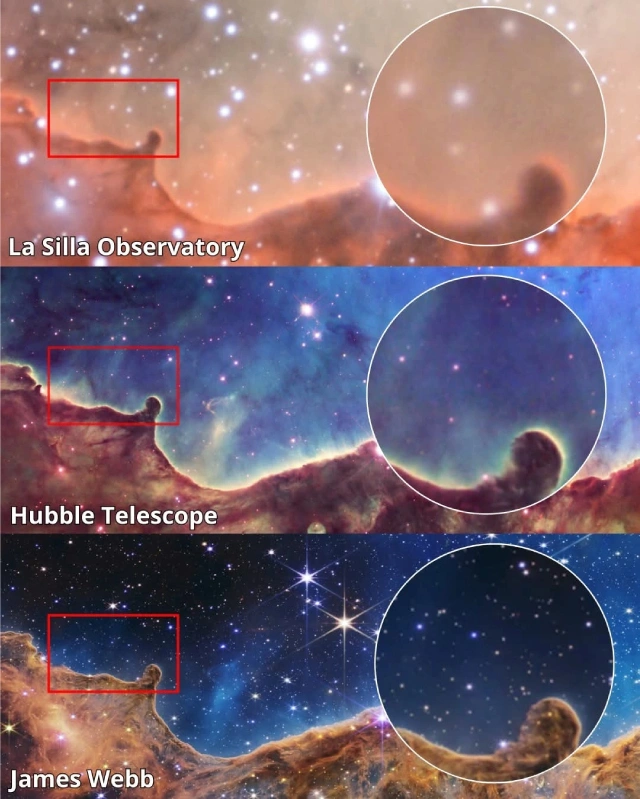
He is a science enthusiast with a deep passion for astronomy. Recently, he saw three different images of the Carina Nebula, each captured using different technologies—one from Earth, and two from space. Seeing the differences between the images, Niloy wondered, “It’s the same object, but why does it look so different?”
So let’s analyze these three extraordinary images of the nebula together and see how technological advances are helping us unlock the secrets of our universe.
Stage One: La Silla Observatory – Space Through the Eyes of Earth
Chile’s skies are among the world’s clearest night skies. Located there is the La Silla Observatory, a powerful ground-based telescope facility operated by the European Southern Observatory (ESO).
When Niloy saw the Carina Nebula imaged by this telescope, he realized that while the image was beautiful, it had many limitations.
📌 Statistics:
- The Earth’s atmosphere distorts the light from space, making ground-based telescope images blurry.
- The mirror of the La Silla telescope is 3.6 meters in diameter—large, but not comparable to space-based telescopes.
- There are currently over 10,000 ground-based telescopes globally, but all of them are always limited by weather and the atmosphere.
But what if we could capture images from space itself?
Stage Two: Hubble Space Telescope – A Window into Space
In 1990, NASA and the European Space Agency (ESA) jointly launched the Hubble Space Telescope (HST), which observes space from outside the Earth’s atmosphere.
When Niloy saw the Carina Nebula image taken by Hubble, he was astounded! Here you can see countless stars being born; epic columns of gas and dust (Pillars of Creation) create a cosmic drama in space.
📌 Statistics:
- The Hubble telescope is 5.4 meters long, orbiting 547 kilometers above Earth.
- Hubble mainly uses ultraviolet (UV) and optical wavelengths, producing highly detailed images of gaseous nebulae.
- Over more than 30 years, Hubble has taken over 1.5 million images!
Yet Niloy wondered, “If Hubble can take such amazing images, what could an even more powerful telescope achieve?”
Stage Three: James Webb Space Telescope (JWST) – Unveiling the Universe’s Invisible Curtain
In December 2021, the James Webb Space Telescope (JWST) was launched, the most powerful space observatory humanity has ever built.
When Niloy saw JWST’s image of the Carina Nebula, known as “Cosmic Cliffs”, he was left breathless! Compared to Hubble, the dust appears far less prominent, and the star-forming regions are revealed in much greater clarity.
📌 Statistics:
- JWST’s mirror is 6.5 meters in diameter—2.7 times larger than Hubble’s!
- It uses infrared technology, allowing it to see through dust and observe much deeper.
- It is located 1.5 million kilometers from Earth at the Lagrange Point (L2).
- JWST can analyze light sources that are 13.5 billion years old!
Why is JWST so advanced?
1️⃣ Infrared Technology:
- Where Hubble is blocked by nebular dust, JWST can peer through and show us star birth in action.
2️⃣ Massive Mirror:
- Bigger mirrors collect more light, making it possible to see fainter and more distant objects.
3️⃣ Operates at extremely low temperatures:
- JWST’s optical system is maintained at -233°C, so there is no interference in infrared observation.
What we find when comparing the three images:
| Feature | La Silla (Ground-Based) | Hubble (Space-Based) | JWST (Most Advanced) |
|---|---|---|---|
| Image Clarity | Moderate (limited by atmosphere) | Bright & detailed | Extremely clear, can see through dust |
| Light Wavelength | Visible | Ultraviolet & visible | Infrared (can penetrate dust) |
| Mirror Diameter | 3.6 meters | 2.4 meters | 6.5 meters |
| Environmental Limitations | Clouds, weather, pollution | No atmosphere, clear images | Most detailed long-wavelength observation |
Final Thoughts: Where is the Future Heading?
Niloy realized that in just a few decades, we have revolutionized the way we view the universe. From ground-based telescopes to the most advanced space observatory, JWST, our journey has truly been incredible.
🚀 Will even larger telescopes come in the future?
- NASA is working on a new space telescope, dubbed the “Successor to Hubble”.
- The ESO is building the Extremely Large Telescope (ELT) with a 39-meter mirror!
Niloy wondered, “If today JWST can pierce the universe’s dark fog, how far will our technology go in the next 50 years?”
🌌 The journey of space exploration is far from over—it’s only just begun!