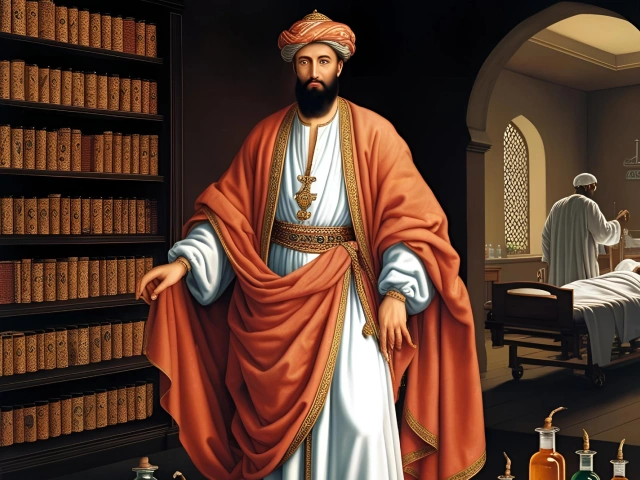
In the silence that blankets the depths of the night, the faint cry of an ailing child drifts from afar. That solitary weeping seems like a call for a compassionate healer—someone who will respond in a moment of need. It is said that many centuries ago, a man received such a spiritual call. He was none other than Abu Bakr Muhammad ibn Zakariya al-Razi—the brilliant figure of Muslim medicine, known in history simply as ‘Al-Razi’.
Childhood and Early Life
Born in the city of Rayy, Iran, Al-Razi (865–925 CE) was inquisitive from early childhood. From chemistry to philosophy—he had an insatiable curiosity for every subject. After completing his primary education in his hometown, he set out in pursuit of greater knowledge. It is said that even as a young man, he established his own laboratory, where he would spend long hours silently exploring the components of chemicals and medicines.
The Beginning of His Career
While residing in Baghdad, Al-Razi’s achievements spread far and wide. Step by step, he gained fame as an expert in medical science. He worked as a consultant and chief physician in numerous hospitals in Basra and Baghdad. One of his major contributions was laying the foundations of experimental, science-based practices in the field of medicine.
Modern medical professionals often mention his renowned manuscript “Al-Hawi” or “Kitab al-Hawi”, which is a vast compilation encompassing medical theory, diagnosis, and pharmaceutical knowledge.
The Major Contributions of Al-Razi
Historian Dr. Nasrul Islam says, “Al-Razi made invaluable contributions to the advancement of medical science, not only within Muslim societies but across the world. He often practiced ‘individualized treatment planning’ for patients, tailoring therapies based on their physical condition and lifestyle. Today, this approach is known as personalized medicine.”
At that time, distinguishing between smallpox and measles was a widely recognized achievement. Through clinical observation, Al-Razi realized that although both diseases spread malignantly, they exhibited distinct symptoms and neurological responses. This discovery brought a new dimension to medical science and paved the way for modern immunology.
Readers’ Reflections
Health-conscious citizen Fatima Alam remarked at an event, “We often hear the names of Greek or modern Western medical scientists. But there remains a lack of adequate discussion about Muslim scholars like Al-Razi. They are not just luminaries of Islamic civilization, but of the entire world.” Like Fatima, many believe that to bring Al-Razi’s name to the newer generations, there needs to be widespread promotion in curricula and the media alike.
Professor Dr. Ahsan Ali from the Department of Medicine at Dhaka Medical College said, “Al-Razi was truly a ‘physician-philosopher.’ The current generation employs many modern medical techniques, and if we trace their roots, we find that the theories and research of Al-Razi and his contemporaries laid the foundation. To honor their work, we must undertake further research and documentation.”
Contemporary Influence and Evaluation
In the annals of medical history, Al-Razi’s name shines as a symbol of knowledge, humanitarian service, and reasoned research. In his era, science was often seen as conflicting with religion, yet he consistently emphasized that true knowledge always advances the welfare of humanity. As a result, rational methods began to be employed in both diagnosis and treatment, which would later find even greater development during the Renaissance in the Western world.
Looking through the pages of history, despite the challenges and rigidities of society in his time, Al-Razi never stopped his research and experimentation. Applying science wholeheartedly for the benefit of humanity was his life’s devotion. It is through this commitment that his intellect and contributions continue to be recognized worldwide today.
Conclusion
Al-Razi’s life is not only a record of scientific and medical achievement, but also a story of profound love for humanity. His journey began by responding to the calls of the helpless in the darkness of night, and that commitment lasted a lifetime. Even today—in laboratories, at hospital bedsides, or within medical academies—his name is spoken with enduring reverence. The hope remains that his path and philosophy will become even more established within today’s healthcare systems.
As journalists, we strive to report facts and events objectively. We urge readers to learn about and share the remarkable life and invaluable contributions of scholars like Al-Razi with future generations.