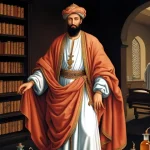
The light of dawn begins to spread, and with it, the words from the pages of ancient history start murmuring once again. On a sunlit day, in a classroom of Baghdad, conversations among newly gathered students buzzed with the complexities of mathematics. Among them, a young learner listened in awe and excitement to tales of how a legendary scientist—Al-Muhammad ibn Musa al-Khwarizmi—brought about a revolution in the world of numbers. At the mention of his name, questions ignite curiosity in many minds: Who was he, and what were his contributions?
The story begins in the 9th century, during the golden age of Islamic civilization at its peak.
Baghdad was, at the time, a sanctuary for knowledge and science. Under the patronage of the great Abbasid Caliph Al-Ma’mun, the ‘Bayt al-Hikmah’ (House of Wisdom) became the finest research center in the known world. It was there that Al-Khwarizmi began his revolutionary work. This inquisitive scholar did not stop with mathematical calculations or scientific pursuits alone; from astronomy to cartography, calendar science to the creation of maps—almost every field bears testament to his exemplary contributions.
“Al-Khwarizmi’s contributions should never be underestimated,”
said Professor Dr. Kazi Rashedul Haque, an eminent mathematician. At a seminar in Dhaka, he remarked, “Al-Khwarizmi taught us the correct use of zero. When he wrote his ‘Kitab al-Jabr wal-Muqabala’, we realized how vast an empire this would create in the realm of mathematics.”
His most famous book on mathematics
“Kitab al-Jabr wal-Muqabala” became a milestone for countless mathematicians. It is from here that the word ‘Algebra’ originates—a term still invaluable to students and researchers worldwide. The role of zero, algebraic explanation of mathematical equations—these advanced concepts began to take root globally thanks to Al-Khwarizmi.
Not only did he lay the modern foundations of mathematics,
Al-Khwarizmi also made significant contributions to astronomy, geography, and cartography. He brought together Greek, Indian, and Persian scientific texts, translated them into Arabic, and added his own analyses. His astronomical treatise ‘Zij al-Sindhind’ demonstrated precise mapping of celestial bodies, the movements of the Sun and Moon, and calendar calculations with minimal instruments. Many of these works later had a direct influence on European scientific research.
Rimi Sultana, a young researcher at the University of Dhaka, says,
“Whenever I study the use of zero and algebra, I am overwhelmed by Al-Khwarizmi’s contributions. He integrated calculation methods in such a way that they are still used today in the development of computer algorithms.”
This is where the word ‘Algorithm’ originates, derived from the Latin form of his name—‘Algorithmus’. Thus, this extraordinary scholar played an indirect but vital role in laying the foundation for modern computer science.
“The intellectual atmosphere that was created in Baghdad
enabled Al-Khwarizmi to take his research to the highest level,” said Professor Dr. Richard Francis of Oxford University (statement compiled from translation). “When a scientist uses existing knowledge to create new wisdom, that is how civilization advances. Al-Khwarizmi’s work was such a groundbreaking leap.”
The scientists of that golden age shed light upon the world through knowledge.
Their contributions not only enriched Muslim society but also played a crucial role in the future European Renaissance and the progress of science. Al-Khwarizmi was one of their chief architects. The formulas and ideas set out by him—like simplification, solving equations, ratios, and true mathematical reasoning—remain integral to our practical lives even in the twenty-first century.
Reviewing Al-Khwarizmi’s legacy, many historians state that
mathematical studies in medieval Europe were very limited. At the right moment, when Al-Khwarizmi’s texts were translated from Arabic to Latin, a new dynamism was infused into European mathematics during the Renaissance. The subsequent rise of world-renowned scientists and philosophers like Isaac Newton, Gottfried Leibniz, and Leonardo da Vinci was built upon foundations profoundly influenced by Al-Khwarizmi.
Standing in a local library in Dhaka, education enthusiast Tareq Mahmud shared,
“Today, we can easily learn various complex topics of mathematics. But if you want to understand the incredible achievements of our predecessors, reading the story of Al-Khwarizmi is enough. His life struggles, research, and creative initiatives still inspire us.”
Many who work in technology say that
the models, algorithms, and mathematical principles behind modern software development, robotics, or artificial intelligence are deeply rooted in Al-Khwarizmi’s thought. The trail of discoveries and innovations through the ages has followed the torch he lit.
Though this discussion may never end,
one thing is clear—Al-Khwarizmi was not just a Muslim scientist; he was a unique architect of human civilization. Today, from our everyday calculations to computer programming or the complex computations of astronomy—his methods are visible everywhere. “He is truly the Renaissance man of mathematics,” remarks history researcher Dr. Anisul Kabir. “We must always recognize the importance of such figures in building bridges from the past.”
In this grand journey of knowledge, Al-Khwarizmi’s name remains ever-vibrant.
He was a pioneer in developing the modern language and principles of mathematics, a trailblazer who opened new horizons in astronomy, and a lasting inspiration in intellectual pursuits. His unique example and creative path prove that with proper guidance, relentless research, and open-minded ideals, one can contribute not only to a community, but to all of humanity. The reach of this timeless scientist’s work and ideas once again proves that the flame of knowledge never extinguishes; rather, it burns on—motivating one generation after another to move forward.