Part One: Entering the Story
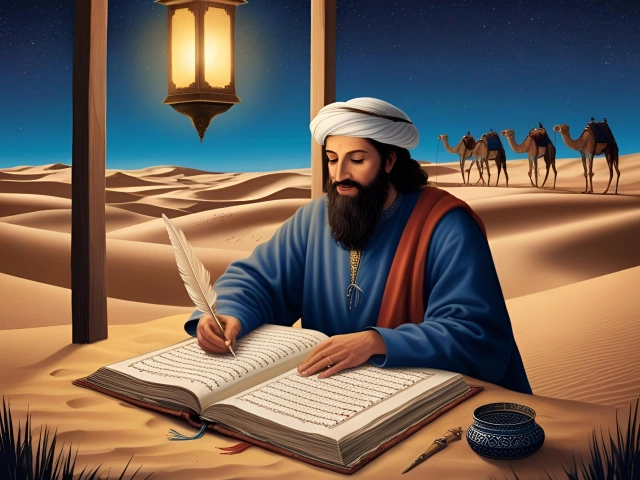
In the deep of night, when the endless silence of the desert was broken only by the sound of camels’ feet, he would sit beneath the gray lamp light—his eyes filled with dreams and his pen scripting history. His name was Ibn Khaldun. From Morocco’s silent desert to the bustling city life of Egypt, the journey of this extraordinary scholar was fueled by a thirst for knowledge and the effort to lay the foundation for Islamic thought. Carrying the memories of his tumultuous childhood days, he aspired to build a culture and civilization unlike anything conceived before. Wherever he set foot, intellectual brilliance illuminated the world of society, history, and economics.
Part Two: Historical Context and Analysis
Ibn Khaldun is often called the “Father of Social Science” and, to some, the “Pioneer of Modern Historians.” His famous work Al-Muqaddimah (“Al-Muqaddimah” or Muqaddimah) offers remarkable analysis on history, sociology, economics, and politics. There, he demonstrated how civilizations pass through cycles of rise and fall, driven by various social and economic factors.
Modern historian Arnold Toynbee once said, “Ibn Khaldun is one of the great men whose work remains the most powerful foundation of our historical studies to this day.” Through this statement, it is clear how Ibn Khaldun’s ideas have broken the boundaries of time and continue to be relevant today.
Distinguished Islamic scholar Dr. Mustafa Kamal says, “Ibn Khaldun not only enriched the intellectual heritage of the Muslim world, but that of all humanity. His theoretical framework still plays a leading role in explaining the deepest layers of society and politics.”
Part Three: Readers’ Opinions
Yesterday at a university in the capital, a seminar dedicated to Ibn Khaldun drew large attendance from students and general readers. One participant, Abdullah Hasan, a young researcher, told our correspondent, “By reading Ibn Khaldun’s works, I realized how, so early on, he was able to keenly analyze the intricacies of society. His concepts are still highly relevant to our current political and economic realities.”
Young sociologists say that Ibn Khaldun’s theories can shed new light on analyzing economic stability and social change in developing countries. In the words of a local analyst, “His perspectives align not only with the past but also remarkably with present-day realities. We can use his theories to identify problems within our own societies.”
Part Four: The Road Ahead and Its Importance
Ibn Khaldun’s thoughts and analyses are valuable in both Eastern and Western worlds. His scholarly works recurrently highlight social cohesion, economic prosperity, and morality—not just as core tenets of Islamic civilization, but as crucial practices for any society.
Analysts believe that in the context of current global crises, religious coexistence, and political conflicts, Ibn Khaldun’s historical perspective can offer many answers. If his theoretical frameworks are applied beyond textbooks and academic discussions into real life, bringing about the desired changes in society will become much easier.
Part Five: Conclusion
Ibn Khaldun’s life story is like an eternal light shining across the desert—where, amidst harsh adversity, the tale of human thought, research, and creativity was inscribed. Through an unprecedented fusion of historical perspective and social analysis, he established a new foundation of knowledge, which is not just an invaluable asset of Muslim civilization, but of all humanity. Even as eras pass, the light of this sage continues to inspire the minds of knowledge seekers with extraordinary vigor.
Like the footsteps of camels breaking the deep silence of the night, the echoes of his thinking still knock at our conscience. When we read history, seek to understand the processes of societal construction and collapse, or search for stability across the complex layers of economics—we are inevitably led back to Ibn Khaldun. Perhaps it is by remembering him that we will find the guiding principles for our path forward and for future progress.