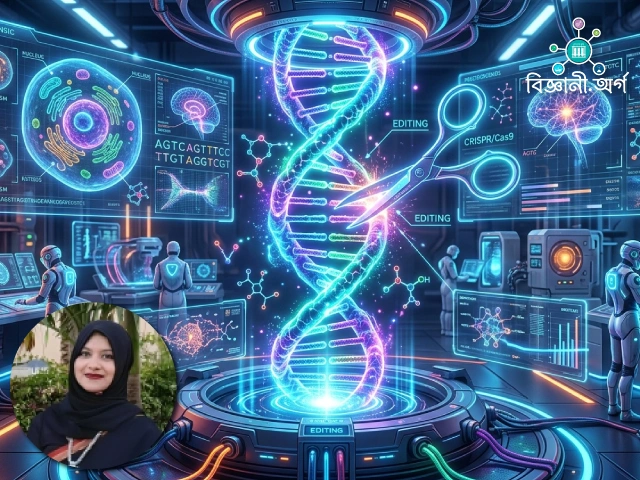
In an ordinary house in Uttara, Dhaka, lives Anika Rahman, a tenth-grade student who spends her days reading books about biology and genetics. Science is her passion, and genetics is her favorite subject. One day, while reading her biology textbook, she learns about the famous “double helix” structure of DNA—two strands twisted together like a spiral staircase. But recently, when she came across a scientific news article, she was astonished—DNA is not just a double helix; scientists have discovered an entirely new structure.
This structure is called the “i-motif”—a knotted, four-stranded DNA structure that naturally exists in human cells. This discovery challenges all our previous understanding about the complexity of DNA.
Unraveling a Longstanding Mystery:
This mysterious structure was first identified in the 1990s, but only under laboratory conditions. Recently, scientists from the Garvan Institute of Medical Research in Australia used a special antibody to observe this structure in human cells in real time.
Researcher Dr. Daniel Christ said:
“We have known for a long time that DNA is not just a double helix. But for the first time, we have seen the existence of the i-motif in living cells. This marks the beginning of a revolution.”
What is the i-motif?
We know that, in conventional DNA, cytosine (C) typically pairs with guanine (G) on the opposite strand. But in the i-motif, cytosine pairs with another cytosine on the same strand, forming a unique knotted, four-layered structure. These knots mostly occur in gene-regulatory areas and at telomere regions—which are directly linked to cellular aging.
Impact of the Research:
The presence of such structures suggests that DNA can change its shape to play roles in gene function and regulation. For instance, the i-motif forms at certain times and then unravels, indicating that it may act as a signal.
Renowned geneticist Dr. Mehedi Hasan says,
“These kinds of structures could open new avenues in our research on gene expression and cellular aging. Perhaps in the future, they will enable us to develop treatments for aging or targeted therapies for cancer.”
On the Threshold of New Possibilities:
In addition to the i-motif, scientists have also discovered an alternative DNA structure called the G-quadruplex. Research into these new structures is now progressing rapidly. Through these discoveries, not only DNA but the very nature of life itself may be understood at a deeper level.
The full details of this research have been published in the renowned scientific journal Nature Chemistry.
(You can read it here: https://www.nature.com/articles/s41557-018-0046-3)
Final Thoughts:
Science always opens new windows onto the world we thought we knew. The discovery of this new DNA structure, the i-motif, is a perfect example. Perhaps, in the days ahead, this mysterious knotted structure will unlock new horizons in medicine, anti-aging, and genetic technology.
This discovery is igniting excitement not only among researchers, but also among curious students of the new generation. Young people like Anika may become the scientists of the future who will open new paths to unraveling the hidden mysteries of life.