


Dr. Ripon Sikder,
Deputy Program Director (Seed), Partner, BADC, Dhaka
Email: [email protected]
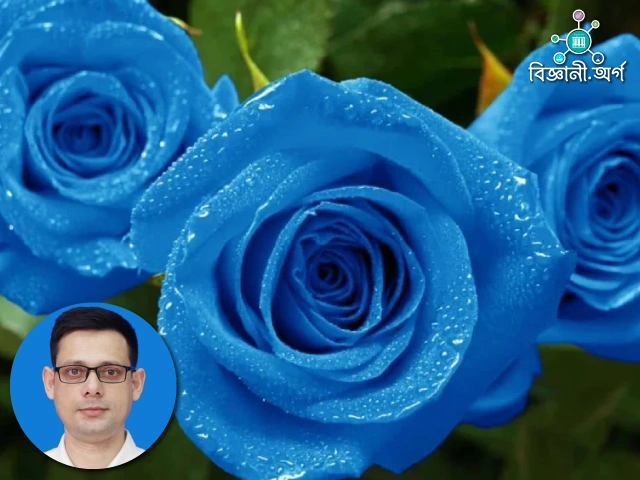
Flowers are synonymous with beauty, emotion, and an expression of aesthetics. For thousands of years, humans have strived to enhance the color, form, and fragrance of flowers. Through conventional hybridization and breeding methods, it has been possible to make red roses redder, white flowers more luminous, but some colors seemed perpetually elusive. Most notably, the blue rose was long regarded as a symbol of imagination.
With the advancement of biotechnology, that dream has now become a reality. How? Let’s explore the molecular mysteries behind flower colors.
The Science Behind Flower Colors
The coloration of flowers comes mainly from three types of pigments: flavonoids, carotenoids, and betalains. Of these, the most important is a class of flavonoids called anthocyanins. These compounds are what give flowers their red, pink, purple, or even blue hues.
The color of anthocyanins depends on their chemical structure. The three primary base compounds are:
- Pelargonidin—bright red
- Cyanidin—reddish-purple
- Delphinidin—blue or bluish-purple
Delphinidin is essential for blue coloration. The problem is, rose species naturally lack the biochemical pathway to produce delphinidin. That’s why blue roses remained unattainable despite centuries of breeding.
Genetic Engineering: The Key to Changing Colors
Scientists discovered that two crucial enzymes determine flower color: F3′H and F3′5′H. Among them, the F3′5′H enzyme plays a central role in producing delphinidin.
Since roses lack this enzyme, researchers isolated the F3′5′H gene from other plants, like petunia or pansy, and inserted it into roses. Additionally, they used RNAi technology to suppress certain competing enzymes within the rose, allowing the new pathway to function effectively.
This combined approach enabled roses to produce delphinidin, resulting in the birth of bluish roses.
In 2009, Japan saw the launch of the first commercial “blue” rose—Suntory Blue Rose “APPLAUSE™”. While the color isn’t truly sky blue, what conventional breeding had made impossible, biotechnology has now achieved.
The “Moon Series” Carnation: A Revolution in Flower Color
The technology for changing flower colors was actually first successful in carnations, before roses. Several carnation varieties under the “Moon Series” name, such as Moondust™, Moonshadow™, and Moonvista™, were highly successful in the global market.
In these flowers, delphinidin content can reach as high as 90-95%. The result is a bluish-purple tint never seen before. Millions of these transgenic flowers have been sold worldwide, with no negative effects reported on the environment or human health so far.
Not Just Genes—Many Factors Behind Color
The final color of a flower depends on more than just one pigment. Several other factors play key roles:
- Cell acidity (vacuolar pH)
- Metal ions such as Fe3⁺ or Mg²⁺
- Co-pigments
- Cell structure and light reflection
For example, a higher concentration of Fe²⁺ ions in some tulips makes them appear blue. In Japanese morning glories, changing cell pH during blooming transforms the color from purple to blue.
In essence, flower color results from a subtle interplay of chemical and cellular processes.
How Risky Is Gene Flow?
Many ask: are genetically modified flowers risky for the environment?
For carnations and roses, the risk is extremely low. Reasons include:
- Most commercial carnations do not produce seeds
- Double-layer petals make pollination difficult
- As cut flowers, there’s no chance for seed formation
- In some cases, transgenes are restricted to petal cells only
Field trials in various countries have also shown no significant environmental impact.
Future Prospects: Flowering On Demand
Research is now going beyond just color. Scientists are working on the FT (FLOWERING LOCUS T) gene, a part of the “florigen” hormone in plants. This gene controls when a plant will flower.
In the future, this technology may allow—
- Inducing flowering at specific times
- Producing flowers based on market demand
- Delaying flowering to increase crop yields
The Amazing Horizons of Flower Technology
Many other technologies are being developed centered on flowers. For example:
- Robotic flowers
- Drug delivery systems using pollen grains
- Bright color technologies based on nanostructures
Flowers have become not just symbols of aesthetics—they’re now inspiring innovation in engineering, medicine, and energy technology.
Conclusion: The Union of Science and Beauty
Changing the color of flowers was once only a dream for horticulturists. Today, it’s the real-world application of molecular biology, genetic engineering, and cellular chemistry.
Although blue roses may still not be quite as sky-colored as we imagine, their achievement proves that when the biochemical boundaries of nature are understood, new doors of possibility open.
In short, even beauty can take new form in the hands of science.






Your writing is truly commendable—it is not only informative but also intellectually mature.
One of its strongest aspects is how you begin with the romantic notion of beauty and gradually lead the reader into the depth of molecular biology without ever losing engagement. Complex scientific concepts such as anthocyanin, delphinidin, F3′5′H, and RNAi have been explained in a way that remains accessible even to general readers like me.
Thank you for presenting the molecular mystery behind flower colors in such a clear and captivating manner.