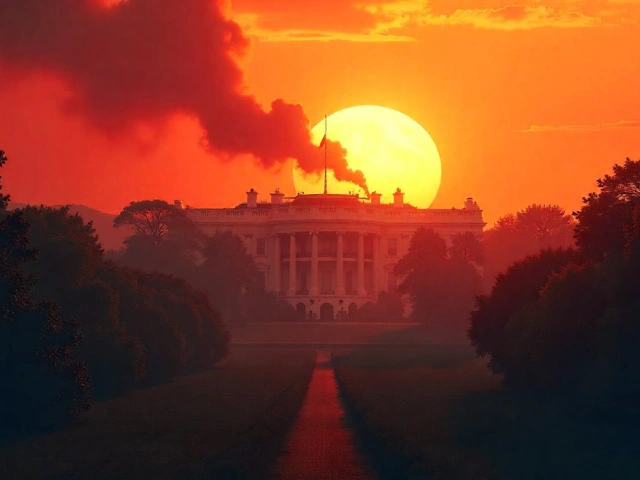
In 2024, the global level of carbon dioxide (CO₂) increased at the highest rate in history — 3.7 parts per million (ppm) in a year. The United States environmental monitoring agency NOAA confirmed this through data analysis. Yet, instead of publicly releasing such a major scientific finding, the Trump administration tried to quietly suppress the news.
NOAA typically publishes detailed reports and press releases about greenhouse gas data from the previous year every spring. But this year, they issued no press release; instead, the data was only shared in limited posts on Facebook and X (formerly Twitter). Even then, the most important fact — that the rate of CO₂ increase was higher than any year in the past — was not mentioned.
According to sources, NOAA staff had prepared a comprehensive web report as usual, but at the last minute, a decision was made not to publish it. The source reported this under condition of anonymity due to fears of the Trump administration.
Additionally, NOAA has already halted its regular monthly climate briefings, and there have been proposals to dismantle the agency’s research and climate programs. There was even a plan from the White House to shut down NOAA’s Oceanic and Atmospheric Research office entirely.
Analysts say that if this report had been properly publicized, it would have become major international climate news. The ‘Washington Post’ and ‘CNN’ have published some information, but there has been little coverage in mainstream media.
Is the Earth’s Natural Carbon Sink System Breaking Down?
Scientists are concerned that the Earth’s natural carbon sinks — such as forests and wetlands — may be steadily weakening. In the past, these natural systems absorbed excess CO₂ and helped mitigate the impact of climate change. But with continuing heat, droughts, and wildfires, they are being degraded and can now absorb less carbon.
Philippe Ciais, a climate scientist at France’s Pierre-Simon Laplace Institute, says:
“In my opinion, if the dry years continue in the future, this trend will only get worse.”
He and his colleagues have analyzed, in a recent (yet-to-be-peer-reviewed) study, that from mid-2023 to the first half of 2024 there was an increased trend of carbon emissions in the planet’s tropical regions. This decline was seen especially in the Amazon due to drought and wildfires.
Problems Beyond the El Niño Effect
Although the natural climate cycle El Niño played some role, it was not the only cause. This El Niño was also not as strong as previous major El Niños, and it ended in the first half of 2024. However, drought and wildfires in the tropics continued for the rest of the year.
As a result, scientists fear the Earth is facing a dangerous ‘feedback loop’:
Rising temperatures → natural carbon sinks are collapsing → excess CO₂ is being emitted → temperatures rise further.
Ciais warned:
“We can’t say everything is going to break down just from one year of data, but if this trend continues, the Earth may start warming even faster than scientists have previously predicted.”
Policy Delays, Worsening Situation
Notably, in 2024, emissions from fossil fuels also reached record highs. While this alone doesn’t explain the rise in CO₂, it’s clear the world is still not on track to meet the Paris climate agreement targets.
Ciais commented:
“Policymakers say we still have some time to achieve the 2-degree target. But these assumptions depend on the belief that the Earth will be able to absorb enough carbon. If that absorption capacity is lost, time will run out much more quickly.”
Related articles: