News Desk, Biggani.org
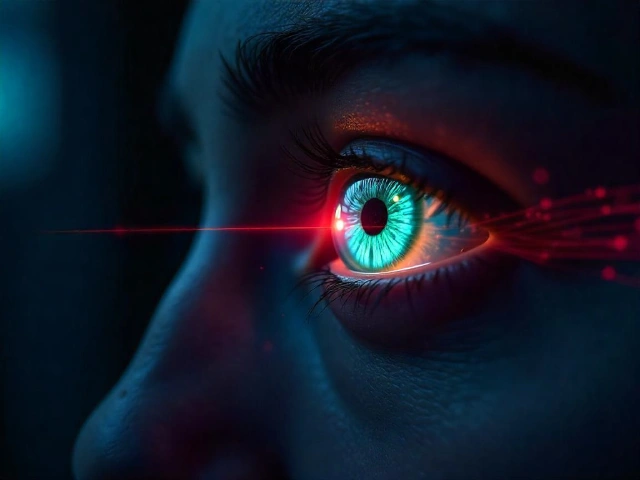
Even with your eyes closed, you can now see your surroundings! It sounds like a scene from a science fiction movie, but Chinese researchers have made this astonishing discovery a reality. Scientists at the University of Science and Technology of China (USTC) have developed a new type of contact lens that allows you to see in pitch darkness.
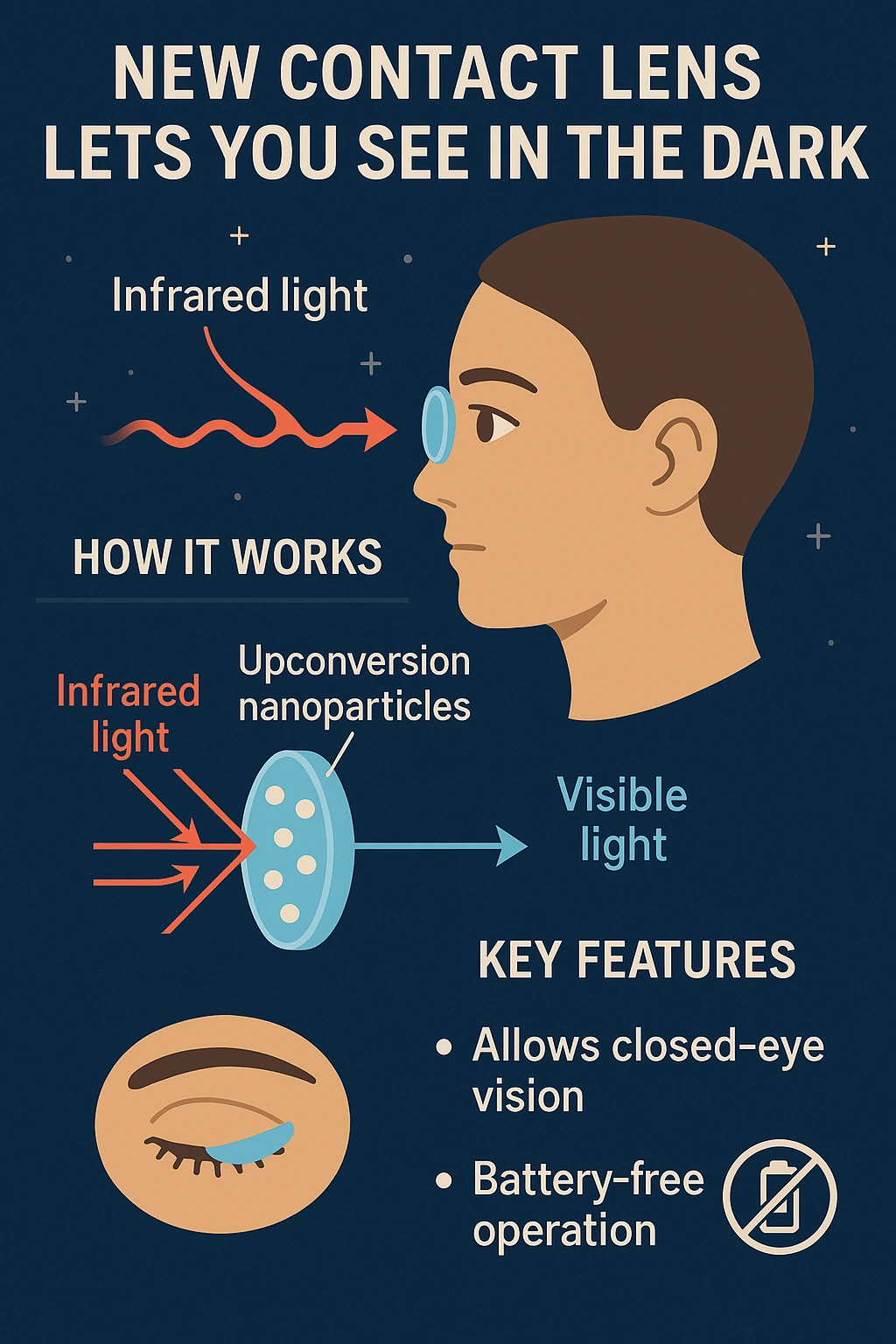
These contact lenses can detect ‘infrared light.’ Normally, the human eye can see light with wavelengths between 400 and 700 nanometers, which we call visible light. But infrared light ranges from 800 to 1600 nanometers—a spectrum that’s invisible to us.
How does this lens work?
The researchers have embedded tiny ‘upconversion nanoparticles’ into the lens. These particles contain two special metals—Ytterbium and Erbium. The particles absorb infrared light and convert it into visible light. As a result, when wearing these lenses, people can see normally invisible infrared light.
What’s even more fascinating is that infrared light can pass through eyelids. That means the contact lens can work even when your eyes are closed. This is being called “closed-eye vision”—the ability to detect infrared signals with your eyes shut.
How is this useful for students?
With this technology, students will be able to move safely at night. In the future, it could benefit police, fire service, and even healthcare professionals—especially those who need to work in the dark. Current night vision devices are heavy and bulky, but this lens is small and works without any batteries.
Some limitations
This lens is still in its early stages. Images may appear somewhat blurry due to light scattering, and a strong infrared light source (like LED) is needed. However, the scientists say they are working to improve its image clarity and sensitivity even further.
Technical terms explained simply:
- Infrared: A type of light that’s invisible to the eye, carries heat, and can be detected by sensors at night.
- Upconversion nanoparticles: Tiny particles that absorb one type of light (such as infrared) and emit another type (such as visible light).
- Ytterbium and Erbium: Special metals used to detect and convert infrared light.
This research not only marks a technological milestone but also opens new possibilities for safety and healthcare in human life.
Author: News Desk, Biggani.org
Contact: [email protected]