A new frontier in medical science is opening up inside the human body thanks to research at the University of Waterloo in Canada. Led by Dr. Veronica Magdan, a team of researchers has developed a tiny magnetic robot capable of dissolving kidney stones directly inside the urinary tract. This seems like a technology straight out of science fiction—no surgery, no long and painful treatments, just a silent little device working inside the body.
Kidney stones have been a long-standing torment for humanity. Millions of people worldwide suffer from this condition. In Bangladesh too, kidney stones are a growing public health issue. Dietary habits, lack of water consumption, lifestyle changes, and even genetics can make people prone to this disease. When stones get stuck in the urinary tract, the pain becomes unbearable and sometimes even life-threatening. Conventional treatments involve medications to thin the urine, painkillers, or surgical stone removal. But these solutions are often limited, risky, or expensive. That’s why doctors and researchers have long sought a minimally invasive, effective, and patient-friendly alternative.
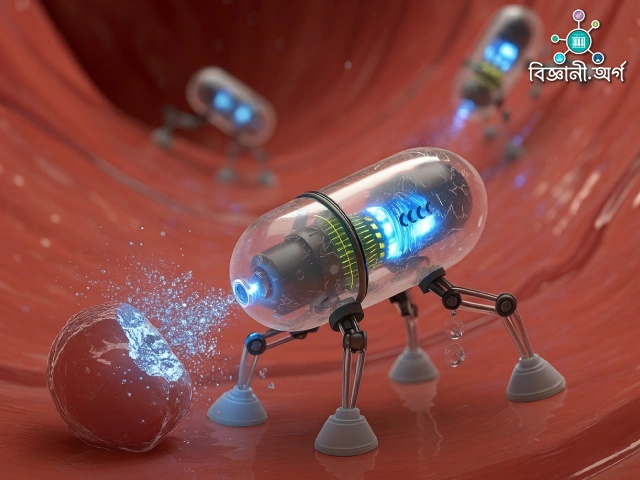
In this context, the innovation by Waterloo’s researchers arrives as a beacon of hope. Their robot is a tiny strip-like device only a centimeter long. It may look simple, but inside lies the future of medicine. It’s made from flexible materials called hydrogel and elastomer. Embedded within is a special enzyme called urease, along with a tiny magnet. This dual feature—biological enzyme and magnetic control—works together to break down kidney stones.
Doctors insert this robot into the patient’s bladder via a catheter. From outside, a robotic arm equipped with a rotating magnet is used to guide the robot. An external magnetic patch helps keep the robot steady at the targeted spot. Once it reaches the stone, its real job begins. The urease enzyme raises the pH of the urine by reducing its acidity, making the urine more alkaline. This causes uric acid-type kidney stones to slowly dissolve. Within a few days, large stones break into tiny pieces, which are then naturally expelled from the body.
Lab tests have shown that this robot can raise urine pH from 6 to 7 in just five days. As a result, the mass of the stones decreased by about 30%. Achieving such results in such a short time is an extraordinary accomplishment for medical science. Usually, large kidney stones require shock wave lithotripsy or surgery, both of which bring heavy costs, risks, and complications for the patient. But with this tiny robot, none of that is required.
The research doesn’t stop here. Scientists are now preparing to test the robot on larger animals. The goal is to see how well it works in real physiological conditions. At the same time, they’re improving its control systems to ensure the robot can be precisely positioned in real time using ultrasound. If all goes well, it could become routine hospital treatment in the next few years.
Robotic technology in medicine is not new. We’ve already seen robotic arms in surgery and the use of nanotechnology to target cancer cells. But using such tiny robots for complicated issues in sensitive organs like the kidney is undoubtedly a new chapter. It’s not just a new technology; it may well change the philosophy of medicine—making treatment less invasive, more precise, and vastly more comfortable for patients.
In countries like Bangladesh, such technology is even more significant. Advanced medical equipment is still lacking here, while kidney diseases remain relatively common. As this technology spreads across developed countries, perhaps one day we too will enjoy its benefits. Maybe someday, a doctor in a hospital in Dhaka will reassure a patient: “There’s no need for surgery, we’ll use a magnetic robot now.” The patient will feel at ease, and faith in medical science will reach new heights.
Kidney stone treatment has long been a source of fear—pain, treatment risks, financial costs—all combine to make it a harrowing experience for patients. But if this tiny robot can work effectively inside the human body, it will revolutionize healthcare. It will usher in an era where treatment is not just effective, but humane.
Every day, science is pushing the boundaries of our limitations. Once, solving big problems inside the human body with tiny invisible devices was the stuff of stories and novels. Today, it’s becoming reality. This research at the University of Waterloo is reaching for that dream.
This tiny magnetic robot fighting kidney stones is not just a piece of medical technology, but a symbol of humanity’s relentless quest—where machines and enzymes work together to relieve human suffering. It reminds us that science is always striving to make life easier, to lessen pain, and to build a more humane future.