News Desk, Biggani.org
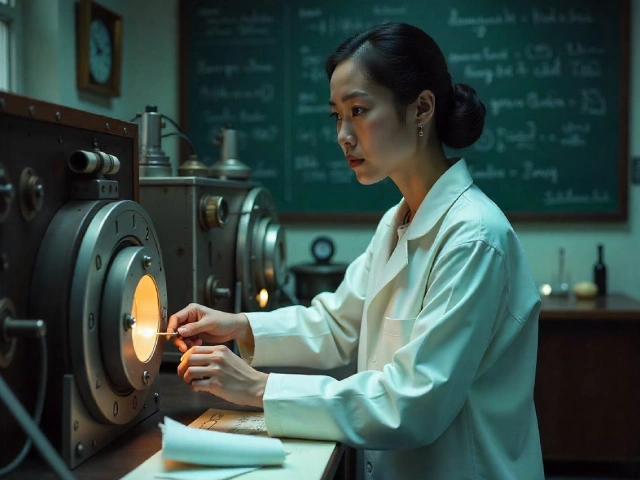
In November 1949, in a small laboratory beneath Pupin Hall at Columbia University in the United States, Chinese-born physicist Chien-Shiung Wu and her student Irving Shaknov conducted a groundbreaking experiment. Their goal was to produce antimatter and, through it, test one of physics’ most mysterious concepts—the “pair theory” or dual particle theory.
The cyclotron used by Wu and Shaknov was so heavy that, a decade earlier, the university had to break through building walls and bring it inside with the help of the football team. By accelerating particles at incredible speeds with the cyclotron’s magnetic field and striking a copper plate with deuterons, they created a temporary isotope called copper-64, which served as a source for antimatter positrons.
Physicist John Wheeler had previously predicted that photons emitted from the collision of antimatter and matter would be polarized at right angles to each other. Wu and Shaknov sought experimental proof of this idea. Previous research had yielded ambiguous results, but Wu’s experiment was unparalleled in its precision. Ultimately, they found that the photons produced by the collision were indeed polarized at right angles to each other, and that this relationship remained intact even across great distances. This was the first experimental evidence of quantum entanglement.
Albert Einstein himself was skeptical about this mysterious phenomenon. He referred to it as “spooky action at a distance.” However, Wu and Shaknov’s experiment demonstrated this astonishing truth of the quantum world. Although the research was published in January 1950, they did not mention the term “entanglement” because, at that time, many regarded working with quantum theory as unacceptable.
In 2022, John Clauser, Alain Aspect, and Anton Zeilinger received the Nobel Prize in Physics for their experimental proof of quantum entanglement. Although they systematically eliminated alternative explanations for entanglement through their experiments, it was historically Chien-Shiung Wu who first conducted such an experiment. Unfortunately, her name was not mentioned in the Nobel Prize announcement—a clear example of the injustice she faced in the history of science.
Chien-Shiung Wu was born in China in 1912. Her father, Zhong-Yi Wu, was a revolutionary, education enthusiast, and feminist. The name Chien-Shiung means “strong hero.” Encouraged by her father, she went to the United States for advanced studies in physics and attended the University of California, Berkeley. There, she came into contact with eminent scientists like Emilio Segrè, Ernest Lawrence, and J. Robert Oppenheimer. During World War II, her research ended up in the hands of the military.
This remarkable scientist faced many forms of discrimination throughout her life. As a woman and an Asian, she encountered severe prejudice in her workplace. But overcoming every obstacle, she achieved extraordinary success in physics. Along with her experimental proof of Enrico Fermi’s beta decay theory, she also demonstrated a fundamental principle known as “parity violation,” which is regarded as one of the most important discoveries in physics. Nevertheless, in 1957, the Nobel Prize was awarded to her two male colleagues instead of her.
Chien-Shiung Wu’s story has become largely forgotten in the history of science, yet her work remains foundational to modern quantum theory and particle physics. Recently, researchers and historians have begun to recognize Wu’s contributions. An asteroid has been named after her, stamps have been issued in her honor, and various awards and accolades are now given in her name.
Chien-Shiung Wu’s story sends a vital message to both science and society—progress in science depends on collective effort and equal recognition. It is our collective responsibility to remember the story of this great, forgotten scientist.