

Introduction:
Climate change refers to significant alterations in the Earth’s long-term weather patterns, such as average temperature, rainfall, and other seasonal attributes. Since the Industrial Revolution, the emission of greenhouse gases (such as carbon dioxide and methane) has caused the Earth’s average temperature to rise rapidly. For instance, the current global average temperature has increased by about 1.2°C compared to the pre-industrial era. As a result of this global warming, an increase in global temperature as shown in the chart (image) has been observed. Climate change increases the risk of excessive rainfall, cyclones, floods, and summer heatwaves, while exacerbating droughts and salinity during dry seasons.
Analytical Main Discussion:
Scientific Explanation of Climate Change-
Climate refers to the average long-term weather patterns of a particular region. When the average temperature or rainfall pattern in an area changes significantly over a period of more than 30 years, it is termed as climate change. Currently, due to human-made factories, vehicles, and the burning of fossil fuels, excessive greenhouse gases are accumulating in the atmosphere. These greenhouse gases trap sunlight, thereby increasing the Earth’s temperature (greenhouse effect). As a result, polar ice is melting and sea levels are rising. Recent studies have shown that in Bangladesh, the average temperature has risen by about 0.5°C over the past 44 years, with up to 0.9°C increase in the eastern region.
Vulnerable Regions (Bangladesh)-
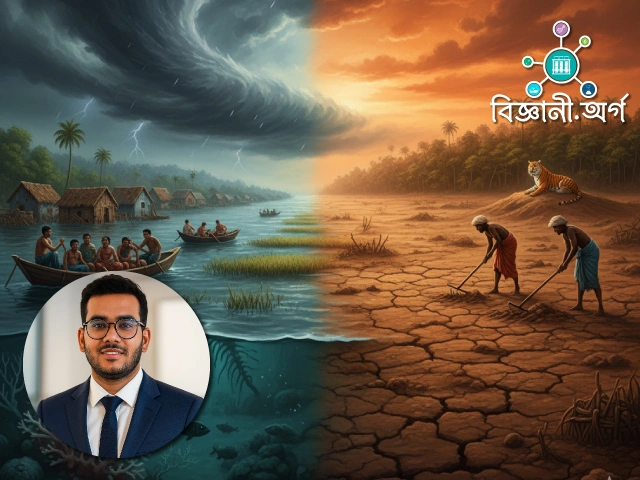
Due to its geographical position (low-lying land) and coastal location, Bangladesh is one of the most vulnerable countries in the world. Especially the coastal areas (Khulna, Barishal, Cox’s Bazar, Feni, Patuakhali, etc.) are at high risk of cyclones, humidity-induced storms, and tidal surges. Similarly, low-lying flood-prone areas (Jamuna-Brahmaputra basin, Meghna basin) suffer from river erosion and flooding every monsoon. The semi-arid northern regions (Rajshahi, Rangpur, Dinajpur) experience both floods during the rainy season and drought in the dry season. Because of these factors, the southwestern coastal areas including the Sundarbans and the northwestern highlands are identified as the most at-risk regions of Bangladesh.
Impacts-
Agriculture: Although agriculture is a mainstay of Bangladesh’s economy, climate change is severely damaging this sector. Crops are destroyed by floods and cyclones, and irregular rainfall or low pressure can delay the monsoon, causing drought to damage crops. Increasing salinity in coastal areas has made rice cultivation nearly impossible in salty water. According to studies, by 2050, about one-third of Bangladesh’s agricultural production sector may be lost due to climate change. Thus, food security is weakening and the livelihoods of rural communities are at risk.
Health: Extreme weather caused by climate change increases the prevalence of respiratory and viral diseases. Waterborne diseases (diarrhea, cholera) spread due to high salinity and polluted water. Excessive heat increases the risk of heat-related blood pressure problems and heatstroke. In many coastal families, hunger and water scarcity in recent years have led to increased worm infections and malnutrition. For example, during the floods of 2022, about 7.1 million people in eastern regions such as Sunamganj, Sylhet, and Chittagong were internally displaced. Climate-sensitive diseases like dengue, pneumonia, and typhoid have also increased due to rising temperatures.
Education: The country’s education sector is also affected by natural disasters. In 2023, heavy floods, cyclones, and excessive rainfall damaged 15,926 educational institutions in Bangladesh, and 726 government schools were severely affected. When surrounding infrastructure collapses and electricity and water supply is interrupted, classes remain closed for six to eight weeks. As a result, students stayed away from school for a long time and many dropped out altogether. Surveys have shown that after a flood, nearly 294,000 students at secondary level left school (over 82% of them girls). This has caused a knowledge gap and stalled educational progress.
Biodiversity: Bangladesh’s unique biodiversity is also under threat from climate change. The world’s largest mangrove forest, the Sundarbans, faces threats from sea level rise, marine incursions, and cyclones. Research shows that since 1964, about 210 square kilometers of forest have been lost in the Sundarbans due to sea water intrusion. Many species in this region, including the Royal Bengal Tiger and various birds, are endangered. Due to increased sea temperatures, Bangladesh’s only coral reef (St. Martin’s Island) is degrading. More than 231 fish species, sharks, dolphins, and numerous marine creatures are becoming vulnerable. These changes are threatening Bangladesh’s aquatic and mangrove forest ecosystems.
Scientific Data and Recent Research Findings-
Recent research on Bangladesh’s climate shows that because of uncertainty in the monsoon and extreme seasonal events, agricultural production is doubly at risk. Crops are repeatedly damaged by excessive rainfall, and crop failure occurs in the dry season. Temperatures are rising rapidly; by 2050, the average annual temperature in the country is projected to increase by at least 1.0–1.5°C. Sea level is expected to rise by 0.30 meters by 2050 and by 0.74 meters by 2100. As a result, about 900,000 people could lose their island homes by 2050, and 21 million people by 2100.
A World Bank report states that Bangladesh is one of the most climate-vulnerable countries and over the past few decades, extensive preparedness efforts have been undertaken in areas like Chattogram, Khulna, and Patuakhali. Still, by 2050, there is a potential economic loss of one-third in the agricultural sector and a possible 13.3 million internal migrants. Essentially, these studies and data indicate that the impact of climate change in Bangladesh is already significant and the situation could become more complex in the future.
Conclusion:
Just as climate change is accelerating globally due to increasing greenhouse gas emissions, low-lying countries like Bangladesh are directly facing its impacts. Research and direct experience in Bangladesh have shown that food, health, education, and biodiversity—all sectors are obviously affected by the negative impacts of climate change. Without proper preparation and science-based adaptation, these risks cannot be managed. Integrating climate awareness and preparedness into development policy and education/training will indeed help protect the future of children and youth. Global research, including that by the World Bank, highlights that not only are safe water supply and embankments needed, but also climate-friendly technology in agriculture, health system improvements, and risk management in educational institutions are urgent. Bangladesh has already reduced storm-related deaths and learned adaptation over the decades. In facing future risks, more science-based actions, community initiatives, and financing must be ensured. By doing so, we can mitigate the real impacts of climate change and safeguard the nation’s progress.
References: Information and statistics used in this article have been collected from the mentioned reports and scientific sources.
Written by,
Md. Fahad Hossain
Student, Department of Zoology.
Shahid Bulbul Govt. College, Pabna.
(Affiliated with the National University of Bangladesh)