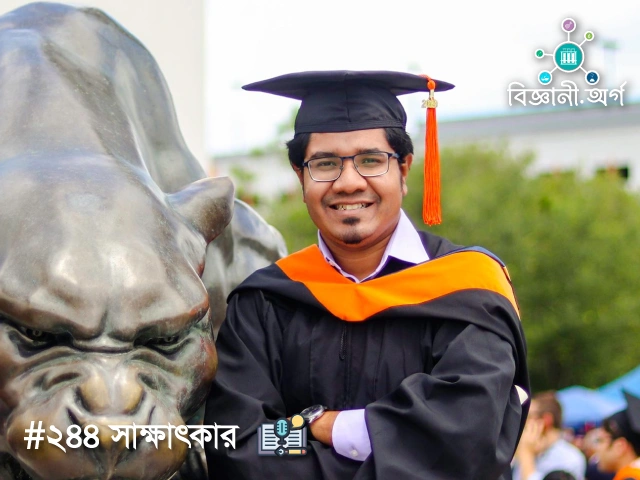
For millions of farmers in Bangladesh whose livelihoods depend on a small patch of green land, even a tiny spot appearing on a leaf can be the first sign of disaster. When outbreaks of pests or fungi spread like epidemics, not only is the crop lost, but a family’s dreams are shattered and the country’s food security is gravely threatened. Addressing this age-old problem with a state-of-the-art solution is one of our own young scientists—Md. Ishtiaq Iqbal. From distant Malaysia, he is developing technology that will put remarkable diagnostic power into the hands of farmers and transform the future of our farming systems.
Md. Ishtiaq Iqbal is currently a PhD researcher at Universiti Putra Malaysia (UPM). On the surface, his field of study appears complex—computer vision, deep learning, and artificial intelligence. But the goal behind it is simple and deeply human: to harness the power of technology to swiftly detect diseases in plant leaves and safeguard crops by taking the right action at the right time. Ishtiaq dreams of sparking a digital revolution in Bangladeshi agriculture, where modern technology combines with farmers’ expertise to ensure prosperity and stability.
Artificial Intelligence: The Digital Doctor for Crops
To most people, “artificial intelligence” or “AI” might still seem somewhat mysterious. But Ishtiaq Iqbal has brought it straight to the farmer’s field. At the heart of his research is technology that can learn from images and make decisions much like a human. Simply put, just as we can distinguish loved ones among crowds by looking at thousands of faces, Ishtiaq’s model can tell—by looking at thousands of leaf photos—which ones are healthy and which are diseased, with impressive accuracy.
To achieve this, he is using a world-class computer vision model called YOLO (You Only Look Once). Ishtiaq likens this model to a ‘digital detective’ whose job is to pick out specific objects from a sea of images. But he hasn’t just used this model as is; he’s adapted and enhanced it specifically for the realities of Bangladeshi agriculture. His research infuses three groundbreaking innovations, turning it from mere technology into a truly exceptional tool.
First, Special Attention: Just as an experienced agronomist focuses on signs of disease while overlooking irrelevant parts of a leaf, Ishtiaq’s model is trained to pay more attention to diseased areas than healthy ones. As a result, it can accurately detect even small or early-stage diseases that might easily be missed by the naked eye.
Second, Flexible Viewpoint: By nature, symptoms of plant diseases don’t appear in regular geometric shapes. Some spots are crooked, some are scattered, and some have odd shapes. Many typical models struggle to recognize these shapes. This is where Ishtiaq’s model stands out—he’s crafted it to easily identify curved, spread, or irregular symptoms of disease. This dramatically increases the model’s diagnostic power.
Third, Speed and Efficiency: Complex models running on powerful laboratory computers are useless to farmers. Realizing this, Ishtiaq trimmed all unnecessary components from his model, making it extremely lightweight and fast. As a result, this technology no longer relies on expensive hardware—it can run conveniently on an ordinary smartphone or a drone used for field monitoring. This means a farmer can snap a leaf photo in the middle of his field using a phone and get a report within seconds, enabling immediate action.
From Lab to Field: An Unforgettable Experience
For a scientist, the ultimate reward comes when theoretical research improves real lives. Ishtiaq Iqbal experienced such a moment that changed his entire outlook on research. Recalling the story, he says, “Some time ago, we went to a small farmer’s field for a field test. There, a disease was spreading rapidly in the crop. I activated my mobile’s prototype model and took photos of the affected leaves. Within seconds, the model accurately identified the diseased areas and advised remedial actions. We acted according to its recommendation.”
When, weeks later, he learned that the disease had not spread and the crops were saved, he deeply realized—artificial intelligence is not just coding or algorithms; it is a powerful human tool for making the right decisions at the right time. In his words, “That moment taught me that the true power of research lies not inside the lab, but in its direct application to real-world problems. When a swift, cost-effective solution brings smiles to a family, no greater inspiration is possible.”
How Will Bangladesh Benefit?
Ishtiaq Iqbal’s research could open doors of possibility for an agriculture-dependent nation like Bangladesh. Its benefits are multifaceted:
- Saving Time and Money: Farmers will no longer have to wait for agricultural officers or rely on guesswork. Quick diagnosis allows farmers to respond in time and avert major losses.
- Environmentally Friendly Farming: Currently, farmers often spray pesticides based on rough guesses, which is harmful to the environment and costly. With this technology, only the affected areas can be treated, reducing pesticide use and benefiting both soil and environment.
- Increased Yield and Food Security: Timely disease detection and treatment will improve both the quantity and quality of crops, playing a key role in ensuring food security for the country’s growing population.
- Early Warning System: By analyzing data from different regions, a map of disease outbreaks can be created, allowing early warnings for farmers before a disease spreads.
The Path of a Scientist and a Message for the Youth
Which qualities are most essential to becoming a successful researcher? Ishtiaq Iqbal believes it comes down to three fundamental things: curiosity, patience, and the mindset to learn from failure. He says, “A scientist’s mind always revolves around ‘Why?’, ‘How?’, and ‘What if?’ These relentless questions fuel new discoveries.” According to him, the road of research is never smooth; persistence and learning from every mistake are the true keys to success.
For Bangladesh’s young students interested in science, Ishtiaq Iqbal’s message is clear and inspiring: “Never let your curiosity fade. A relentless drive to learn, patience, and creative thinking will lead you to success. Don’t be afraid of small mistakes or failures—they are your greatest teachers. Above all, dream of using science to solve your country’s problems. Acquire world-class skills, but let your purpose be the welfare of your people.”
Md. Ishtiaq Iqbal’s research is not just an academic venture, but a new dawn for Bangladesh’s agricultural sector. Young scientists like him are our hope, quietly working behind the scenes with intellect and technology to change the lives of millions. His journey will doubtless become a shining model for the next generation of Bangladeshi scientists.
📞 Contact Information
📧 Email: [email protected]
🔗 LinkedIn: www.linkedin.com/in/md-ishtiaq-iqbal-a5559058
The Digital Guardian of the Green: A Bangladeshi Scientist’s AI Revolution for Farmers
For millions of farmers across Bangladesh, a single discolored spot on a leaf is more than just a blemish; it is a harbinger of potential ruin. In a land where livelihoods are woven into the green tapestry of its fields, a sudden outbreak of plant disease can unravel a family’s dream, threatening not only their income but the nation’s food security. This age-old battle between the farmer and the blight is now entering a new era, thanks to the pioneering work of a young Bangladeshi scientist, Md. Ishtiaq Iqbal. From his research lab at the Universiti Putra Malaysia (UPM), Iqbal is forging a powerful new weapon for this fight: an artificial intelligence system designed to be the farmer’s smartest ally.
Md. Ishtiaq Iqbal, a PhD researcher, has dedicated his work to a field where cutting-edge technology meets grassroots necessity. His focus lies in Computer Vision and Deep Learning—complex terms for a beautifully simple goal: to create a system that can diagnose and suggest cures for plant diseases with incredible speed and accuracy. His vision extends beyond academic papers; he aims to spark a digital revolution in Bangladesh’s agriculture, empowering every farmer with a tool that was once the stuff of science fiction.
Artificial Intelligence: A Digital Doctor for Crops
At the heart of Iqbal’s research is a sophisticated AI model known as YOLO (You Only Look Once). To the average person, AI can seem abstract, but Iqbal explains it with a powerful analogy. “Think of it as a digital detective,” he suggests. Just as a detective can spot a suspect in a crowd, the YOLO model can identify the tell-tale signs of disease in a photograph of a plant. It learns by example; by being shown thousands upon thousands of images of both healthy and diseased leaves, it trains its digital “eye” to recognize patterns that might even escape a human expert.
But Iqbal didn’t just adopt an existing technology. He recognized that for this tool to be truly effective in the fields of Bangladesh, it needed to be tailored to real-world conditions. He has enhanced the standard YOLO model with three crucial innovations.
First, he imbued it with Specialized Focus. An experienced agronomist, when examining a plant, instinctively ignores irrelevant details and zooms in on the symptoms. Iqbal has trained his model to do the same. It intelligently pays more attention to the diseased portions of a leaf, allowing it to detect infections in their earliest stages, long before they become catastrophic.
Second, he gave it a Flexible Viewpoint. Nature is rarely neat and tidy. Plant diseases don’t appear as perfect circles or squares; they are often irregular, splotchy, and oddly shaped. Many standard AI models struggle with this randomness. Iqbal’s model, however, has been taught to recognize these imperfect, real-world patterns—the curved, spreading, and strangely shaped marks that signify a genuine threat. This adaptability makes its diagnostic ability far more reliable.
Finally, and perhaps most importantly, he prioritized Speed and Efficiency. A brilliant AI that requires a supercomputer in a lab is of little use to a farmer in a remote village. Iqbal has meticulously streamlined his model, stripping away unnecessary complexity to make it incredibly lightweight. The result is a powerful diagnostic tool that can run on an ordinary smartphone or a low-cost drone. This single achievement bridges the vast gap between the laboratory and the land, placing expert-level analysis directly into the hands of the farmer.
From the Lab to the Land: A Moment of Revelation
For any scientist, the true measure of success is seeing their research make a difference in the real world. For Iqbal, that moment came during a field visit that profoundly reshaped his perspective.
“I was on the land of a small farming family not long ago,” he recalls. “A disease was spreading rapidly through their crops, and you could feel their anxiety. I took out my phone, which had a prototype of my new model, and snapped a picture of an affected leaf.” The result was immediate. “In just a few seconds, the model identified the afflicted areas and suggested a targeted treatment. We followed its advice.”
Weeks later, he received the news: the disease had been contained. The crop was saved. That experience, he says, was a revelation. “It taught me that AI is not just an algorithm or a string of code; it is a tool for human empowerment, a way to make the right decision at the right time. That moment crystallized the true power of this research—where a fast, affordable solution can change the fortunes of a family.”
How Will This Technology Benefit Bangladesh?
Iqbal’s innovative work holds immense promise for a nation as agriculturally dependent as Bangladesh. The potential benefits are transformative:
- Saving Time and Money: Farmers can get an instant diagnosis without waiting for an agricultural officer, allowing for immediate action that prevents widespread crop loss.
- Eco-Friendly Farming: Instead of blanket-spraying entire fields with expensive and often harmful pesticides, farmers can apply treatments precisely where needed. This “precision agriculture” reduces chemical usage, protects the environment, and lowers costs.
- Boosting Yield and Food Security: By catching diseases early and treating them effectively, crop quality and quantity will improve, strengthening the nation’s food supply chain.
- Early Warning Systems: By collecting data from various regions, it would be possible to create disease maps, predicting outbreaks and issuing timely alerts to farmers in vulnerable areas.
The Mind of a Scientist and a Message for the Future
What does it take to be a scientist? For Iqbal, it boils down to a few core qualities. “It begins with curiosity,” he explains. “An insatiable desire to ask ‘Why?’, ‘How?’, and ‘What if?’.” He emphasizes that the path of research is paved with challenges and failures. “Patience, the resilience to learn from mistakes, and the commitment to continuous improvement—these are the qualities that carry you through.”
To the young, aspiring scientists of Bangladesh, Iqbal offers a heartfelt message: “Never lose your curiosity. Your passion for learning, your patience, and your creative thinking will guide you toward great achievements. Do not be afraid of small mistakes or failures; they are your greatest teachers. Above all, dream of using science to solve the problems of our own country. Acquire world-class skills, but let your ultimate goal be the welfare of your people.”
Md. Ishtiaq Iqbal’s work is more than just an academic pursuit; it is a vision for a new dawn in Bangladeshi agriculture. He stands as a powerful example of how Bangladesh’s brightest minds, wherever they are in the world, are harnessing the tools of the future to build a more prosperous and resilient homeland. His journey is a source of national pride and a powerful inspiration for the next generation, proving that with passion and innovation, a single individual can indeed help sow the seeds of a better tomorrow.
📞 Contact Information
📧 Email: [email protected]
🔗 LinkedIn: www.linkedin.com/in/md-ishtiaq-iqbal-a5559058