News Desk, Biggani Org |
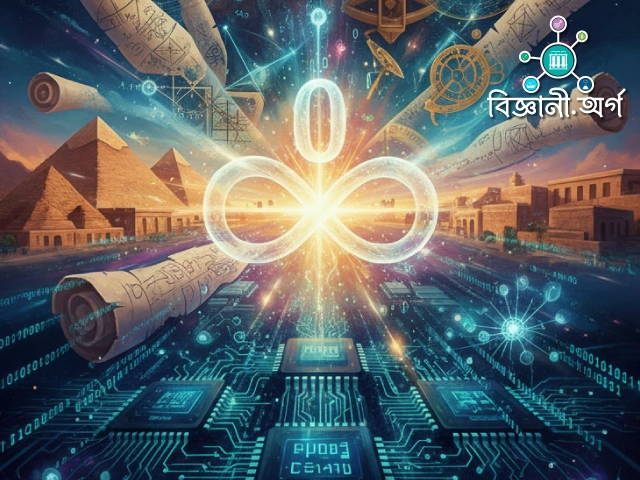
At the dawn of human civilization, when humans were hunters and gatherers, they needed to understand the laws of nature, keep track of time, and determine the number of food items or domesticated animals. From these needs, the concept of numbers was born. Today, the journey of numbers stretches from zero to infinity—not merely as a counting tool, but as an entire realm of thought. Constance Reid’s book Zero to Infinity: A History of Numbers takes us into this world, where numbers are not just mathematical symbols, but each one holds a history and represents a cultural exploration.
Numbers are not just about calculation—they are an expression of the deepest insights of the human mind. In her writing, Reid explains in simple language how we created numbers and how they were transformed into parts of philosophy, science, and even religious context. The number “zero” that we use so casually today was once a revolutionary discovery. The concept of zero was born in India, later reaching Europe through Arab mathematicians. This single number changed our methods of calculation, the logic of mathematics, and even the depths of our thoughts.
To the ancient Egyptians, numbers were an assemblage of images. They used mathematics for purposes such as collecting agricultural taxes or tracking the flooding of the Nile. In contrast, the Babylonians used a base-sixty number system, the reflection of which we still see in our timekeeping today—sixty minutes in an hour, sixty seconds in a minute. This continuity shows us that numbers are not just mathematical entities but also reflect the lifestyles of different civilizations.
Reid skillfully weaves the stories of multiple civilizations into her book. For the Greeks, mathematics was the highest form of logic. Pythagoras said, “Number is the music of the universe.” Euclid’s geometry and Archimedes’ analysis still form the foundations of our mathematics. But these figures were not just inventors of numbers; they were also heroes of stories, who shaped numbers into tools for understanding the world.
But it’s not just history—the book takes us on a journey through the transformative evolution of mathematics. Numbers have become intertwined with objective rationality, such as mathematical logic, proofs, and equations. Pi (π), imaginary numbers (i), or infinity (∞)—they seem to have emerged from the world of imagination into reality. How can a number be infinite, or how can the square root of a negative number not be real yet be crucial in calculations—seeking answers to these questions sets the reader off on a unique intellectual adventure.
In the context of Bangladesh, mathematics is still a dreaded subject for many—often a monotonous lesson memorized just to fetch exam marks. Yet this book proves that within mathematics lie poetry, mystery, beauty, and humanity. When Reid speaks of the history of numbers, she doesn’t just engage in scholarly discussions fit for a math classroom; rather, she traces the path along which our ancestors learned to think, to reason, and ultimately to build civilization.
Another unique aspect of this book is its accessibility. Many books on mathematics are full of complex terminology, making them incomprehensible for ordinary readers. But Zero to Infinity is different. Reid writes as if she’s sitting down with the reader over a cup of tea, explaining the mysteries of numbers and the exciting mathematics hidden in the twists and turns of history. Especially for young students, this could be an inspiring read—learning mathematics is not just about memorizing formulas, but opening the doors of thought.
Reid also draws numbers into social and cultural contexts. In medieval Europe, when church authorities were fearful of numbers—especially of the concept of zero—Muslim mathematicians were leading the advancement of mathematics. Philosophers like Brahmagupta and Aryabhata in the Indian subcontinent laid down theories that would later form the foundations of Europe’s Renaissance. This cultural connection reminds us that science and mathematics have never belonged to a single nation—they are a collective resource of humanity.
Another fascinating aspect of this book is that it considers the future of numbers. Today, we live in a digital age—where every technology, form of communication, and even social relationship can be expressed by numbers—and their roots can be traced back to the discovery of ancient numbers. Reid shows us that numbers are not just of the past; they are the language of the future, too. Artificial intelligence, big data, quantum computing—at the core of everything is a mathematical framework.
If we could present mathematics from this perspective in Bangladesh’s education system, perhaps the next generation would find not fear, but beauty within numbers. For those of us who work with mathematics or speak about science, it is our duty to connect this subject to the realms of human thought and imagination. Constance Reid calls us onto that very path—to love numbers, to understand them, and to keep questioning.
In the end, Zero to Infinity is not just a book, but a journey—one that takes us to the wellspring of thought, to the very beginnings of civilization, and onward toward the unknown frontiers of the future. If you want to hear, understand, and fall in love with the story of numbers, this book could be your next beloved companion. The history of numbers from zero to infinity tells us the story of being human—a grand tapestry of logic, beauty, and imagination.