


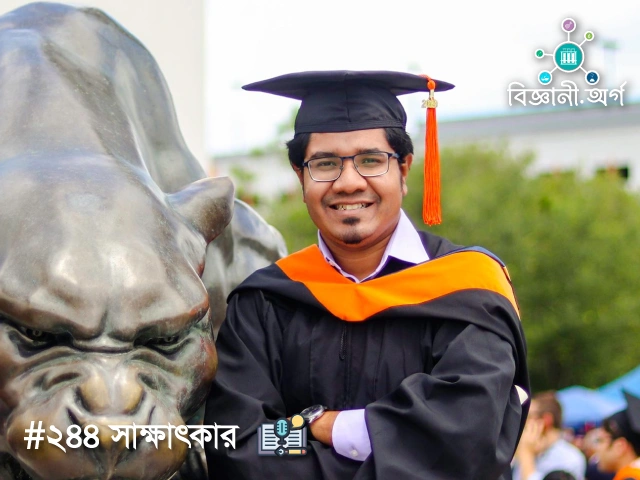
At biggani.org, we introduce scientists living both at home and abroad to our Bangladeshi audience. On behalf of biggani.org, Dr. Moshiur Rahman spoke with expatriate Bangladeshi scientist Dr. Monjur Ahmed, who resides in America.
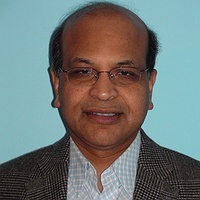
biggani.org: Thank you, Dr. Monjur Ahmed, for giving us your valuable time. To start off, we would like to know more about you.
Dr. Monjur: Currently, I am employed as a physician, professor, and researcher in the Department of Gastroenterology at a tertiary medical care center. Alongside this, I serve as the Editor-in-Chief for the World Journal of Gastro-Oncology.
biggani.org: We have learned that you are currently a doctor and researcher. Could you tell us about your childhood?
Dr. Monjur: I spent my childhood in Ishwardi, Pabna. My school was the area’s oldest and most renowned, S.M. High School. Every year, many talented students graduate from there after finishing their secondary education. During my time, as my academic results were good, my father wished for me to become a doctor. However, after passing matriculation, I started pursuing opportunities to go to America, and after completing my intermediate exams, there was a chance. But financial concerns at that time made it impossible to go. Later, I decided to complete my studies in the country and enrolled at Dhaka Medical College. I completed my MBBS from Dhaka Medical College and also did my internship there. Afterwards, following my father’s wishes, I enrolled at the Royal College of Edinburgh in England to pursue an MRCP degree. I completed my MRCP training in 1990. After that, I came to America and began working.
biggani.org: What is your area of specialization within medical science?
Dr. Monjur: I specialize in gastroenterology.
biggani.org: What area of the body does this department deal with? What led to your particular interest in this field?
Dr. Monjur: This department mainly deals with the human digestive tract. Gastrointestinal organs like the gallbladder and pancreas are included in this field. Many highly successful medical interventions are employed to treat these diseases, such as endoscopy, colonoscopy, liver transplant, gallbladder transplant, pancreas surgery, and kidney transplant. One of the main reasons for my interest in this field is the pattern of illnesses among Bangladeshi people. While studying medicine, I noted that gastrointestinal issues were particularly prevalent, mainly due to our dietary habits and lifestyle.
Moreover, the diseases within this field and their management are among the most effective in medical science. Personally, working in this department helps in one’s individual development. Gastroenterology deals with very important organs in the human body, involving not just a single organ but many interconnected ones. The potential for medical advances in this field is quite high. In other specialties, practice often depends on hospitals, but in gastroenterology, it is possible to practice independently in terms of understanding diseases, their types, and their treatments.
biggani.org: As a doctor, there is so much we can learn from you. As we mentioned at the outset, our aim is to share your experiences with Bangladeshi students who are contemplating higher education and advancement in science. To boost their confidence, could you share your experience with research?
Dr. Monjur: Research is a kind of training program. Those who join it are called “fellows.” The trainees receive proper guidance to complete their own research. Afterwards, they write up their analysis, and, following rigorous review, it is published in various journals.
Being involved in education management, I have to run these types of training programs. In this situation, I have to submit a few job descriptions. For example-
Train and Teach the Fellows: Here, there are specific training programs in which trainees practice ways to treat patients who present with intestinal problems such as jaundice, diarrhea, colitis, pancreatitis, etc. There is a curriculum for this type of teaching, which specifies which topics require lectures or training. In this way, after three years a trainee is recognized as a gastroenterologist.
Research: For these programs, several topics are selected at national meetings and planned for at the beginning of the year.
Clinical Care: Here, the clinic of the training center regularly reviews patient cases. However, in research medical centers, only complex cases that doctors from other hospitals are unable to resolve are referred here. As a result, members of the research institute review the symptoms and determine management strategies.
As a faculty member, I have to pay constant attention to all these matters.
Publication: The more research is published, the greater the university’s reputation. Every year, preparations must be made for some national and international lectures in research. Almost every year, research papers are presented at national conferences.
biggani.org: What are you currently researching?
Dr. Monjur: Currently, I am researching gastrointestinal and hepatobiliary conditions in medical students. The aim is to determine and treat issues such as pancreatitis, ulcer bleeding, and other intestinal problems in young medical students.
biggani.org: How do you collect research-related data?
Dr. Monjur: In most cases, clinical resources are used for research. For example, over the past several years, if we have seen 5,000 patients, we analyze what problems they had, what kinds of symptoms were present, what treatments were given, and what outcomes resulted. Data is also collected from the general population as needed, based on circumstance. All this data is submitted for approval to the IRB (International Research Bureau), and then published in various journals.
biggani.org: What advanced technology do you use? Do you conduct clinical trials of new drugs?
Dr. Monjur: Yes, clinical trials are conducted. Sometimes, multiple institutions collaborate on clinical trials so that the data can be accurately verified. If any new technology is developed in medical science, it comes to us for final trial and approval. Various pharmaceutical companies also contact us to trial their drugs for promotion, and if they are found to be up to standard, only then do we promote them.
biggani.org: You lived in England for many years and now reside in America. What differences have you noticed between the two countries?
Dr. Monjur: Every place has both advantages and disadvantages. I lived in various cities in England from 1986 to 1990 to pursue higher degrees. Afterwards, I moved to America. Since then, technological advancements in America have been superior.
Additionally, at that time, England was almost entirely white; foreigners were rarely seen. In contrast, America has been multicultural from the beginning, with foreigners such as Indians, Filipinos, and Cambodians living here. As a doctor, I have been able to observe very closely how ethnic and social backgrounds influence the prevalence of certain diseases.
Clinical care in England was much more organized, whereas it was not like that in America.
biggani.org: You are involved in both clinical practice and research, which is not commonly seen. What is your philosophy on this?
Dr. Monjur: Academic activity is never truly adequate without research. To start a research project, one must study the field thoroughly and analyze its context, so that one’s understanding of the subject becomes robust. Academic disciplines face a significant shortfall without research. Especially in medical science, there is no substitute for research in order to achieve specialization in any particular field.
biggani.org: At this level of success in your life, what advice would you give to students?
Dr. Monjur: Always remain optimistic and hardworking. If someone sets a clear goal and works diligently towards it, they will definitely reach their aim. My advice is: never give up.
Acknowledgment: Thanks to Zaynab Binte Ali for composing this article.
References







This comment has been sanitized for the English site.
This comment has been sanitized for the English site.