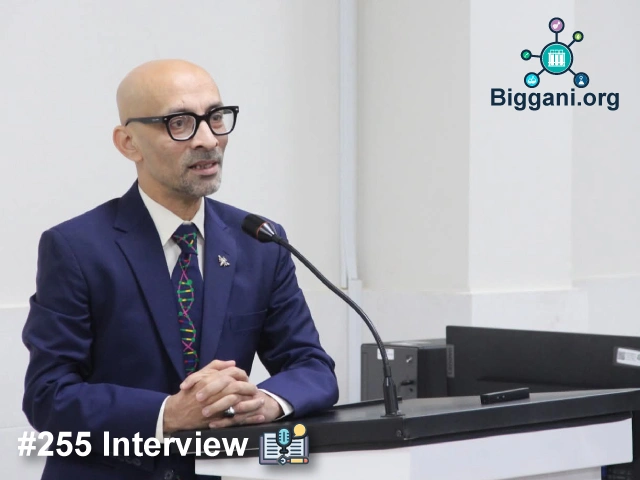
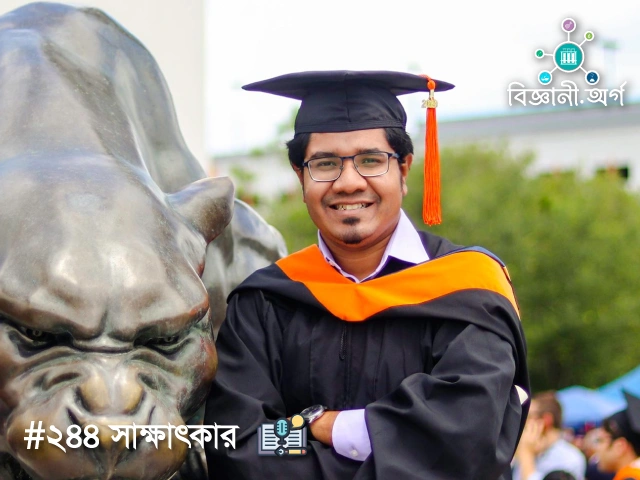
Physicist Abu Said Mahazumi is currently serving as Senior Lecturer at Southwest Jiaotong University, China.
At the same time, he is conducting research on semiconductor nanostructures and high-energy-rich semiconductors for rail traction applications.
Biggani.org spoke to him to learn about his extensive 8 years of experience in the field of physics and engineering.
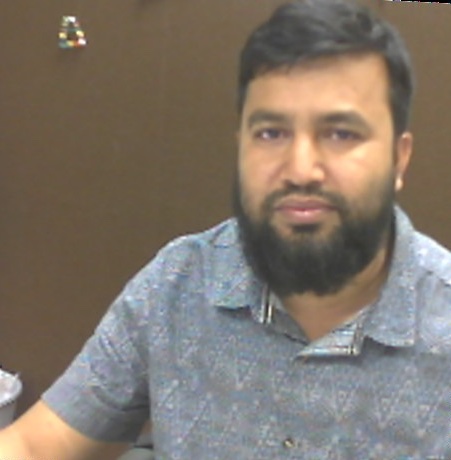
Biggani.org: What was your childhood like in terms of becoming a successful scientist?
Dr. Mahazumi: When it comes to my childhood, most of my inspiration came from my family. Even though I grew up in a middle-class family, I never faced any difficulty regarding my studies. My father had a modest government job, but he never let us realize how hard he worked for us. He always encouraged me to study, saying, “If you study properly, I’ll provide whatever you need.” So, I would say that my father’s encouragement was significant from my early years.
Biggani.org: Where did you begin your formal education?
Dr. Mahazumi: I grew up in the village of Joaria in Comilla. That is where my schooling began.
Biggani.org: How was your educational journey after secondary school?
Dr. Mahazumi: I completed my secondary education in Electrical Technology at Comilla Polytechnic. I studied there for three years. After that, I finished my studies in Electronics at BIT, Gazipur (now DUET). My teachers greatly influenced me during school, which led to my interest in engineering. I completed my studies at DUET with good results.
Biggani.org: We know you are now teaching and involved in research abroad. How did your journey progress after completing your studies in Bangladesh?
Dr. Mahazumi: After finishing my studies in Bangladesh, I started working as a lecturer at a private university (Northern University). At the same time, I held another job.
While continuing like this, I realized this was not the way to go. Therefore, I applied for further studies in Sweden. After completing the first semester in Microelectronics and Photonics at Halmstad University, Sweden, I moved to KTH Royal Institute of Technology, Stockholm, Sweden.
But since I didn’t enjoy studying there, I returned to Halmstad University. I was doing my MSc thesis in Microelectronics and Photonics. During that phase, I applied to several universities in the UK and started my PhD at Lancaster University, UK.
Biggani.org: What was your research focus?
Dr. Mahazumi: I was working on the characterization of quantum dots.
Biggani.org: Could you briefly explain what quantum dots are?
Dr. Mahazumi: Quantum dots are semiconductors whose electronic properties depend on their size and shape. Generally, the smaller the quantum dot, the greater its band gap. The higher the band gap, the more energy is needed to move an electron from the valence band to the conduction band, and when the dot returns to its lowest energy state, it emits a higher-energy photon.
Biggani.org: What types of equipment are used to characterize quantum dots?
Dr. Mahazumi: Quantum dots are grown by molecular beam epitaxy (MBE).
Biggani.org: What does MBE mean?
Dr. Mahazumi: MBE is a Nobel technology or machine.
There are many types of substances to control the beam in this process.
Biggani.org: What materials are required to make quantum dots?
Dr. Mahazumi: For MBE growth, gallium arsenide substrates are used. Then, by embedding it, gallium antimonide quantum dots are made and layered in different ways—such as single layer, double layer, up to the 10th layer—to test which layer is most suitable for solar cell applications.
By testing each layer in this way, we found that the efficiency of solar cells is highest at the 10th layer.
Biggani.org: When did your research start?
Dr. Mahazumi: We began in 2009, and this research continued through 2010, 2011, 2012, and up to March 2013.
Biggani.org: Solar cell efficiency usually ranges from 5 to 10 percent. What efficiency did you achieve with your quantum dot solar system?
Dr. Mahazumi: In the laboratory, we achieved 22 percent efficiency from a single solar cell, which was much higher in the commercial sector at the time. For silicon, 11 or 12 percent is considered very high, but our research focused on gallium arsenide. We observed excellent efficiency here as well.
Biggani.org: Was this research approved for commercialization by any company?
Dr. Mahazumi: Towards the end of the research, we were about to sign a commercialization agreement with a South African company, but just then my PhD ended and I had to leave. So, I do not have any current information on this matter.
Biggani.org: Was your intention to work on solar power from the beginning?
Dr. Mahazumi: Actually, at first I thought I would become an engineer, but I had no idea about masters, research, PhDs, etc. My work on solar power started while I was still studying.
Biggani.org: How did your professional life begin after completing your research?
Dr. Mahazumi: After my PhD, I applied to move to Saudi Arabia. I moved there with my family without any trouble. But since there was no work in my field, I started teaching. I began teaching several subjects including electronics, electrical circuits, and manufacturing in electrical engineering.
Biggani.org: Many major universities have been established in Saudi Arabia and the Middle East. What is research like there?
Dr. Mahazumi: I taught at the largest, King Saud University. Most of the students there are Saudi, along with a few international students. Admission is based on higher secondary exam results. Engineering is given priority after medical, so students’ morale is good—quite similar to our country.
Biggani.org: In what language did you teach there?
Dr. Mahazumi: Teaching engineering is 100% compulsory in English. However, some instructors teach in Arabic, since it’s their native language. But those of us from abroad use English as the medium.
Biggani.org: How long did you teach at King Saud University?
Dr. Mahazumi: I taught there for a continuous five years—from December 2013 to December 2018.
Biggani.org: Were you able to continue your research during that time?
Dr. Mahazumi: My research required the MBE machine along with other materials such as helium, liquid nitrogen, liquid helium, etc., which were not readily available there. Though one organization did have an MBE machine, it wasn’t possible to operate it without support staff.
Biggani.org: Was there any cleanroom or fabrication room there?
Dr. Mahazumi: Yes, there was, but I did not get the proper environment and support to use it. Later, I realized my research had almost come to a halt, so I left.
Biggani.org: Where are you working now?
Dr. Mahazumi: After leaving King Saud University, I joined Southwest Jiaotong University in Chengdu City, Sichuan, China. Southwest Jiaotong University and Leeds University jointly run a program where I am working as a Senior Lecturer.
Biggani.org: Are you still only teaching, or have you started research as well?
Dr. Mahazumi: I have started teaching here full-time.
Biggani.org: What subject area do you plan to work on?
Dr. Mahazumi: There is no MBE (Molecular-beam epitaxy) machine here, but the research labs for characterization are very good and have sufficient support staff. I intend to collaborate with the professors here working on power electronics and electronic materials.
The main work will be on understanding how the particles inside power transistors function.
Biggani.org: As transistors get smaller according to Fermi law, how do you evaluate the potential of quantum dots in this context?
Dr. Mahazumi: This actually depends on many major factors. In short, whether semiconductors will survive or not, I believe that the technologies currently being used will bring huge changes to the future electronics industry. As a semiconductor enthusiast, I would say—they will definitely continue to exist, as this depends on usability. Since transistors are getting smaller, other materials such as organic or plastic electronics will become more accepted. The technologies of the future are going to be even more advanced.
Biggani.org: What exactly are organic semiconductors?
Dr. Mahazumi: Organic semiconductors are also known as plastic electronics. They have very low electron mobility, so working with them requires a much more refined approach. They work in various forms of liquid materials. Sometimes they are given metallic form. Inorganic electronics are technology-dependent but easily available, whereas organic electronics are much more technology-dependent. The main issue with organic is that it involves working with phosphorus, which comes from liquid substances.
In my opinion, for small-sized electronics, organic or plastic electronics are more acceptable.
Biggani.org: Are there heat problems with both inorganic and organic semiconductors?
Dr. Mahazumi: Both organic and inorganic semiconductors have limitations. It depends on the value of electron mobility. Working with inorganic semiconductors is easier, while organic ones are more technology-dependent.
Biggani.org: Thank you for your time. Today we learned some important insights about the remarkable contributions of quantum dot electronics.
The interview was transcribed with the assistance of Joynab Binte Ali.