


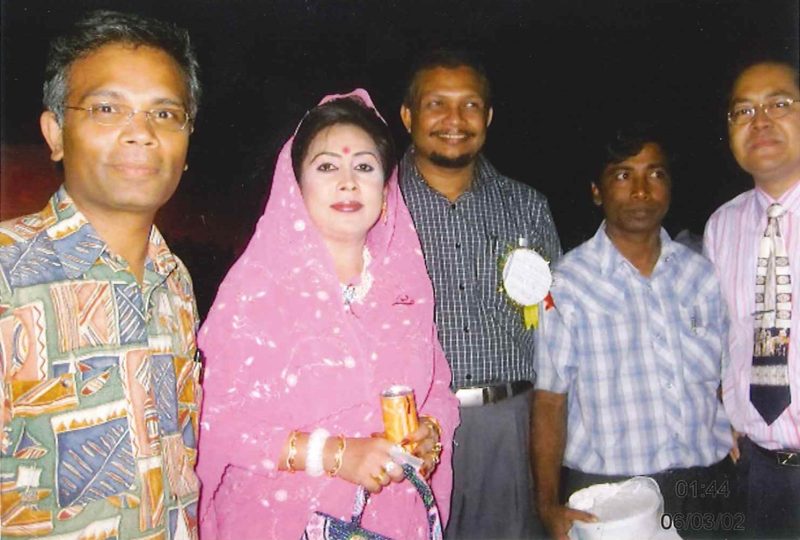
Aziza Rahman Sylvia is the first female textile technologist in Bangladesh. She earned her four-year degree in Textile Technology from Bangladesh College of Textile Engineering and Technology, under the University of Dhaka, in the 1981-82 academic session. She currently works as the Deputy General Manager at Bangladesh Textile Mills Corporation.
Her research and professional experience are mainly in textile processing, fabric production, and the garments industry. In particular, she has taken initiatives to identify and solve the “backward linkage” problem in the textile sector, which plays a crucial role in addressing shortages of local raw materials and reducing production costs. Her contributions are especially significant in the development of Bangladesh’s textile industry, boosting exports and fulfilling domestic demand.
She resides in Dhaka and continues to work for the long-term development of the country’s textile sector.
💬 Q&A Session:
Question: Congratulations and best wishes. How do you feel about your promotion and new responsibilities?
Answer: Definitely delighted—every achievement is gratifying, except for infamy. So, I feel really good about my new title and duties.
Question: You are from Bogura. How was your childhood?
Answer: Although I am from Bogura, I spent my childhood, adolescence, and current life in Dhaka. Like most girls, my childhood was joyful and full of exciting memories.
Question: Why did you choose a career in textile technology?
Answer: I used to draw as a child, so I wanted to study architecture. But as I didn’t get that chance, and since I didn’t want to go outside Dhaka for studying medicine even though I was accepted, I enrolled in textile engineering on my father’s advice. I was the first woman in this field and have become a successful professional.
Question: Nearly 80% of Bangladesh’s export earnings come from the textile and garment industry. What challenges do we face in this sector?
Answer: Bangladesh’s garment industry faces various challenges both at home and abroad. Competing with neighboring countries in terms of quality and design, using different textile materials, and the discontinuation of quota-based trade—all these are challenges. Additionally, the backward linkage problem within the country remains; without solving it, export growth is not possible.
Question: How can we turn these challenges into opportunities?
Answer: Both government and private initiatives are needed. We need to establish new spinning mills, set up factories according to each step in the supply chain, and make proper plans as required. If textile sectors like knitting, weaving, dyeing, etc. are developed in dedicated zones, production costs can be reduced. More progress can be achieved through research and innovation.
Question: Any advice for advancing Bangladesh’s textile sector?
Answer: The textile sector has tremendous potential. In the next ten years, it will play a crucial role in meeting domestic demand and boosting exports. New mills and factories will be established, and the industry will continue to expand.
Aziza Rahman Sylvia’s perspectives and contributions shed new light on the potential and relevance of Bangladesh’s textile industry. Her planning and innovative efforts are vital for making the country’s textile sector stronger and more advanced in terms of quality. The biggani.org team wishes her all the best in her future endeavors and hopes her work will inspire the young scientists of Bangladesh.
Unlocking the Potential of Bangladesh’s Textile Industry – A Conversation with Aziza Rahman Sylvia
Aziza Rahman Sylvia is recognized as Bangladesh’s first female textile technologist. She began her academic journey in 1981–82 at the Bangladesh College of Textile Engineering and Technology, under Dhaka University, completing a four-year degree in textile technology. Currently, she serves as the Deputy General Manager at Bangladesh Textile Mills Corporation.
Her professional expertise lies in textile processing, fabric production, and garment industry management. She has focused on addressing challenges such as “backward linkage” in the supply chain, helping reduce reliance on imported raw materials and optimizing production costs. Her contributions play a crucial role in strengthening both the domestic and export-oriented textile sectors of Bangladesh. Based in Dhaka, she continues to work toward long-term development and modernization of the country’s textile industry.
💬 Q&A Session:
Q: Congratulations on your promotion and new responsibilities. How does it feel?
A: It is certainly a joyful experience. Every achievement is gratifying, and apart from reputation issues, I am very pleased with my new designation and responsibilities.
Q: You are originally from Bogura. How was your childhood?
A: Though I am from Bogura, I spent my childhood, adolescence, youth, and present life in Dhaka. Like many other girls, my early years were filled with joy and memorable experiences.
Q: Why did you choose a career in textile technology?
A: I had a talent for drawing from a young age and initially planned to study architecture. However, I did not get a chance there, and although I could have pursued medicine, it required leaving Dhaka, which I did not want. Following my father’s advice, I enrolled in textile engineering. Being the first and only female student at the time, I studied well and later pursued a successful career in this field. In retrospect, I feel my father guided me to the right path.
Q: About 80% of Bangladesh’s export revenue comes from the textile and garment sector. What challenges does the industry face?
A: While the garment sector generates the highest export revenue, it faces challenges both domestically and internationally. For instance, competition with neighboring countries in terms of quality, design, and use of textile materials remains significant. Additionally, internal challenges such as backward linkage issues persist, limiting our capacity to meet demand without importing raw materials.
Q: How can these challenges be turned into opportunities?
A: Addressing backward linkage problems requires proactive initiatives from both government and private sectors. This includes establishing new spinning mills, followed by factories along the production chain up to finished garments. Careful annual planning is needed to determine required fabric production and raw materials. Moreover, separating the industry from political influence is crucial. Group or zone-based clusters for knitting, weaving, and dyeing can reduce production costs, and continued research and innovation can further enhance efficiency.
Q: Any advice for improving Bangladesh’s textile sector?
A: The textile sector is highly promising. In the next decade, it will significantly contribute to both domestic demand fulfillment and export growth. I expect that new mills and factories will emerge, the industry will expand, and Bangladesh will continue to strengthen its position in the global textile market.
Aziza Rahman Sylvia’s insights illuminate the immense potential and challenges of Bangladesh’s textile industry. Her vision and strategic planning have contributed to building a stronger, more efficient sector capable of meeting domestic demand while remaining competitive internationally. The biggani.org team extends its best wishes to her for continued success and hopes her work inspires young scientists and engineers across Bangladesh to pursue innovation in the field of textile technology.






Hellow Madam,
Thanks for your hope on the textile world esp. Bangladesh. yes, we need to keep the textile sector away from the bloody bangladeshi political people!!!
Thanks,
Baezid /Dhaka
This comment has been sanitized for the English site.
Baezid,
Thanks for your complements! Yes, we can empower our people and politics!!
“amader deshe hobe sei chhele kobe, kothai na borro hoye kaje borro hobe!”
Bolunto ei uktiti kar?
Shuvarthee,
Shafiul.
This comment has been sanitized for the English site.
Original ta chilo Kusum kumari debir r eta apnar!
Thanks a lot .
This comment has been sanitized for the English site.
Thanks for your thoughts! We can train our brain to further our talents!
Thanks Mr. Shafiul Islam for his writings.
Aziza madam is a crown woman in this sector who has taken such type of decision to be a textile engineer in that time. Now lots of women are educated in this field.
Anyway please write about
Textile and garment sectors contribute more than 80% of our export but there is no research institute. It’s a shame for us. Lots of foreigners are working in this sector. But we the Bangladeshi are not capable for this? What do you think?
Thanks,
Khokon
Khokon, Thanks for your thoughts. We all can make a difference!
first of all I think I should be sorry, If I make any mistake in my comment. My confusion is all about the industries related to BTMC. Because the private textile industries are making profit with little investment and expanding dramatically, but the industries under BTMC have not seen profit for many years and are almost closed. Why this situation come and can it be overcome?
I am Student of textile engineer.I got inspiration by Aziza silvia because i am bograr chol.
This comment has been sanitized for the English site.
Greetings Md Mirjahan Khan,
Thank you for your thoughts and concerns. Unfortunately we cannot comment on BTMC’s activity and productivity. But we feel we all can do our part – empower ourselves, dare to dream and exceed expectations.
Greetings Md Didarul Islam Rupon,
Thanks for your wonderful thoughts….
This comment has been sanitized for the English site.