News Desk, Bignani.org
Can a bee be steered left or right with a remote control? While it may sound like science fiction, Chinese scientists have recently invented a technology that truly makes this impossibility a reality.
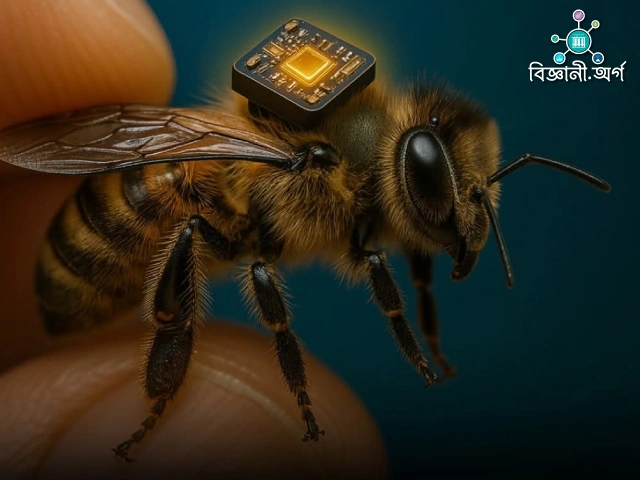
A team of researchers led by Professor Zhao Jieliang at the renowned Beijing Institute of Technology in China has recently created an ultra-light “brain control device” that can be directly attached to a bee’s brain to control its movements with remarkable precision. This invention opens a new horizon in research and technology, but at the same time, raises several ethical and environmental questions.
🧠 How Does This Brain-Control Device Work?
This “brain controller” device weighs only 74 milligrams—even less than the load of honey a bee can carry. This means it doesn’t noticeably impede the bee’s natural movement. The device is mounted on the bee’s back, and three micro-needles are inserted directly into the bee’s brain to deliver specific electrical signals. These signals influence the bee’s nervous system, allowing the device to control the bee’s forward, backward, left, or right movement with nearly 90% accuracy.
The research paper was published on June 11, 2025 in the Chinese Journal of Mechanical Engineering. It offers an in-depth discussion of the device’s technical structure, operating method, and possible applications.
🔬 The Technology’s Structure and Features
The device is constructed using an ultra-thin, transparent, and flexible polymer film circuit, which resembles an insect’s wing. It includes a tiny infrared receiver that enables remote control operation of the bee.
While this type of ‘flexible electronics’ technology has previously been used in robotics and some bioengineering experiments, this is the first time it has been successfully applied to such a delicate and small creature as a bee.
🌍 Uses and Future Prospects
The researchers have highlighted two potential uses for this technology:
- Humanitarian Use:
These bee-cyborgs could be deployed to search for people trapped in earthquake rubble or collapsed buildings. Their small size allows them to navigate tight and inaccessible spaces where drones or robots cannot reach. - Military/Espionage Use:
These cyborg bees could be used for intelligence gathering, anti-terrorism missions, and anti-narcotics operations for covert information collection and tracking purposes.
⚠️ Ethical and Environmental Concerns
However, this technology has sparked considerable debate and raised some key questions. The two main concerns are—
- Ethical Concerns:
Is it ethical to exercise direct control over animals? Some experts believe that deliberately sending electrical signals into a bee’s brain and using it like a ‘robot’ crosses the boundaries of biology. - Ecological Risks:
Bees are a vital part of the world’s pollination systems. If this technology is commercialized, it could disrupt bees’ natural behaviors—which, in turn, may negatively affect our food chain and agriculture.
🔎 Background: How Did ‘Insect Cyborg’ Research Begin?
This control technology for bees is not an overnight achievement. It is the product of many years of research and development. Notably, the “HI-MEMS” (Hybrid Insect Micro-Electro-Mechanical Systems) program by America’s defense agency DARPA played a significant role.
In this program, scientists first attempted to control the movements of insects, such as beetles and cockroaches, by implanting microchips. Later, similar research expanded to Japan, South Korea, and Europe. Some educational institutions have even created “AI-bot Cockroach Kits” for students.
However, until now, such precise and advanced control with such light devices was not possible on sophisticated and sensitive creatures like bees.
🧪 Science and Society: Revolution or Peril?
This research, while being a stunning example of technological advancement, has also opened a new avenue for reflecting on the relationship between science and society.
On the one hand, it holds potential for saving human lives; on the other, if misused, it could enable secret surveillance, animal cruelty, and disruption of ecological balance.
🔮 Directions for the Future
Further research into this technology is expected over the next 5 to 10 years. In the future, perhaps—
- The devices will become even lighter
- The control methods will become more complex
- Other species of insects or small creatures could be included
- And possibly a new era of bio-robots will begin
However, it will be important to ensure that these advancements do not cross the boundaries of humanity, ethics, and environmental protection.
✍️ Conclusion
This research from the Beijing Institute of Technology is ushering in a new era, where living creatures can be ‘steered’ with the aid of technology. While it is a technological triumph, we must remember that there should be limits to intervening with the laws of nature. May science guide us not just toward development, but also toward compassion and humanity.