News Desk, Biggani.org
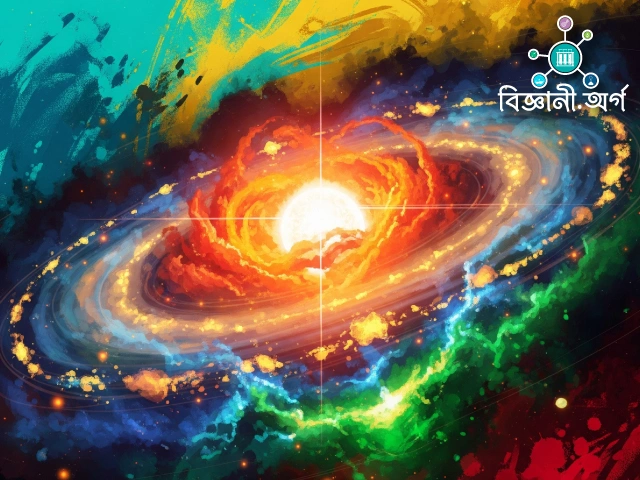
Astronomers have been able to directly observe the initial stages of planet formation around a young star located 1,400 light-years away. For the first time in history, we have obtained such a clear image of a star and the solar system forming around it—one that could help answer many unknown questions about the history of our own solar system.
This groundbreaking discovery comes from the joint observations of the James Webb Space Telescope (JWST) and Chile’s Atacama Large Millimeter/submillimeter Array (ALMA). The young star at the center of their research is called HOPS-315, situated in the Orion constellation, a vast region of star birth.
A Young Star, A Future Sun
This star named HOPS-315 currently has a mass equal to 0.6 times that of our Sun. Scientists believe it will eventually evolve into a star similar to our Sun. Thus, what’s happening in its surroundings can serve as a mirror image of the birth era of our own solar system.
This young star is still enveloped in dense dust, known as a protostellar envelope—a region where the star is drawing in gas and dust to form itself. Typically, this dust layer is so thick that nothing inside can be seen. But by combining JWST’s infrared and ALMA’s radio waves, astronomers managed to peer through this dense envelope and observe the interior.
First Stage: Clues to Mineral Formation in the Protoplanetary Disk
Astronomers have observed a swirling disc full of gas and dust, known as a protoplanetary disk—the womb of planet birth. Within this disc, tiny mineral particles gather together to form planetesimals, which later gradually develop into planets.
But before that, the gas needs to cool down for the first mineral grains to condense and become solid. Evidence for this process has long been rare, because the thick dust layer tends to hide everything. Even in our own solar system, a gap of 4.5 billion years has left many of these details unknown.
Solar System “Time Zero”: CAIs and the Origins of History
To pinpoint our solar system’s birth moment, scientists use a special kind of mineral called Calcium-Aluminum-rich Inclusions or CAIs. These are found in ancient meteorites, and are considered the first solid objects of the solar system. Scientists regard them as “time zero” or the starting moment of solar history.
Scientists speculate that these CAIs formed when the hot gaseous disk cooled, causing minerals to precipitate out. But exactly how, where, and when they formed has long remained a mystery.
HOPS-315: A Unique “Unicorn” Star
A research team led by Leiden University’s astronomer Melissa McClure detected chemical signatures of gases inside HOPS-315, such as silicon monoxide and crystalline silicates—clear evidence of mineral formation. Further ALMA observations revealed that these mineral grains are not part of any outflowing jet, but are located in a region of the disk stretching to twice the distance between the Sun and Earth.
This region is equivalent to our solar system’s main asteroid belt. Possibly, disk rotation or intense stellar winds from the young star are helping the mineral grains accumulate there.
No CAIs Detected Yet, But Signs Are Promising
Although CAIs were not directly detected, the ratio and location of mineral grains indicate that the conditions here were optimal for CAI formation. Phil Armitage, a theorist from the Flatiron Institute in New York, says that the kind of environment needed for CAI formation in HOPS-315 develops within the first few hundred thousand years of star birth.
Arizona astrophysicist Ilaria Pascucci notes, “If CAIs are detected, we could compare the history of our solar system with how other planetary systems form.” Even though this study did not directly detect CAIs, the fact that the environment is similar is significant.
Triumph of Technology: The Extraordinary Power of JWST and ALMA
NASA’s Spitzer Telescope had long ago identified HOPS-315 as a promising candidate, but proper analysis was not possible at the time. JWST’s unparalleled spectral resolution and sensitivity has now made such analysis possible.
McClure’s team observed HOPS-315 with JWST in March and September of 2023, and confirmed their findings with ALMA in November. Scientists found that silicon—a key ingredient of planet formation—is absent from the star’s outflows. This suggests that the silicon may have already transformed into dust or larger rocky bodies deep within the disk—just as happened in our solar system.
The Road Ahead: Potential for Deeper Exploration
This discovery has turned HOPS-315 into an “astronomical time machine” for scientists. It’s showing us the earliest stages of planet formation, long hidden in mystery. Researchers are also urging renewed focus on even younger stars—such as HOPS-68—for further study.
These observations teach us that the story of solar system formation isn’t just written in ancient meteorites, but also scattered throughout the galaxy, in the birth of new stars and planets.
Conclusion: Looking to the Sky Reveals the Past
Young stars like HOPS-315 teach us that today’s advanced technology and telescopes allow us to peer through time to understand the universe’s distant past. Just as an old photo recalls our own childhood, this star helps paint a picture of the birth hour of our solar system. Future research may one day reveal exactly where the story of planet formation began.
And this quest for astronomical knowledge is not just about space—it’s also a search for our own identity.
📩 For more fascinating science news, stay with biggani.org.
✍️ Author: News Desk, Biggani.org
📧 Contact: [email protected]