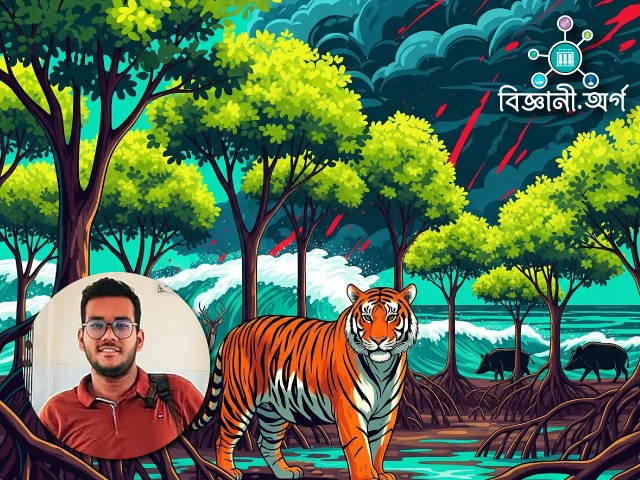
The Sundarbans, the largest tidal mangrove forest in the world, spans approximately 10,000 square kilometers, of which at least 6,017 square kilometers are located in the southwestern districts of Bangladesh (Khulna, Bagerhat, and Satkhira). Formed at the confluence of the Ganges, Brahmaputra, and Meghna rivers, this forestland is inundated by saline water from tides and features an abundance of muddy and sandy soil. Nearly a third (31.1%) of the forest comprises scenic wetlands such as rivers, canals, and lakes. The Sundarbans is home to over 800 species of plants, fish, reptiles, birds, and mammals, including the white Gewa and the large Sundari trees. This diversity and environment are unique: due to intense tidal actions, the shape and landmass of the forest change every year, with various islands emerging or vanishing. Recognizing its global significance, UNESCO designated the Sundarbans a World Heritage Site in 1997.
Environmental Impact of Climate Change on the Sundarbans:
Climate change is gradually compressing the environment of the Sundarbans. Due to global warming and rising sea levels, the fringes of the forest are steadily disappearing; since 1964, about 210 square kilometers of land in this region have submerged into the sea. Alongside, the frequency and severity of cyclones have increased—with the devastating Sidr cyclone in 2007 damaging about 40% of the Sundarbans, and the Aila tidal surge in 2009 affecting hundreds of thousands of people. Intensified storms have also accelerated erosion of soil and vegetation. The combined effects of rising seawater and reduced fresh water supply are increasing salinity throughout the Sundarbans. As a result, when the freshwater flow in the tidal wetlands is depleted due to the pressure of salt water, vegetation dies off in parts of the forest. Such changes pose a significant threat to the biodiversity and ecosystem balance of the Sundarbans. A study notes that “the rising sea level, stronger cyclones, and soil erosion are altering the landforms of the Sundarbans.” These transformations also destabilize the region’s climate and weather—the forest’s soil and climate gradually change as islands vanish and salinity increases.
Tiger Habitat and Food Crisis:
In this changing natural landscape, the habitat of the Royal Bengal Tiger is shrinking. Although it remains a prime forest area in Southeast Asia, much of the Sundarbans mangrove forest is now waterlogged. Research shows that “by 2070, the combined impacts of climate change and sea level rise will leave no suitable habitat for tigers in the Sundarbans.” That means, in less than 50 years, tiger populations in the Bangladeshi portion of the Sundarbans risk extinction. The same study warns that, without intervention, by 2050 tigers will be confined to only the less saline forests along the India-Bangladesh border. In fact, the latest surveys indicate that only 83–130 tigers remain in Bangladesh’s Sundarbans (about 86 in the Indian part), making the rate of habitat loss even more alarming.
The pressure on food sources is also immense. According to wildlife experts, deer account for about 78% of the tigers’ diet in the Sundarbans. However, climate change and tidal surges have increased salinity, leading to a shortage of freshwater in the forest’s ponds and wetlands. This crisis affects prey animals—such as spotted deer, wild boar, and monkeys—putting many forest species at risk. Water scarcity and salinity have caused declines in the populations of deer and wild boar, pushing tigers towards starvation and making prey increasingly scarce.
Tiger Population and Safety:
In addition to environmental changes, tiger security is a pressing concern. On the bright side, government conservation efforts have recently shown some growth in tiger numbers in the Sundarbans; surveys in 2015 and 2018 identified 106 and 114 tigers respectively, while the most recent camera-trap survey recorded more than 125 tigers. However, the first prerequisite for population growth is survival—illegal poachers and ecological destruction remain the tigers’ greatest threats.
To address these threats, the Forest Department has formed a ‘Tiger Response Team’ comprising 340 local people in 49 villages under the supervision of local mosques. As a result, there have been no incidents of human-tiger conflict in the Sundarbans in the past five years. Additionally, the government has declared 52% of the total habitat area (about 3,000 sq km) as protected forest, a significant increase from the previous 23%. In these reserved areas, tigers can roam freely and safely.
Experts caution that political and institutional measures alone are not enough to secure tiger safety—ecosystem protection requires awareness and active involvement from local communities. Wildlife researcher Pavel Partha reminds us, “Tiger conservation is impossible without protecting the ecosystem; the existence of tigers, deer, and monkeys are all intricately linked.” Thus, safeguarding every layer of the forest will ensure both food and shelter for the tigers.
Recent Research and Statistics:
Recent research and surveys on Sundarbans tigers present both hopeful and daunting pictures. The latest (2023–24) camera-trap survey estimates a minimum of 125 adult tigers in Bangladesh’s Sundarbans, about a 10% increase from 2018 (previous counts identified 106 and 114 tigers in 2015 and 2018 respectively). This indicates a slow but steady rise in the tiger population. The same report notes that the Bengal tiger is still globally endangered, with around 5,574 wild tigers remaining across 13 Asian countries.
Researchers in the subcontinent are hopeful that increased conservation efforts and monitoring will improve the chances for tiger survival in the Sundarbans. For example, another study shows that numbers of key prey species—deer, wild boar, monkeys—have significantly increased in recent times. The population of spotted deer has risen from 80-85,000 to about 141,357, and wild boar numbers have grown from about 28,000 to 45,110. Experts believe this increase in prey population indirectly aids the revival of the tiger population.
Initiatives and Recommendations:
Environmentalists and conservationists emphasize that saving the Sundarbans tigers requires more than just protecting the forest; comprehensive policy initiatives are needed. The Bangladeshi government has already taken a proactive approach: last July, it was announced in Ashbolla that the goal is to increase the number of Royal Bengal Tigers in the Sundarbans by 20% over the next five years, reaching 145. As part of this, over 51% of the forest has been declared protected area. Entry into the forest during tiger breeding season (three months) remains prohibited. Forest protection operations and patrol activities have been strengthened, as have community-based participation initiatives.
Conservation organizations have also provided various recommendations. For example, local and international environmentalists advise treating the Bangladesh-India mangrove zone as a continuous corridor for mutual conservation. To reduce climate risks, increased public participation has been recommended for reforestation and prevention of prohibited agriculture. Emphasis is placed on maintaining ecosystem balance to enhance food availability for tigers. Additionally, forest department researchers and environmental activists urge accelerated public awareness and law enforcement; as Professor Abdullah Harun Chowdhury notes, law enforcement must be stricter to combat the trafficking of tiger parts.
Above all, environmentalists unanimously state that saving the Sundarbans’ extraordinary ecosystem is key to the survival of its tigers. They remind us that the Sundarbans tiger is not only a national symbol of Bangladesh but is also important for the world. Therefore, reliable research-based initiatives and multilateral cooperation are essential for its conservation.
Source: The above information has been gathered from various studies and reports. Notable sources include: environmental features and statistics of the Sundarbans, international research on the impact of climate change, recent tiger census and prey surveys, and published initiatives and recommendations in environmental conservation literature and news.
Md. Fahad Hossain
Student, Department of Zoology
Shaheed Bulbul Government College, Pabna
(Affiliated with National University, Bangladesh)