News Desk, Biggani.org
📧 [email protected]
How a remarkable scientific discovery brought new light into the life of a science teacher—this story almost sounds like fiction! But it’s entirely real, and that reality is once again illuminating the possibilities of scientific research for us.
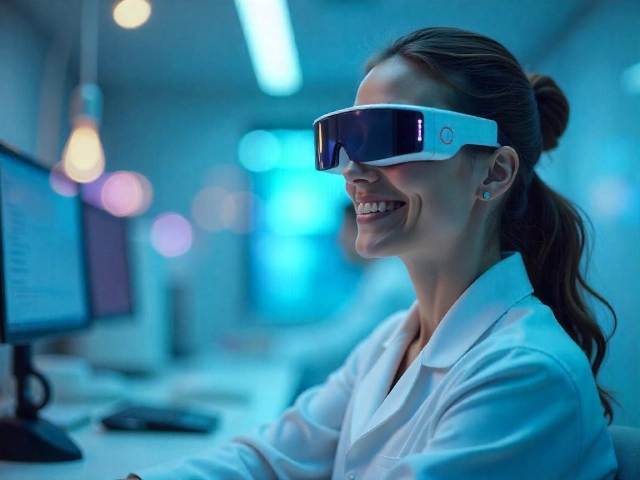
Today’s story is about Barna Gomez. At one time, she would stand in class and tell her students, looking them in the eye, “I see science through your eyes.” But eventually, her own eyes could see nothing at all. For 16 years, she was completely blind. Yet today she sits smiling in a laboratory, wearing a special pair of glasses equipped with a camera, with a tiny chip implanted in her head. This unique combination has given her back the sensation of seeing light!
🔍 How Was This Possible?
The story begins with a microchip called the Utah Electrode Array. This technology is implanted in the part of our visual cortex—the area of the brain where information from the eyes is processed.
🧠 How Does It Connect with the Brain?
Let’s imagine for a moment. Suppose you’re watching a movie. Light enters your eyes and forms an image in your brain. But Barna’s eyes no longer worked. So, the scientists decided to bypass the eyes and send visual information directly to the brain.
They implanted an electrode array in her brain, which can generate images without the eyes by sending tiny electrical pulses. It was paired with a camera-equipped pair of glasses. Whatever the camera sees is converted into signals—which go straight to the brain and create a shadowy image.
🔡 Seeing Letters Again?
Yes! During the trial, Barna Gomez was able to identify simple letters like I, L, O. It’s not that she can see clearly like we do—but she can recognize those letters through light and shadow. This is the first step in restoring vision.
📷 How Exactly Does This Camera Glasses Work?
Here’s a simple example. Imagine you’re taking a picture with your phone, but you’re not holding the phone—instead, you’re wearing a pair of glasses with a camera built in. Whatever the camera sees, the image signal is sent to a computer. That computer then converts it into the brain’s language—electrical signals. These signals reach a specific part of the brain and produce the feeling of small spots of light. With this, the brain can make out when something is in front.
🧪 The Science Behind This Discovery
This isn’t just about technology; it’s a revolutionary application of neuroscience. We know the brain has millions of neurons that communicate with each other using electrical impulses. The Utah Electrode Array gently stimulates these neurons to create the sensation of ‘seeing’.
🏥 Why Is This Research So Important?
If this research can be successfully applied to many more people, then in the future, countless blind individuals could regain partial vision. It is giving rise to an innovative new field called bionic vision, where technology helps overcome the limits of the human body.
📚 Final Thoughts: Science Surpasses Science Fiction
Once, things that seemed impossible have now become reality. Being able to suddenly recognize letters after 16 years of blindness is no magic—it’s science, human perseverance, and the result of research.
Dear students, this story is not just about regaining sight—it’s a light of hope. Love science, learn it, question everything. Because maybe one day you’ll create a technology with your own hands—one that brings not only the blind, but the whole world, into new light.
🖋 Author: News Desk, Biggani.org
📮 Contact: [email protected]