Has anyone ever hypnotized you? In reality, any brain is always aware of itself—this awareness is what we call “consciousness” or “awareness.” However, this perception can occur in two ways—directly and through the surrounding environment. When your brain is in a hypnotic state, or “hypnosis,” your consciousness splits into two parts—one part continues to perceive itself directly, which is not under the control of the hypnotist (or yourself), but the other part perceives itself through the surrounding environment, which is largely under the influence of the hypnotist. So you can understand that hypnotizing someone is not a very easy task. Only after proper training can a person master the skill of hypnotizing another person.
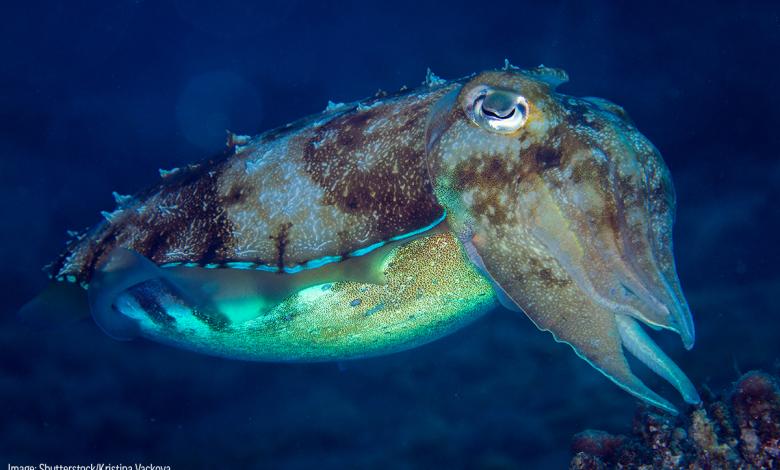
However, there are creatures in nature that possess an innate ability to hypnotize! They are the second largest “Sepiida” or “cuttlefish,” meaning that like octopuses and squids, they belong to the class “Cephalopoda.” They don’t have a true body trunk, but they do have eight arms, each directly connected to their head, which is why they are called “cephalopods.” With their tentacles included, they can reach up to fifty centimeters in length and weigh at least ten kilograms. Their habitat is the Indo-Pacific coral reefs. Among them, the males are slightly larger than the females. Along the entire circumference of their bodies are soft fins, which they continuously undulate up and down, propelling them slowly through the sea water. Inside their bodies is a hollow space called the “mantle,” where their gills are located. After drawing in seawater, it enters the mantle, where the gills extract dissolved oxygen to breathe. When they need to move quickly, they forcefully expel the water collected in the mantle as a jet through a muscular tube-like structure called the “siphon,” propelling themselves forward at great speed—much like a jet plane. Not only that, but their internal skeleton, the “cuttlebone,” is actually a porous internal shell with several chambers. By adjusting the amount of fluid and gas within these chambers, they can regulate the buoyant force exerted by the surrounding seawater on their whole body. As a result, with minimal effort, they can float at a desired depth in the ocean, such as hovering near the sea floor while hunting preferred prey like crabs, lobsters, shrimps, sea snails, fish, etc. Using their two tentacles, they snag their prey and bring it swiftly to their mouths. At the tip of each tentacle there is a broad, paddle-like structure called a “broadclub” that helps them catch prey tightly, along with the previously mentioned “cuttlebone” in their body. For these two reasons, they are named “Broadclub Cuttlefish.”
Now, let’s discuss the hypnotic abilities of the “Broadclub Cuttlefish.” You might be surprised to learn that this power lies in their skin. Their skin consists of four layers. The top three layers are filled with millions of pigment cells. Each elastic pigment cell is attached to several muscles around its perimeter, allowing it to expand in size, and these muscles are each controlled by a specific nerve from the brain. The outermost layer contains yellow pigment cells. The next two layers feature red and brown pigment cells, respectively. With each yellow, red, or brown pigment cell, they can produce small spots or dots of yellow, red, or brown on their skin. For example, to create a small yellow spot on its skin, a specific nerve cell in the broadclub cuttlefish’s brain is stimulated, causing the muscles around a yellow pigment cell in its skin to contract and expand it, resulting in a small yellow spot or dot. When the nerve cell becomes inactive, the muscles relax, the yellow pigment cell shrinks back to its original size, and the yellow spot disappears. The broadclub cuttlefish divides its pigment cells into various groups, expanding and contracting them in a specific rhythm. The resulting play of colors on their skin seems as if you’re watching electric lights at a Durga Puja or Kali Puja festival! They can separate their pigment cells into a multitude of different groups and expand/contract them in various patterns—imagine just how many kinds of color displays they can create! The fourth and deepest layer of their skin is white, filled with countless iridescent reflector cells. When viewed from different angles, these reflector cells display brilliant shades of blue, green, red, pink, and more! As the broadclub cuttlefish approaches its prey, it begins its colorful displays, which mesmerize creatures like crabs (with their dioptric eyes), lobsters or shrimps (with compound eyes), or the eyes (ocelli) of sea snails. Not only do these displays catch the prey’s eye, but they are also extremely hypnotic! As a result, the prey often shows little inclination to escape!
If needed, the broadclub cuttlefish can change not only the color but also the texture or structural characteristics of its skin! By using this ability, they sometimes imitate seaweed to stalk prey and, at the right moment, catch the prey with their two tentacles and swiftly carry it to their mouth! The broadclub cuttlefish’s skin helps not just in hunting but also in avoiding being hunted. When one of their main predators, sharks, approach, they can change the color and texture of their skin to match the surroundings, rendering themselves almost invisible to the shark’s eyes! If mimicking the colors or textures of the environment isn’t possible, they release a thick cloud of ink called “sepia” around themselves, quickly changing their skin’s color and texture to blend with the ink and disappear! These methods of hiding are what we call “camouflage.”
During reproduction, each female broadclub cuttlefish mates with multiple different male broadclub cuttlefish on the coral reefs and stores the collected sperm in her body. Later, she chooses which male’s sperm to use to fertilize her eggs. The female then attaches the fertilized eggs firmly to the coral reef or another hard surface, where, in due time, each fertilized egg develops into a new broadclub cuttlefish.