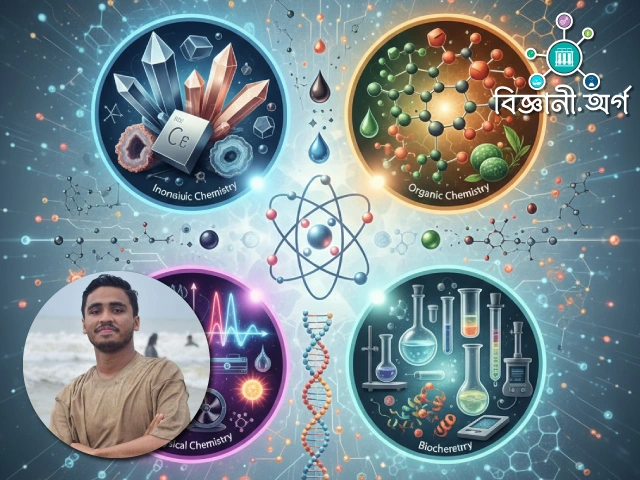
Chemistry is a science that discusses the composition, properties, change, and mutual interactions of matter. It is involved in every aspect of our daily lives—from cooking food to making medicine, agriculture, industry, and even space research, the role of chemistry is immense.
Chemistry is primarily divided into several main branches, each focusing on specific aspects and properties of matter. Below, you’ll find detailed information about the major branches of chemistry and their applications.
🔹 1. Inorganic Chemistry
Inorganic chemistry deals with substances primarily consisting of elements and compounds other than carbon. Examples include metals, non-metals, salts, minerals, etc.
You will learn here:
The structure of elements and compounds
Reactions of salts, acids, and bases
Formation of alloys and minerals
Applications:
In industry: In the production of cement, glass, metal equipment, fertilizers, etc.
In medical science: Certain compounds used in medicines, such as FeSO₄ (iron supplement), Mg(OH)₂ (antacid), etc.
In environmental science: Various chemicals are used for water purification and air pollution control.
Inorganic chemistry is the foundation of basic chemistry. If you want to understand the structural aspects of chemistry well, mastering this area is essential.
🔹 2. Organic Chemistry
Organic chemistry mainly deals with carbon-based compounds. Carbon can bond with other elements to form an enormous number of compounds—it’s this diversity that makes organic chemistry so vast and important.
You will learn here:
The structure and reactions of hydrocarbons, alcohols, acids, esters, aldehydes, ketones, etc.
Biomolecules (proteins, carbohydrates, lipids, etc.)
Polymers (plastics, nylon, polythene, etc.)
Applications:
In the pharmaceutical industry: Almost all types of medicines, vitamins, enzymes—all are organic compounds.
In the petrochemical industry: Production of petrol, diesel, plastics, rubbers, dyes, etc.
In agriculture: Pesticides, fertilizers, plant growth hormones—all are results of organic chemistry.
Organic chemistry is called the chemistry of life because almost every chemical reaction occurring in living organisms is mediated by organic compounds.
🔹 3. Physical Chemistry
Physical chemistry is a branch where the physical properties of matter and the kinetics and thermodynamics of chemical reactions are discussed.
You will learn here:
Chemical thermodynamics
Reaction rate and kinetics
Atomic structure and quantum chemistry
Electrochemistry
Applications:
In industrial production: Helps control temperature, pressure, catalysts, etc. to increase reaction efficiency.
In environment and energy: Physical chemistry plays a crucial role in the development of batteries, solar cells, fuel cells.
In research: Essential for understanding the process of creating new substances or reactions.
Physical chemistry is known as the “mathematical part” of chemistry. If you want to become a scientist, knowledge in this area will help enhance your analytical thinking skills.
🔹 4. Analytical Chemistry
This branch is involved in determining the composition, quantity, and purity of substances.
You will learn here:
Qualitative analysis: Identifying what is present in a substance.
Quantitative analysis: Determining how much of a substance is present.
Instrumental analysis: Techniques such as spectroscopy, chromatography, titration, etc.
Applications:
In medication and food quality control: Used to determine whether any product contains harmful substances.
In research: The structure and purity of new compounds are verified.
In environmental monitoring: Measuring pollutants in water, soil, and air.
If you enjoy lab-based work or research, analytical chemistry is an ideal field for you.
🔹 5. Biochemistry
Biochemistry primarily studies the chemical processes occurring in living organisms.
You will learn here:
The functioning of proteins, carbohydrates, lipids, and enzymes
The chemistry of DNA, RNA, and genes
Metabolic processes
Applications:
In medicine and genetics: Understanding disease causes, drug mechanisms, gene therapy, etc.
In food and agriculture: Nutritional analysis and production of organic fertilizers.
In biotechnology: Development of new vaccines, biofuels, and genetically modified organisms (GMOs).
Biochemistry is one of the most important branches for understanding human life and health.
🔹 The Integrated Importance of Chemistry
These five branches of chemistry are deeply interconnected. You cannot fully understand one without knowledge of the others. For example, developing a new medicine requires organic chemistry, but analyzing its structure involves analytical chemistry, understanding its mechanism requires biochemistry, and improving production efficiency involves physical chemistry.
✅ Final Words
Chemistry is not confined to laboratories—it is intricately linked to human life, industry, technology, and the environment. If you are proficient in chemistry, you can contribute to any field—science, engineering, medicine, agriculture, and more.
Learning chemistry is not just about memorizing formulas; it’s about understanding the behavior of matter and uncovering the mysteries of nature. So if you want to know the world deeply, every branch of chemistry will lead you to new horizons.
Hossain Md. Arafat
Department of Chemistry, Chittagong College.