


There has been a lot of research on whether information can be stored in mediums other than hard disks, which are used in computers. In this regard, Japanese scientists have discovered a method to store information within DNA.
What is DNA?
DNA is essentially a repository of information for our bodies. Through DNA, physical structure, character traits, and various other information from previous generations are passed down to the next. We often refer to “blood ties,” but in reality, it’s the “bond of DNA.” The relationship between parents and their children is determined through DNA. A large portion of a child’s DNA is inherited from both parents. In nature, the information in DNA is stored, and scientific instruments can be used to read this data. Scientists routinely do this now—and we also perform this in our lab.
We usually copy or modify a particular DNA. Just as children build houses with Lego, we create blocks with DNA in much the same way. It is worth mentioning that we do not directly use human DNA; rather, we use artificial DNA made from various bacteria. However, some labs do use actual human DNA directly.
Many years ago, the Genome Project was very popular among scientists. The goal of the Genome Project was to collect all the information contained in human DNA. The Genome Project is now complete, and we know about the structure and contents of our DNA.
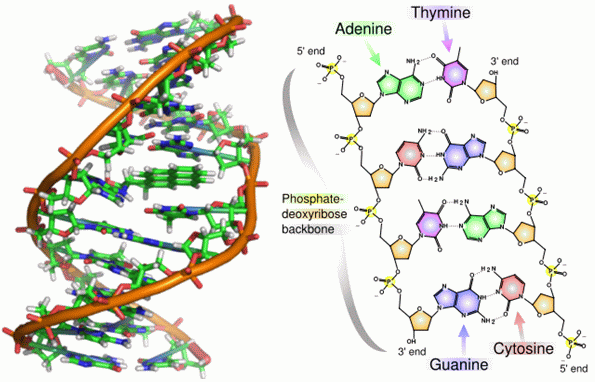
Figure: Structure of DNA
How much information can DNA hold?
DNA is primarily composed of four components: Adenine, Thymine, Cytosine, and Guanine. These A, T, C, and G elements can be arranged in various sequences within DNA, and it’s through these arrangements that information is stored. It’s important to note that DNA itself does not create anything; it merely contains information. Our cells use the information in DNA to build various proteins that make up our bodies. Whether your skin will be fair or dark is determined by your DNA. Until now, information was simply stored in DNA, and we would extract or sequence that information.
The most fascinating thing is that recently, a Japanese researcher, Masaru Tomita of Keio University, discovered a new method to store information inside DNA. For storing or inserting information, they chose “e=mc2” and “1905”. The former is Albert Einstein’s famous equation, which he formulated in 1905. Dr. Tomita and his team succeeded in inscribing these two pieces of information inside a bacterium. Later, they were able to retrieve this information successfully. Until now, no one had invented a process to store information inside something via DNA in this way. This marks the first discovery proving that various codes can be stored in DNA.
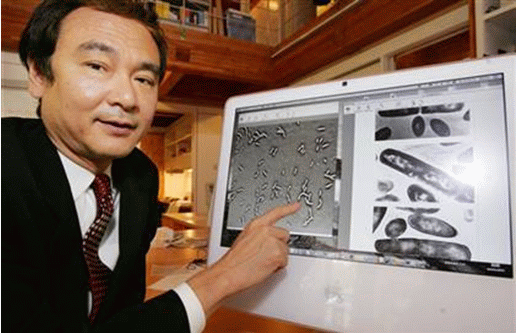
Figure: Japanese scientist Masaru Tomita demonstrates how “e=mc2” and “1905” are stored in bacteria
Why is there so much excitement about storing data in DNA?
The main reason is the question of whether, just as computers use different hard disks to store information, it is possible to store data in other materials—in particular, biological substances. This has been an area of intense research.
People have been amazed by DNA’s tremendous data storage capacity and believe that DNA could fulfill this long-held dream. When Japanese scientists developed this method of storing information, other experts suggested not only using bacteria but even cockroaches as hosts. In other words, there’s even speculation about storing DNA data inside a cockroach. But why a cockroach, among all possibilities—why this “ugly” insect? The reason is that cockroaches can survive in the harshest environments. It has been found that even if Earth is destroyed by sudden radiation or a nuclear bomb, cockroaches would likely survive. They can live at a wide range of temperatures and even survive some chemical explosions. For these reasons, the cockroach is considered capable of enduring the most extreme conditions. The genome of a cockroach contains about 2.9 billion sequences—equivalent to around 750 megabytes of data. Most importantly, if information is stored in a cockroach’s DNA, it could remain preserved for generations to come!
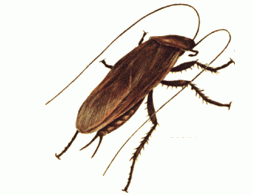
Figure: It is even possible to store information in this cockroach!
However, an interesting fact about DNA is that not all information contained within it is essential. Only about three percent (3%) holds crucial data. For cockroaches, that’s about 22,000 important pieces out of 2.9 billion. The remaining 97% is commonly referred to as unknown, filler, or “junk” data.
We still don’t know what this unknown information in DNA is. There are even some fun stories among scientists. For instance, there is ongoing research to find out if any secret information is hidden within DNA’s double helix structure—the form discovered by Francis Crick in 1973. Crick even suggested that DNA might have originated from another planet. That’s why some believe there may be hidden messages inside DNA that we have yet to unlock.
Many of you know about the SETI (Search for Extra-Terrestrial Intelligence) program, which monitors radio signals from the sky to search for potential messages. This search for extraterrestrial or alien life is referred to as Out World research—the search for hidden messages in external sources. On the other hand, the process of searching for information within DNA is called In World research—looking for secrets within ourselves. There are differing opinions on this; for example, Gill Bejerano from the University of California says that while much new information is being discovered in DNA, some interpretations are coincidental rather than meaningful facts, much like how some people claim to find secret codes in the Bible—the intention was possibly never there, but connections are sometimes drawn anyway.
The current point of interest is whether DNA can truly be used for data storage, and if so, for how long can the data remain preserved? One of DNA’s biggest issues is that its information can easily mutate or be lost. However, Dr. Tomita’s Japanese team developed a storage method where, even if up to 15% of the data changes, recovery is still possible. While 15% may seem small, in the case of bacterial DNA it would take up to a million years for that much change to occur—so over time, this is actually a minimal rate and the data remains recoverable.
This method is important because we can not only store information, but also retrieve it. Still, like many scientists, Dr. Bejerano believes that storing data in DNA is a bit “foolish” since it can be lost so easily. If data is inserted but no one can read or retrieve it later, what is the use? Yet debates continue among scientists. For those researching DNA, this is a hot topic. Until now, we viewed DNA purely as a data repository from which information was extracted and used to understand protein formation. But now, the focus has shifted—is it possible to insert artificial information into DNA, just as the Japanese team entered Einstein’s famous “e=mc2” equation and the year 1905? Not only did they insert the data, but they could also retrieve it. Furthermore, their method allows for recovery even if 15% is damaged. This is a major advancement in the field of DNA research.
Scientists are exploring various media for data storage to propel computers into the future: for example, some are considering storing information inside three-dimensional holograms, while others are experimenting with storing data in crystals. Amid all this, the idea of storing data in DNA is gaining new ground, and Japanese scientists have proved it is possible. And so, the scientific exploration of DNA continues.
SETI is used in the “Out World” search for messages from outer space, while “In World” refers to searching for hidden data within DNA—or somewhere within ourselves. Here, “someone else” may refer to extraterrestrials or, in some beliefs, to a divine being. Thus, discussions of “In World” and “Out World” continue.
In summary, research on DNA is incredibly fascinating and new discoveries are continually being made.
Sources:
- The New York Times, 28 June 2007
- International Herald Tribune, June 26, 2007
- Masaru Tomita et. al. “E-CELL: software environment for wholecell
simulation”, Bioinformatics, Vol 15, 72-84, 1999
Published in: Amader Desh, 24 July 2007






This comment has been sanitized for the English site.
This comment has been sanitized for the English site.
This comment has been sanitized for the English site.
Likhati PDF file kore dile valo hoto. Thanks for your write up.
khubi valo legese
This comment has been sanitized for the English site.
Gorgeously Awesome!!!
This comment has been sanitized for the English site.