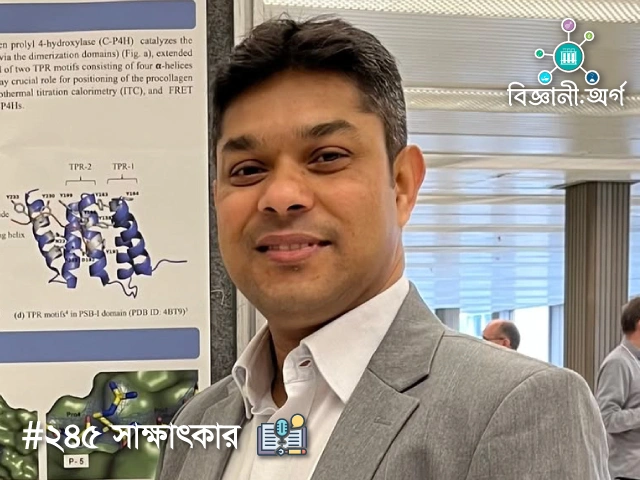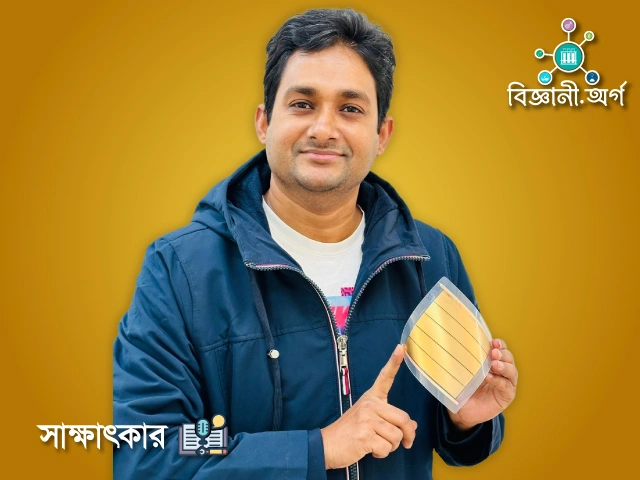
From an ordinary student in Bangladesh to a place among the world’s top 2% of scientists, Dr. Mohammad Shahiduzzaman Sohel is now a renowned name at home and abroad. His life began filled with failures and obstacles, but through relentless perseverance, right decisions, and hard work, he changed his own fate. In just over a decade, he has become an associate professor at the Nano-Materials Research Institute of Kanazawa University in Japan, the author of more than 120 research papers (including 35 as first or corresponding author), and a noted specialist in renewable energy. His publications in journals with an average impact factor above 6, and his receipt of Kanazawa University’s “Best Young Researcher” award (2023), are testaments to his excellence. Especially with 12 years of research experience in perovskite solar cells, Dr. Sohel has brought innovation to renewable energy technology. The ups and downs, struggles, technological breakthroughs, and inspirational stories from Dr. Sohel’s personal and professional journey offer our students valuable lessons and motivation.
Childhood and Educational Challenges
Dr. Shahiduzzaman Sohel was born into a middle-class family in Faridpur, and his early chapter in life was quite ordinary. His father, Haji Abdul Khaleq Mia, was the headmaster of the local primary school—a principled and hardworking man who dreamed his children would attain higher education. The youngest of three sons, Sohel was a talented student but, influenced by friends and a lack of parental supervision during adolescence, he strayed from his path. When he left Faridpur to study his intermediate at Madaripur with friends, Sohel lost focus on academics. As a result, in the 2001 HSC exams, all his friends failed, and Sohel barely managed a second division pass. This unexpected result was a tremendous shock for Sohel’s family. His father had hoped he would achieve “star marks”, but was instead faced with a son on the brink of failing—leading to disappointment and anger.
His father dreamed that Sohel would become a doctor. Despite his results, Sohel enrolled in coaching for Salimullah Medical College in Dhaka at his father’s insistence, although he was fully aware that his academic foundation wasn’t strong enough for medical entrance. Tension built between his father’s pressure and his own lack of interest; eventually, when his father learned of his second division HSC result, he declared, “You won’t be able to study anymore.” Out of frustration, Sohel’s father didn’t even allow him to sit for public university entrance exams, and instead forcefully admitted him to local Rajendra College (affiliated with National University) for undergraduate studies.
This blow forced Sohel to rethink his priorities. The guilt of failing his father’s dream and facing the consequences of his own mistakes made him resolute—he decided that he would study as much as possible in Bangladesh, but would prove himself abroad through higher studies. From his time studying physics at Rajendra College, Sohel set his sights on becoming a researcher and conducting research at developed foreign institutions. As preparation, he prioritized improving his English skills. From 2007 to 2009, living in Dhaka’s Dhanmondi, he practiced English day and night—scoring high in exams like TOEFL, IELTS, and TOEIC (for example, 110 out of 120 in TOEFL iBT and 7.0 in IELTS). Alongside his language preparations, he searched for opportunities for admission and scholarships at international universities. As a result, in 2010, Mohammad Shahiduzzaman Sohel earned admission to pursue a master’s at the prestigious Japan Advanced Institute of Science and Technology (JAIST).
Research Journey and Hardship in Japan
The young Sohel, who set out alone for Japan in 2010, faced daunting challenges. Due to limited family finances, he had to go without any scholarship initially. Apart from adjusting to the new environment, language, and culture, he had to work tirelessly to cover tuition and living expenses. After formally enrolling in the master’s course at JAIST in September 2011, the university granted him a modest scholarship (about seventy thousand yen monthly), but this wasn’t enough for tuition and living costs. As a result, Sohel had to juggle two part-time jobs: working at McDonald’s during the day and delivering newspapers late at night. Many nights, he would sleep for just three to six a.m., then head out, before dawn, to deliver newspapers, return home, eat quickly, and be at the laboratory by morning. For several consecutive years, he rarely got more than four hours of sleep, surviving on countless cups of coffee to keep himself alert. Even on holidays like Eid, when others celebrated, Sohel continued working late in the lab to fulfill his goals.
For his master’s research, Sohel worked in a synthetic chemistry lab, focusing his thesis on synthesizing new nanoparticles and using them as thermoelectric materials. Thermoelectric materials are those that can directly convert heat into electricity—for example, generating electricity from waste heat from a car’s engine. Alongside the demands of research, the strict lab environment posed a new trial for Sohel. His Japanese supervisor, Professor Mineo Sano, was exceptionally disciplined and strict, never allowing any compromises in drawing out the best performance from students. Professor Sano rejected Sohel’s master’s thesis twelve times in a row—every time Sohel submitted a draft, any minor flaw would result in “It’s not right” and the thesis would be handed back. Such repeated revisions were undoubtedly exhausting, but Sohel never gave up. Finally, on the thirteenth version, the thesis paper was approved—just a day before the final defense! For the first time, Professor Sano shook his hand and said, “Well done, congratulations.” Passing through such rigorous stages, Sohel completed his master’s degree in 2013 and realized that this tough training had truly prepared him for the harsh realities of research. Although he once resented his professor (as he had to help a peer write a paper with his own research data, receiving only third author credit), today he remembers him with gratitude. Professor Sano shaped him like fire tempers iron—making it flexible and refined—enabling Sohel to develop the mindset to tackle any challenge.
One positive side effect of these tough experiences at the end of his master’s was reigniting Sohel’s motivation. The ongoing thesis struggles and not receiving due recognition in an important publication firmed his resolve: “I will publish at least one more first-author paper than my supervisor’s lifetime record.” This fierce determination became Sohel’s relentless inspiration throughout his research career.
A New Journey in Perovskite Research
Just before finishing his master’s in 2013, Sohel decided to switch subjects for his Ph.D. He had a keen interest in renewable energy and solar power. At that time, perovskite solar cells were just beginning to attract global research attention: in 2009, Japanese professor Miyasaka had first created a solar cell using liquid-state perovskite; between 2012 and 2013, work began on solid-state perovskites. Perovskite is a type of semiconductor crystal named after Russian mineralogist Lev Perovski, and is a hybrid material containing both organic and inorganic components. Its unique property is that even in very thin layers, it can efficiently absorb sunlight. In general, a semiconductor absorbs sunlight and creates an electron-hole pair (negative and positive charges); if the charges can be separated and made to flow in a circuit, electricity is produced. Perovskite’s light absorption capability (extinction coefficient) is ten times higher than silicon, so even at nanoscale thicknesses (~ couple hundred nanometers), it can absorb enough sunlight to generate as much or more electricity as silicon. For example, silicon-based solar cells typically require micrometer-thick layers, making them heavy and rigid; in contrast, perovskite’s thin nanolayer cells are much lighter and flexible. Theoretically, single-junction perovskite solar cells could reach up to 33% efficiency, and with multiple-layer (tandem cell) technology, could potentially exceed 45%.
Seeing this potential, Sohel dove into perovskite research for his Ph.D. After earning his master’s from JAIST, he enrolled in a Ph.D. program at Kanazawa University in October 2013 and, fortunately, received Japan’s MEXT scholarship. Yet, starting at a new university, with a new supervisor, and in a completely new field, wasn’t easy. In the first few months of his Ph.D., he struggled with insufficient research results, all while facing major changes in his personal life—returning home in April 2014 to get married, then coming back to Japan to resume research. His supervisor was not pleased with Sohel taking leave for marriage right at the start, which further increased the expectations and pressure on him.
Despite not seeing much early success in the first eight months of research, Sohel didn’t give up. There were hardly any senior or Bengali-speaking colleagues in his lab, so he sought advice from a neighboring Indian assistant professor (Professor Ram). Though not a perovskite specialist, this researcher gave Sohel some general strategies that helped spark new thinking. Sohel would work non-stop in the lab during the day, and while delivering newspapers late at night, his mind constantly turned over his research problem—how could this new material astonishingly form its own tiny nanoparticles directly on ITO glass, and what could the mechanism be? Sometimes, after only 2–3 hours’ sleep, he would rush back to the lab to test his ideas. After almost three months of intense day-and-night brainstorming, he suddenly arrived at a logical explanation for the mechanism. Running home at dawn, he wrote down his insight, then excitedly presented it to his supervisor in their next meeting. Initially skeptical, his professor listened carefully and admitted he was surprised—Sohel’s answer was correct. The supervisor immediately suggested patenting the discovery and moving forward with follow-up research. This was a turning point in Sohel’s life—winning recognition for his first discovery boosted his self-confidence tremendously.
Technological Innovations and Contributions
Sohel and his team’s breakthrough was introducing “ionic liquid” into perovskite solar cells. In simple terms, an ionic liquid is a salt that is liquid at room temperature—composed of positively and negatively charged ions. These liquids have unique properties—they are environmentally friendly “green solvents” and quite hydrophobic. By adding a small amount of a special ionic liquid to the solution when making perovskite solar cells, the stability of the crystals in the resulting solar film is significantly improved. Early perovskite cells suffered from poor stability—whereas silicon solar panels last 20+ years, basic perovskite cells would lose function after only a few months. Sohel aimed to increase the lifespan and enhance the manufacturability of perovskite cells. Around 2014, he was the first in the world to implement the concept of mixing ionic liquid into perovskite casting and filed for a patent in Japan. At first, such cells achieved only 10% efficiency and weren’t fully stable, but this innovation planted the seeds for future major breakthroughs.
After completing his Ph.D. (in 2016, with three first-author research papers and a patent), Sohel worked for a year as a specially appointed postdoctoral researcher at Kanazawa University. He then took another postdoc position at Tokai University in Japan, where his research further expanded. Focusing on “seeded growth” techniques for the ionic liquid-treated perovskite nanocrystals he had developed—using these nanoparticles as seeds to nurture the growth of perovskite crystals, enhancing cell performance and durability. In 2021, after returning to Kanazawa University as a specially appointed assistant professor, he experimented with these advanced cells, finding that even after being kept in a normal environment (with ambient humidity and oxygen) at room temperature for eight months, his enhanced perovskite cells retained most of their efficiency. This was a major breakthrough—since previously, these cells could only be made inside controlled glove boxes, lest they spoil in days. Sohel’s ionic liquid innovation protected the crystals from moisture, ensuring stability.
Building on this success, Dr. Sohel decided to take perovskite technology straight from the laboratory to industrial scale. He licensed his technology to a Japanese company, which used it to produce 10×10 cm perovskite solar modules and verify their potential. As the next step, in February 2026, Dr. Sohel will launch a startup company with three Japanese professor-colleagues—named NST Solar Technology (proposed; the three founders’ initials: Nakano, Sohel, Taima—NST). This startup aims to produce and distribute affordable, long-lasting solar panels, particularly for developing countries.
The roll-to-roll method Dr. Sohel envisions for making solar panels is a technology where solar cells are continuously printed onto a large strip, like a giant roll of tape or toilet paper, producing sheets of solar film several meters long. Compared to traditional silicon panels, this approach enables the rapid, cost-effective production of flexible solar cells in bulk. Such ultrathin and flexible solar panels have diverse potential uses—for example, as tile-like cladding on building walls, as transparent coatings on windows, or as panels integrated into electric vehicles for Vehicle-Integrated Photovoltaics (VIPV). Where the weight and fragility of silicon panels make these uses impractical, perovskite’s light, thin films open whole new worlds. In earthquake-prone regions, there’s a real danger of heavy silicon panels falling from roofs—perovskite panels, even if broken, are lightweight and safer. Moreover, research is ongoing on perovskite cells that function even with normal indoor lighting, potentially powering smart home devices and building self-sufficient energy systems.
In countries like Bangladesh, blessed with abundant sunshine but limited land, flexible solar cells installed on rooftops, walls, or vehicles could revolutionize power generation. Especially, with Dr. Sohel’s eco-friendly, open-air process, there’s no need for expensive clean rooms or glove boxes—a major advantage for developing countries like Bangladesh. If simple spin-coating equipment can be used to make perovskite films in open air, then local companies could begin domestic solar panel production with minimal investment. Of course, perovskite cells do have some limitations: for example, the organic top layer is moisture-sensitive, so panels must be well encapsulated and sealed to block water vapor. Dr. Sohel’s team has also advanced techniques for securing this protection with plastic lamination. When properly sealed, the panels accumulate less dust and maintain their performance for years.
Mentors and Global Research Collaborations
On the road to scientific success, collaboration and mentorship are critical. Several inspiring mentors stand out in Dr. Shahiduzzaman Sohel’s journey. First among them is Dr. Jamal Uddin, professor and director of the Nanotechnology Center at Coppin State University, USA. Dr. Jamal has long been a guide for Sohel among the Bangladeshi research community, regularly offering encouragement and support. Sohel gratefully acknowledges that Dr. Jamal’s advice and networking helped him set ambitious goals and find the courage to pursue them.
Early in his Ph.D. at Kanazawa, Sohel was fortunate that Dr. Ismail from Chittagong University (now at Fukushima University, Japan) was there as a visiting professor. For a year, Dr. Ismail mentored Sohel almost daily in the neighboring lab, teaching him how to write research papers. At the same time, another senior, Dr. Mosharraf from Chittagong University, came to Japan for a week. On Dr. Ismail’s suggestion, Sohel spent every moment with Dr. Mosharraf, learning invaluable lessons on research planning, data analysis, and academic writing. Sohel jokingly says these two mentors trained him so well that his own number of publications now surpasses their combined outputs. In truth, the guidance from Professors Ismail and Mosharraf enabled Sohel to become the first or corresponding author on more than 35 scientific papers—a remarkable achievement for a rising researcher.
During his postdoctoral research, Dr. Sohel had another major turning point when he met Professor Miyasaka, the inventor of perovskite cells, in Japan. After attending Sohel’s seminar at Tokai University, Miyasaka was so impressed that he invited Sohel to work in his lab. Collaborating and co-authoring two papers with Miyasaka brought Sohel greater international recognition. He also spent a short stint as a visiting researcher at Waseda University in Tokyo, placing him at the center of Japan’s scientific network.
Dr. Sohel’s research network now spans the world. He is collaborating with researchers at Stanford University in the USA, as well as in Hong Kong University, Malaysia, and Saudi Arabia. Among Bangladeshi researchers, he’s started a recent project with Dr. Mainul Islam of Dhaka University. Even living away from home, Sohel tries to involve talented Bangladeshis in world-class research—for example, he has co-published work with Dr. Ismail (now at Panasonic Research Labs in the USA, formerly at AIUB) and Professor Akhtaruzzaman (working in Malaysia and Saudi Arabia). Underpinning this diverse network is Sohel’s philosophy: scientific research is now a global platform—without cross-border collaboration, major breakthroughs are impossible. Therefore, aspiring researchers must focus on global networking from the start.
Recognition and Milestones of Success
The list of Dr. Shahiduzzaman Sohel’s achievements is long and still growing. His research output has already brought Bangladesh pride—he was included in the world’s top 2% scientists list published by Stanford University in 2021. In 2023, he earned the Encouragement Award (Best Young Researcher Award) at Kanazawa University for his outstanding research—a rare honor for a Bangladeshi there. In just a decade, he has published over 120 research papers, including more than 35 as first or corresponding author. Notably, his articles have appeared in top-tier publishers like the American Chemical Society (ACS) and Elsevier—such as ACS Sustainable Chemistry & Engineering, and the high-impact journal Nano Letters. From 2018 to 2022, he has published an average of 8–10 papers per year—an enviable mark for any international researcher. By the end of his Ph.D., he held a Japanese patent, and in recent times, he’s filed an international patent for his new perovskite technology.
As a teacher and researcher, Dr. Sohel’s career progression is equally impressive. After completing two postdocs, he was appointed Assistant Professor at Kanazawa University, meeting the requirement of publishing about 10 first-author papers. After several years of research and publishing, as of May 2025 he has been promoted to tenured (permanent) Associate Professor at the same university. This promotion secures his permanence and leadership in Japan’s academic system. Currently, he leads a research group at Kanazawa University, where about 25 researchers (including postdocs, Ph.D., master’s, and honors students) work on perovskite solar cells. For a young Bangladeshi to form an independent research team in Japan and contribute to such a pioneering field as renewable energy is undeniably a great success.
Advice and Inspiration for Students from Dr. Sohel
Dr. Shahiduzzaman Sohel’s life story is one of struggle, but it’s also an inexhaustible source of inspiration for students. Drawing from his own experiences, he’s shared lessons for future researchers on various platforms. According to him, to be a successful researcher, you must carve your own path—waiting for outside encouragement or ideal circumstances won’t do. As Sohel often puts it directly: “In this harsh world, no one will guide you by the hand. You must set your own goals, and take steps yourself.” First, you must decide what you want to become—if you aspire to be a researcher, wholeheartedly embrace that long-term vision. After that, it’s crucial to select the right subject or research field. Ensure the field is timely and matches your interests. Before entering any area, thoroughly read recent research papers and innovations. Self-motivation is key from the beginning—no one else will push you.
Once you’ve chosen your field, the next step is to connect with experts and learn from them. In today’s digital age, social media and professional networks—like LinkedIn—allow you to follow updates from leading scientists worldwide. Study their publications and working methods to shape your own approach. But you must take the initiative in reaching out—ask for help and advice; you’ll find many respond gladly. Still, you shouldn’t expect anyone to proactively offer you opportunities; you must prepare yourself.
For young Bangladeshis interested in research abroad, Dr. Sohel especially advises developing fluency in English. He cites his own life as an example: the first step in proving your talent overseas is communication—if you can’t present your ideas well, no one will understand your worth. Therefore, while in school, prepare for exams like TOEFL/IELTS and aim for confidence in speaking, writing, reading, and listening skills. Scientific reading and writing practice are just as important as conversation. Sohel recommends becoming comfortable in English before emailing professors abroad or sending research proposals—otherwise, misunderstandings can occur.
On the research path, there is no substitute for hard work and consistent perseverance—Dr. Sohel’s own life is proof of this. He quips to students, “We’re young, there’s no need to fear ruining our looks with a little lost sleep. I spent seven years sleeping only four hours a night for the sake of work—and it did no harm, rather, it led me to success.” Of course, he adds this with a sense of moderation. The main point is: to achieve your goals, you must, when necessary, sacrifice comfort. Many students cram before exams by working through the night, then relax for a long stretch—you can never achieve anything great with such inconsistent effort. For Dr. Sohel, consistency is vital in research: reading every day, spending time in the lab, regular thinking—these are how ideas come and intellect grows. “Today I study for six hours, tomorrow I laze away ten”—this won’t work. Create your own routine and discipline, and stick to it rigorously.
Most importantly, Dr. Sohel reminds young people never to undervalue themselves—but also to avoid excessive self-satisfaction. He says, “You might be studying at a good university in Bangladesh, doing well in exams, and feel you’re something special. But step outside the country once; then you’ll understand where you truly stand. Only then will you realize how much farther you have to go to reach global standards.” So, never rest on your laurels—keep learning endlessly. Likewise, don’t get demotivated by failures or weaknesses; treat setbacks as lessons. Using his own story, Sohel says: a disastrous HSC result, his father’s reproaches, coming from a modest background to marrying into an elite family—he has turned every blow into motivation. The thought of having to prove himself and uphold his family’s honor, to stand beside his wife’s accomplished siblings, was an added spur. That pressure drove him to silently prove himself through achievement. His clear message: “No one is born brilliant—brilliance comes through effort.” In truth, God has given everyone talent, but many don’t use it—whoever applies their abilities with honesty and dedication can achieve astonishing success.
Watch the video interview of Dr. Shahiduzzaman Sohel on YouTube at the link below: 👇👇👇
Conclusion
The life story of Dr. Mohammad Shahiduzzaman Sohel is a tremendous source of inspiration for Bangladesh’s young students and researchers. Driven by values and lessons learned from family, lessons learned from failure, setting goals through self-effort, and relentless hard work on the global stage—he exemplifies how a person can rise from nothing to the peak of success. Dr. Sohel has shown that through hard work, perseverance, and self-belief, unimaginable achievements are possible—a regular student can reach the ranks of world-class scientists. The technology he has developed could transform Bangladesh’s renewable energy sector, and the lessons from his life can change the outlook of future generations. Dr. Sohel has taught us: dream big, keep your goals clear, work tirelessly, and stay connected to the global world of science and knowledge. The path may be difficult, but if today’s university student displays Sohel-like fierceness and resolve, Bangladesh will surely secure a brighter position on tomorrow’s global research map.